Showing posts with label School Affairs. Show all posts

Friday, April 5, 2013

The Secret to Passing the CEM-LSQT: Prepare Like Pacquiao The Boxer

LSQT
It's the time of the year when fresh college graduates are mulling over whether to take that law school entrance exam. Obviously for anyone who wants to be a lawyer, it's the first exam that one needs to hurdle.

I'm not familiar with other law schools' entrance exam, but here in Davao City, the University of Mindanao-College of Law and ADDU-College of Law both require prospective law students to pass the LSQT (Law School Qualifying Test) provided by CEM (Center for Educational Measurement).

Having taken the test myself and passed it, I know how it feels when your family is constantly egging you on to take the test, and the pressure is building up as the entrance exam date is getting nearer.

Relax! Just prepare. Only if you prepare, and prepare like Pacquiao The Boxer, you can pass the test. The old Manny Pacquiao used to prepare way ahead of his fight. He used to spend long hours of grueling drills and exercises. Here are five steps you might want to take:

1. Research on the nature of exam.

What sort of questions are asked in the exam? How long is the exam?  How is the exam scored? What score should I get to pass the exam?

You must be familiar with the nature of the exam before taking it. Think of how Pacquiao studies his opponent before going up on the boxing ring. Prepare like Pacquiao the boxer.

According to CEM,  the "LSQT, a 240-item test administered for 2 hours and 50 minutes...consists of sub-tests in Verbal Reasoning, Critical Thinking, Quantitative Ability, and Figural Reasoning. It also features an Essay Test designed to assess an applicant's ability to present ideas in written form. Intended users are graduates or graduating students of degree programs.

For additional information on CEM-LSQT, read this LSQT Guide.

2. Determine your strong and weak points.

Remember that the LSQT has four sub-tests:

a. Verbal Reasoning (Don't be bogged down by the jargon, language lang ito.)

b. Critical Thinking (Logic)

c. Quantitative Ability (Math)

d. Figural Reasoning (Abstract)

Of the four, ask yourself where are you good at, and where are you weak at.

3. Make your strong points stronger, but focus most on your weak points.

Give more time to that which you're not good at. But never disregard the others, lest what is formerly your strong point becomes your weak point now.

For instance, I'm not good at Math. So what I did was I asked my Math major friends to tutor me. Talk about tapping human resources.

4. Test yourself.

There is this thing people are addicted to. It's called the Internet. And in the Internet, there are lots of practice tests for each sub-tests of the LSQT. Almost all of them can be had for free.

5. Show up!

Of course, all these things don't mean anything if, because you're crippled by your fear of failing the test, you don't show up. In the first place, how would you know you fail or pass if you haven't taken the test. Take the test by all means.

If, after all, you fail, no big deal. It's better to be an LSQT flunker than a Bar flunker.

Tuesday, February 12, 2013

How I misspelled "case"?

IMG_20130213_071750During our Prelim Exam in Intellectual Property Law, I misspelled a word so simple even a Kindergarten pupil can spell it. A question was asked whether or not Joe Sison, Jr.'s infringement case would prosper.

Then I wrote, "Joe Sison, Jr.'s cas will not prosper."

I admit. I won't even try to rationalize how I did it. It was sheer carelessness that I misspelled the word "case" and instead wrote "cas."

This must be one of the downside of relying too much on Spellchecker in MS Word. I have become so much dependent on it I expect red jagged lines would appear under the word every time I misspell a word.

My consolation was that only one point is deducted from my score.

Sunday, February 3, 2013

Alternative Lawyers – 'Conscience of the Legal Profession'

[caption id="attachment_2476" align="alignright" width="300"]Delegates and organizers of the Basic Orientation Seminar on Legal Aid. Delegates and organizers of the Basic Orientation Seminar on Legal Aid.[/caption]

When you become lawyers, in what field of the law you want to be engaged?

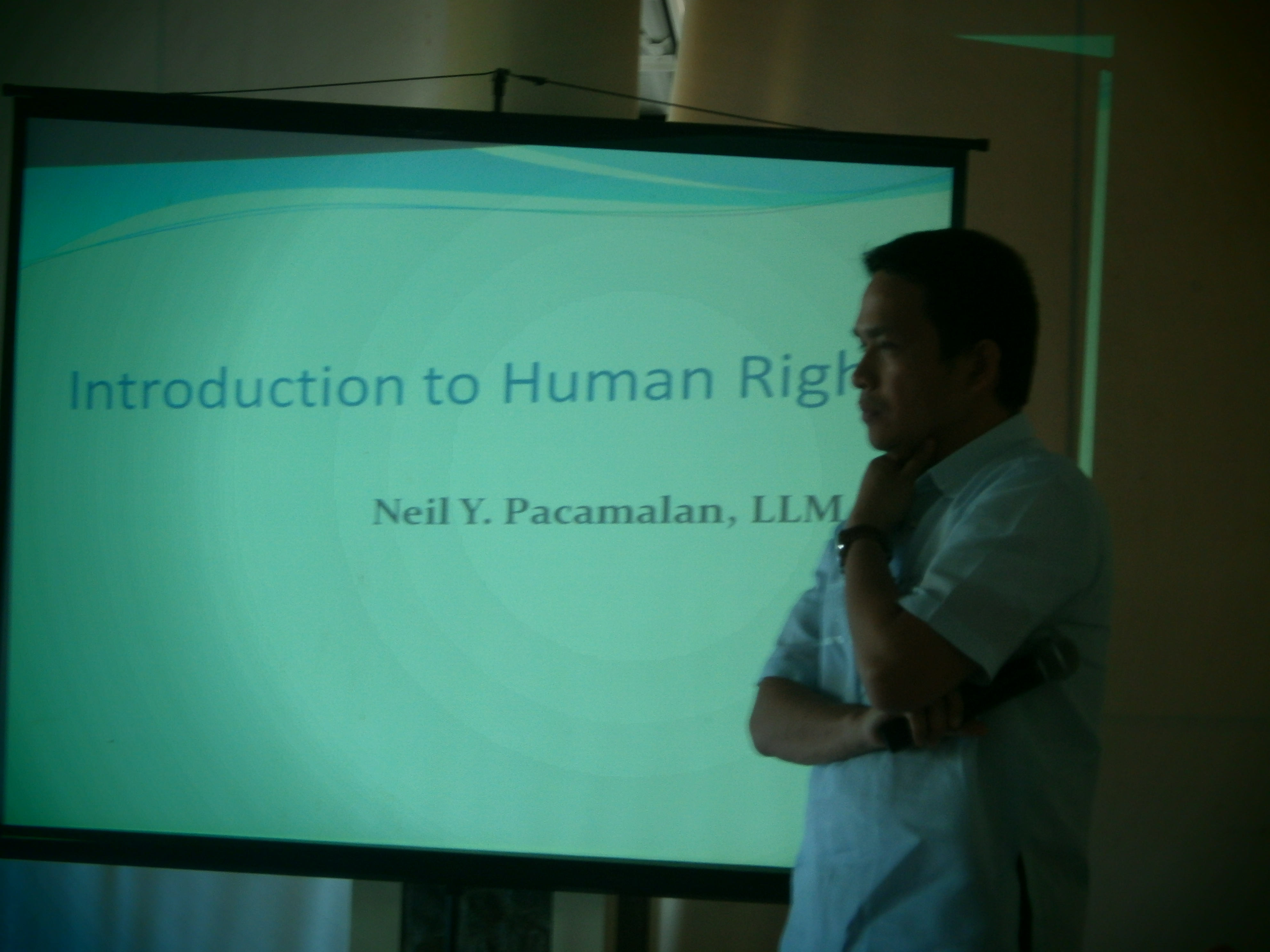
On the second day of the two-day Basic Orientation Seminar on Legal Aid Atty. Neil Pacamalan, Cultural Affairs Specialist for Mindanao of the US Embassy, Manila, asked that question to the delegates from the University of Mindanao and Ateneo de Davao University College of Law.

The question drew a variety of response: commercial law, criminal law, international law, labor law, among others. Few mentioned about public interest lawyering, which others call alternative lawyering or developmental lawyering.

[caption id="attachment_2478" align="alignleft" width="144"]Atty. Neil Pacamalan Atty. Neil Pacamalan[/caption]

This type of lawyering, according to Atty. Pacamalan, is devoted to lending legal assistance and empowering such marginalized groups as urban poor, farmers, or fishers. He said these are the groups that are historically, culturally, and economically marginalized.

Atty. Pacamalan is convinced that involvement in alternative lawyering is not detrimental to the law students’ studies. He surmises that while UP, ADMU, and San Beda excel in the Bar Exams, the three are able to maintain a robust legal aid centers.

He said that alternative lawyering should not be a second choice only, reiterating what former Chief Justice Hilario Davide, Jr. said.

“To me it is troubling that the lawyers who advocate such worthy causes are called the alternative,” said Davide at the First Alternative Law Conference on November 8, 1999. “An alternative is a second choice. You should be considered the mainstream, the first choice, the true and ideal lawyers. Better yet, the conscience of the legal profession.”

Help Mindanao, US Embassy official urged law students

[caption id="attachment_2469" align="alignleft" width="240"]483714_2776201700910_2049610267_n Officials from the US Embassy, US DOJ-OPDAT, UM, and MYVC join the delegates from UM College of Law and ADDU College of Law.[/caption]

"Stop kidding around," intoned Atty. Neil Y. Pacamalan, Cultural Affairs Specialist for Mindanao, Public Affairs Section, of U.S. Embassy. "This is not for the US Embassy, but for Mindanawons."

Atty. Pacamalan was referring to the two-day Basic Orientation Seminar (BOS) on Legal Aid, which was organized by the U.S. Embassy, Manila and the Mindanao Youth Volunteer Corps. The BOS is attended by 31 law students, 21 of which come from University of Mindanao, and 10 are from Ateneo de Davao University.

[caption id="attachment_2472" align="alignright" width="240"]Atty. Neil Pacamalan, Cultural Affairs Specialist for Mindanao, Public Affairs Section, US Embassy, Manila. Atty. Neil Pacamalan, Cultural Affairs Specialist for Mindanao, Public Affairs Section, US Embassy, Manila.[/caption]

According to Atty. Pacamalan, who gave an introduction on what the purpose of the BOS is, Mindanao has a lot of problems, legal problems at that. Law students, he said, should lend their knowledge of the law to address these problems.

Acknowledging the heavy workload of a law student, Atty. Pacamalan nevertheless encouraged the students to get involved, and disabuse themselves from worrying over their petty problems.

"If you continue to stick to your selfishness," he said, "if you always think that you have no time to help others because you have to study first, then nothing will happen to Mindanao."

One way of helping the community in which law students are a part of, he said, is through establishing a Legal Aid Office, which is primarily run by law students, and working on it seriously.

"Tell us if you need our help," he said. "We will help you. But if you don't, we are not forcing you. But we are knocking on your door. Help Mindanao."

Friday, February 1, 2013

Beyond the Bar Exam

Almost everything we do in law school is for the Bar Exam. In a little while, however, a group of law students from the University of Mindanao College of Law will gather for a seminar on the establishment of a Legal Aid Office.

A Legal Aid Office, usually run by graduating law students who are supervised by law professors, primarily provides free legal assistance to those cannot afford to have one. The experience law students get from dealing with real clients and doing real legal stuff is definitely something they can use long after the Bar Exam.

The seminar will be held at Loleng's Mountain Spring Resort. It will last from February 02 to 03, 2013. It will be sponsored by the U.S. Embassy.

Thursday, January 3, 2013

5 Law Student Must-Haves

There are people who use a lot of tools to do their work. And there are those who use nothing at all.

As for law students?

Well, there are lots of things a law student brings every day to class. But there are five things that I consider a law student list of must-haves. To be sure, law students could live without these things. But these things are so common a property among law students that they seemed to have become part of what a law student must have:

Friday, November 30, 2012

Digest A Case Your Way

There's a marked difference between the law students then and the law students now. Of course, the law students then are probably lawyers now.

What I mean, though, is the way the Internet affects the study of law today. One of the wonders of the Internet is its power to connect people across different time zones and places. For instance, a law student studying in Manila can talk to a law student studying in Davao, thanks to Skype, YM, Facebook, Twitter, etc. A law student can share his digested cases by posting it in his blog or website. And everyone is free to copy it.

When a professor assigns a case or two for the students to read, it's tempting to seek the aid of the Internet. Just type the case title. Then voila! There you have it. Google, or whatever search engine you're using, will provide everything for you----the case digest with a link to the full text of the case.

I've done this many times myself. When I don't have enough time to read the case in its entirety, I read the case digest people in the cyberspace provide. But I find it counterproductive because after reading the case I'm left with more questions than answers. How did the RTC justify its ruling? What was the CA's rationication (I hate this word) in granting or dismissing the appeal? How did the Supreme Court rule on the CA's ruling?

Of course, the exact answers to those questions can only be had if one were to read the entire case. Yes, reading digested cases saves me a lot of time. But it doesn't save me from the grueling question and answer portion law professors like to subject their students.

That is why I think it's better to read the entire case and make your own case digest. Reading a case in its entirety gives you a better grasp of the case. And making your own digest allows you to present the case in a manner that fits your style and frame of mind the most because you made the digest yourself.

Tuesday, November 27, 2012

Strive for Simplicity, Not Legal Pugnacity

Justices, judges, lawyers, and law students are a brilliant lot. Too often, however, their brilliance is lost when they start writing down their ideas. The case of Leonor vs. CA  drives home this point.

The decision of the Trial Court regarding the merits of the case is as repugnant as the manner by which the decision was written. This is the first paragraph of the judge's decision, quoted in Footnote 13:
This is an action for “Cancellation of Entry in the Civil Registry” particularly on the marriage contract of one Mauricio Leonor, Jr. and Virginia Amor supposedly to have taken place in a long distance past on March 13, 1960 and after a Rip Van Winkle sleep and dormancy liken to a Mt. Pinatubo explosion that rocked the peace and quiet in the lives of the supposedly participants to this drama in Calatrava and San Carlos City, Negros Occidental when out of the blue one party in the person of an aggrieved left-behind spouse revived and revealed an ancient piece of marital bond between her and a reluctant spouse.

What's wrong with the paragraph? Everything, except perhaps for the spelling.

No less than the Supreme Court, through Justice Panganiban, called the language of the decision "convoluted," "painfully a sophomoric and pathetic portrayal" of Virginia, the petitioner in this case.

Further, the Court tersely remarked, "The said decision’s crude attempt at literary sophistication is matched only by its jarring syntax and grammatical incongruencies."

In his essay "On Developing My Decision-Writing Style," former Chief Justice Artemio Panganiban, this time not writing for the Court, shared the motive behind every decision he wrote.

"Even though my decisions are written primarily to resolve legal issues and are thus emblazoned with a considerable amount of legalese," he said, "I have endeavored to write in simple English, comprehensible as much as possible to a high school graduate.  I want to be understood not only by the legal profession but also by the parties themselves, especially by persons accused of crimes, and by the public at large as regards cases involving interpretation of the Constitution."

"More than lingual elegance and even legal pugnacity," he further said, "I strive for simplicity, clarity and precision in nuances and shades of meanings.  I believe the trend in all professions and occupations -- be they medicine, theology, science or music -- is to be understood not just by the members of that particular discipline but by the public at large."

Thus, lawyers and law students alike should strive for the same simplicity, clarity, and precision. After all, writing aims to reveal rather than conceal.

Monday, July 30, 2012

Class Materials

Here are the slideshows for Aralin 1, 3 and 4. Plus the Project Plan and the Template for the Project Proposal.

Aralin 4: astong Pagpapahalaga sa mga Pinagkukunang-yaman

Aralin 3: ng Katangian at kahalagahan ng yamang tao

Aralin 1: Ekonomiks sa paglipas ng panahon

Project Plan: First Grading

Project Proposal: Template

Tuesday, July 10, 2012

Let peace be our star

Below is a speech I gave at the launching of the Araling Panlipunan Area's Peacebook Campaign on July 9, 2012.

Respice stellam. Look at the stars. That’s the motto of our school. The star has always been within our sight, but never within our reach. Peace is like the star: always within our sight, but never within our reach.

For sure, all of us agree that there should be peace among peoples of Mindanao. We just can’t agree, however, how exactly we can achieve peace.

For the separatist factions, only when Mindanao is made into an independent state can there be real peace. By then, wars between the government and rebel groups will have ceased. Muslims will be free from the shackles of Imperial Manila. They will have governed and managed their own resources.

For the government, only when rebels and those who took up arms against the government are eliminated can there be real peace. Socio-politico-economic and educational reforms are hard to initiate in a war-torn environment. Remove the rebels, peace will follow.

For us Marisians, how can we help achieve peace?

Let’s be guided by our motto. Respice stellam. Look at the stars. Indeed, we are asked only to look at the stars, not to get hold of it. For no man has ever gotten hold of the star. But stars have guided countless men in their quests.

Let peace be our star. We may not get hold of it, but it would guide us in all our dealings with men of different class, color, and creed.

Professor Edith Brown Weiss said “In all that we do, we inherently represent not only ourselves but past and future generations. We represent past generations, even while trying to obliterate the past, because we embody what they passed on to us. We represent future generations because the decisions we make today affect the well-being of all persons who come after us and the integrity and robustness of the planet they will inherit.”

As representatives of the future generations, how can you ensure that they will enjoy the blessings you are enjoying now? What specific ways will you take so that those who will come after you shall look to the past, not with grudge, but with gratitude?

Thursday, June 28, 2012

Wet and wild

Those in the field of education know very well that 'tis the profession that is fraught with so daunting a task that if one were not to take an occasional break, one would surely be stressed out. Sometimes, it takes nothing less than a trip somewhere else to renew the energy and vigor that teachers badly need to face a new set of challenges the new school year might present.


One such trip took place on June 08, 2012. To have their Socialization, teachers, administrators, and staff of Stella Maris Academy of Davao went to Matin-ao Inland Resort, New Corella, Davao del Norte. There, the teachers and staff gamely participated in the activities the Socials Committee prepared.

In the beginning of the program, all the eight Emmaus groups presented their impromptu yet entertaining cheers and yells. Then the parlor games ensued. All enjoyed playing such games as “Bandaging” where they demonstrated what they learned from the First Aid Training they had; “Ipasok mo, Baby” where they had to string using a yarn all the members of the group while in the on the swimming pool; and “Isda Me?” where they had to swim and get as much Bingo tiles as they could.


The Socialization lasted only a day. Yet one could see that everybody came home not with a sense of regret, but with a sense of joy and fulfillment. For, it’s not everyday that they get to relax from their tedious work.

Sunday, April 1, 2012

Onyot's Trip: Walang basagan ng trip!

[caption id="attachment_2201" align="aligncenter" width="394" caption="Taken during our trip to Seagull Mountain Resort (Seagull 3), located on the outskirts of Bukidnon and Davao City (BuDa)."][/caption]

I have many nicknames. But it's "Onyot" that survived the test of time. I don't mind if you call me Onyot. I have become used to it anyway. In fact, now I like it when you call me Onyot. It's as if you and I have known each other for so long a time.

So I'm Onyot, and ito ang trip ko.

Trip, in English, denotes a "voyage," a "journey." But from the dingy and squalid kanto and looban of Philippine slums to the posh and bongga subdivisions, the word "trip" takes on a different meaning.

It refers to the things you do to break your humdrum routine, to express your in-ordinariness in this ordinary world, to wean yourself from a stressful work, or to try things for the sake of trying them.

Someone's trip might be food, manicure, or, uh, saving Mother Earth.

But sometimes if you do something as outrageous and bizarre as the acts of Jesse Caigoy,"Master of Pain," something as outlandish as having a Winnie The Pooh tattoo on your back, something as banal as planking, people would ask you this standard question, "Anong trip mo?"

"Wala lang!," or "Walang basagan ng trip!" is, of course, the standard retort.

When I started teaching, in 2010, I thought my teaching experience would be a fodder for my blog. I thought the bouts with students in particular and school life in general would be a well from which I can draw inspiration to blog. But no, I was caught in the thick of making lesson plans, preparing slide presentations for class, making test papers, checking test papers, recording and computing grades, reading essays, accompanying students to contests and conferences, meeting with parents, and complying with a host of other paper-works.

As a result, blogging became less frequent. Blog posts were sparse, mostly limited to announcements, slide shows for students to download, and a few lousy write-ups---lame attempts at reminding people who stumble upon this blog that its owner still exists. Soon, all I wanted was not to blog more often, but to have a goodnight's sleep.

Nevertheless, I continue to write. Sometimes, if I have time I write about teaching. I never write about sleeping. Most often I write about my activities in between---mga bagay na trip kong gawin.

That explains why I found the name of this blog---Onyot's TRIP---most fitting because this blog has been, is, and will always be about my trip: trip as a journey and voyage, and trip as wala lang, I just feel like doing it.

So welcome to Onyot's TRIP. And please walang basagan ng trip!

Monday, March 26, 2012

5 foolproof, tried-and-tested, and damn-so-accurate tips on how to finish high school with honors, and the law of success, etc.

[caption id="attachment_2174" align="aligncenter" width="744" caption="Photo courtesy of Shella Mae Cascaro-Amba"][/caption]

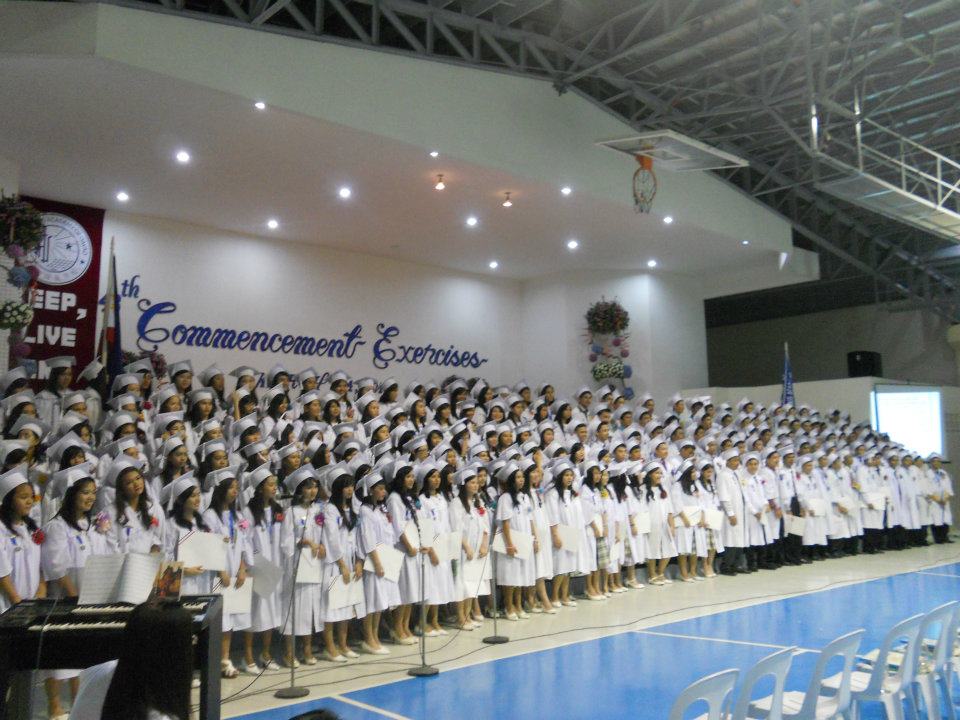
The graduation ceremony is over. We call it commencement exercises here. Rightly so. As Bob Teh points out in his blog, "...aren't ends just beginnings in disguise?"

To witness a graduation ceremony is inspiring enough, especially when you see the graduates' teary-eyed parents, and to witness graduates who graduate with flying colors is even more edifying.

"Sir, what's the secret?" students often asked me.

I don't know. Perhaps it will never be known---it's not called secret for nothing.

Besides, why would students often ask me that. I've never been an excellent student myself. The only thing I can boast of is having graduated cum laude (which is really not as difficult as whistling while eating a polvoron), and being hailed as Mr. Heart 2008. Ehem!

But I have five tips to offer anyway. I'm not that sure if these tips would work for you, but they did work for me. Here goes:

  1. Cut classes.

  2. Don't take down notes.

  3. Cheat.

  4. Always be absent.

  5. Disregard numbers 1 to 4.


Many years ago, there lived a man who never graduated from college. He opted to compete in the larger university of life. But boy was he successful. He's one of the architects of the Labor Code of the Philippines, and figured prominently as a former president of the International Labor Organization.

He was Blas Ople.

He once gave a commencement address, and pondered what's the law of success.

"The nearest thing to a law of success," he said, "is that if you are committed, you will succeed. The strength of commitment can even be quantified—in terms of the time and effort you allocate to your goals, not in sporadic burst, but in a steady state."

Saturday, March 10, 2012

Jonathan Bangayan, Valedictorian

Jonathan Bangayan, one of the two valedictorians for the SY 2011-2012On March 9, 2012, in the cold Audio Visual Room filled with nervous and excited fourth year students, the honors for the Stella Maris Academy of Davao (SMAD) graduating class of 2012 were announced. Through a video presentation, the awardees were shown, and each picture flashed is greeted with "Woaws," or "Yes!," or "Wows."

And then the most awaited came, the valedictorian award. For this school year, two got the most-coveted and perhaps the most difficult-to-get award: Jonathan Bangayan and Fredrich Nierra.

Both richly deserved the award, but I'd like to dwell more on Jonathan because the story of Jon, as we call Jonathan, is a remarkable one.

Perhaps six or seven years ago, nobody would have thought he'll be the class valedictorian. He was just not a shoo-in for the award. Jon is not your typical promising youth who was spotted early on, groomed until graduation, and awarded meritoriously. His is a story of determination, persistence, courage, and passion.

This is what I noticed about how most people write a biography of someone else. It usually begins with the first encounter of the writer and the subject---the circumstance, the atmosphere of the location, or the general mood. I will not succumb to the formula by writing where I first met Jonathan. Besides, I cannot recall anymore under what circumstance that I got to know that a Jonathan Bangayan exists in SMAD.

Back when he was in grade school, Jon was, in his words, a non-entity, almost unheard of. He never figured in contests or in any other school activities. His world was small. He had only few classmates whom he could consider as friends. He had barely involvements in activities outside the school. And he seemed to have gotten used to the grinding sameness of his school life.

Academically, Jon was not that slow. Far from it. But he was just not the top or the best in just about every subject. He even ranked 60th out of over a hundred students.

Despite the lackluster performance in grade school, Jon remained persistent, and showed that one's past does not define one's future, although for most of us we make it as our impetus to recreate ourselves and rise to greater heights.

Jon said it was his parents who prodded and encouraged him to excel and succeed. Jon had a low opinion of himself, but his parents showed him that there's more he could do and give. And succeed Jon did.

Jon started joining extra-curricular activities. He relished outreach activities as a way to widen his horizon. It's with this outreach that it dawned on him that there's another world besides his own---a world far harsher and meaner than his cocooned existence. He harnessed his speaking skills. He joined the Debating Team of the school. He tried hosting. He also tried courting a few girls (one or two), though Jon is so coy to admit it that he wouldn't openly talk about it and would rather brush the topic aside.

In short, he immersed himself in the hustle and bustle of high school life. And all his self-deconstructing and reconstructing effort culminated in third year high school when he ranked first among his batch-mates. For Jon, there's no way but up. So when he reached fourth year, he rose even higher---higher than most people expected.

And now, Jon is class valedictorian, together with Fred. Jon is also the candidate for the 2012 Most Outstanding High School Graduate.

Jon's story in a way mirrored my student life story. In high school, I was an underachiever. I belonged to the general section. In the hierarchy of sections in Davao City National High School, the general section is at the bottom-most tier. I flunked in one grading period in Chemistry. We loitered at the bilyaran or internetan.

And so, my high school classmates were surprised when I graduated cum laude in college.

"Unsa imo gikaon?" I was often asked.

Well, you can ask Jon the same question. I am sure his answer has nothing to do with food. It has everything to do with old-fashioned virtues of patience (which, by the way, is the section of Jon now) in times of frustrations, determination in times of failures, and faith in times of uncertainties.

Monday, March 5, 2012

Twitter as an ally in learning

Parents, teachers, and school administrators are wary of student use of social networking sites, particularly Twitter, a micro-blogging platform that enables users to post messages (or Tweets) up to 140 characters. It sits well with the students since they need not compose a long article, which admittedly most of them find it hard to sustain.

Our students spend so much time with it, losing their precious little time to studying. We are afraid that, if unchecked, this will have a detrimental effect on our students’ academic performance.

A recent study, however, shows just the opposite. The study, “The effect of Twitter on college student engagement and grades,” is led by the team of Reynol Junco, a leading scholar who explores the nexus between social media and education.

125 college students participated in the study. One group of 70 students was required to use Twitter for educational purposes. Another group of 55 students was required to communicate through a traditional learning system.

The findings belie the claim by many that social networking sites, particularly Twitter, are detrimental to the academic performance of students. Junco et. al. found out the following:

  • The Twitter group’s score in engagement—defined as “the amount of physical and psychological energy that the student devotes to the academic experience”—was almost twice as much as the group who used traditional communication methods.

  • At the end of the semester the Twitter group’s average GPA was .51 higher than the control group.

  • Students were also surprisingly comfortable with candid expressions of their feelings and their short-comings.

  • Student use of Twitter generated more and different types of questions than would have been generated in typical class discussions on the same topic.

  • Using Twitter in educationally relevant ways had a positive effect on student engagement.


Social media is not just a fad, only popular to this generation, and will soon wither into oblivion. It is, as Eric Qualman argues, a fundamental shift in the way we communicate.

As teachers, we must understand the dynamics of our students. We must meet them where they are, Reynol Junco said. And nearly all of them are in social media. We must seize the opportunity this digital era presents to us and take full advantage of the social media, particularly Twitter, if only to help our students learn.

Saturday, February 25, 2012

Embittered over 'tweets' in Twitter, or How not to deal with controversial digital speech?

You updated your Twitter. You made a comment about your school. You are sure your school administrators wouldn't like. But, you think, it's a fair and valid comment. And to be scientific, it's a comment that is based on empirical evidence.

Then somebody print-screened your and your friends' tweets. The print-screened tweets found their way to your school administrator's table. The next day, you and those who made "negative" comments were called by school administrators.

You asked why. Nothing, they replied. The admin just wanted to talk to your group. Then you found out why. The admin was disappointed, nay, offended by you and your group's tweets. You were reminded not to do it again and to be careful with your tweets.

Worse is, just when you thought it's over, you found out you were punished. Your conduct grades were decreased. Why? For making such comments.

Too often, students find themselves embroiled in this situation. And too often, school administrators take punitive steps to respond to this.

It can't be denied that the Internet and the social networking sites are now the new plaza. That's where most of the young people stay and hang out, though they don't necessarily have to leave their homes. That's where students talk, send Private Message, Comment, Like,  Tweet and Retweet, search, select and invite Friends, and Share stories, photos and links.

Indeed, that's where everything gravitates towards, at least for the "Digital Natives."

The pervasiveness of the Internet and especially the social networking sites in the lives of young people poses several challenges, among others, to the school administrators.

The Internet has given young people another venue where they can exercise their freedom of speech and expression. Through the Internet, they voice out their opinions. They comment on issues which they think matter---the impeachment trial of CJ Renato Corono, the deluge of concert by foreign artists this Valentine season, the death of Whitney Houston, and, yes, the improvements or lack thereof in their school. They express their disgust over everything else they find disgusting.

No less than the Constitution guarantees and protects that freedom. And the students can enjoy that same freedom, and indeed a robust exercise of that freedom must be encouraged, provided they are forewarned not to go beyond the ambit of the law. As Justice Dante Tinga said, in his separate opinion on Chavez vs. Gonzales, "For as long as the expression is not libelous or slanderous, not obscene...it is guaranteed protection by the Constitution. I do not find it material whether the protected expression is of a political, religious, personal, humorous or trivial nature - they all find equal comfort in the Constitution. Neither should it matter through what medium the expression is conveyed, whether through the print or broadcast media, through the Internet or through interpretative dance. For as long as it does not fall under the above-mentioned exceptions, it is accorded the same degree of protection by the Constitution."

This freedom of speech, however, like all other freedoms, can be potentially abused. And if it is abused or seem to be abused, how then should we deal with it?

Should we punish students or threaten them with suspension or deduction of grades for posting innocuous remarks in Twitter or Facebook? Should we berate the students and give them a mouthful of reminders?

Sunday, February 19, 2012

The valedictory speech I never gave

(Graduation is drawing near. When I was about to graduate from college, I dreamed of delivering a valedictory speech, but that dream would remain just that: a dream. If I were to deliver the valedictory speech, however, I would've given this speech.)


I wish I could talk about how our government manages the public money, so that the accountancy and commerce students could relate to me. I wish I could talk about our criminal justice system, so that the criminology student could relate to me. I wish I could talk about our health care system and child abuse, so that the social work students could relate to me. I wish I could talk about the use of psychology in preventing crime, so that the psychology students could relate to me.

I wish I could talk on those different fields, so that everyone present here could relate to me. But I could not because I don't know any better. And if I do talk about the things I know better, I'm afraid you could not relate to me. If I would talk about Multiple Intelligences or Learning Styles or Teaching Strategies, nobody but the education students would listen to me.

I'm not even sure if they would listen, and listen like their grades depend on it. They've heard enough of them in the classroom. Surely they don't want to recall their harrowing experience in the classroom, not even now that they are wearing toga whose origin they barely know.

So I will talk about my own experience in college. After all, we human beings are by nature chismoso. We always wanted to know something about other human beings.

Yet I won't try to please everybody because I'm afraid that if I try to please everybody, I just might end up pleasing nobody.

Thank you for listening to the introduction. If you have one more minute to spare, do spare it.

Tuesday, September 13, 2011

Using Graphs & IPR Issues in ICT

Using Graphs

IPR Issues in ICT

Download and study.


Saturday, July 16, 2011

Aralin 3: Ang Katangian at Kahalagahan ng Yamang Tao

The last person who download a soft copy of the lesson got zero in the test. As I always say, download it at your own risk.

Don't tell me you haven't been warned.

Aralin 3: Ang Katangian at kahalagahan ng yamang tao ng Pilipinas

Tuesday, June 21, 2011

Aralin 1: Ekonomiks sa Paglipas ng Panahon

"You can lead a horse to the water, but you can't force it to drink." So goes a proverb. Download, or leave at once.

Ekonomiks sa Paglipas ng Panahon