Showing posts with label Human Rights. Show all posts

Monday, June 29, 2020

Human Duties

Today we live in an age of human rights. It is the time when every segment of society insists that its rights be recognized and protected.

For instance, the LGBTQ community advocates that marriage be redefined to include same-sex marriage, and that they be assigned a bathroom of their own. The more audacious groups like Kadamay demands free housing, and more. Erring students and their parents invoke their rights under the Child Protection Policy to avoid punishment. In Resident Marine Mammals of the Protected Seascape Tañon Strait v. Sec. Angelo Reyes, it was even argued that marine mammals−toothed whales, dolphins, and other cetacean species−have “the right to sue for the faithful performance of international and municipal environmental laws created in their favor and for their benefit.”

Not that it’s a bad thing to speak of the language of rights. But too much attention on human rights hinders us from focusing on the other equally important side of the same coin: human duties.

One school of thought holds that we have rights because we have duties. Rights proceed from duties, which are based on natural or positive law and contracts. As Mohandas Gandhi once wrote, “all rights to be deserved and preserved came from duty well done.” And in Auguste Comte’s simplest formulation, “there is only one right, and that is to do our duty.”

Thus, a bank has the right to engage in banking business for as long as it observes extraordinary diligence in handling its clients’ money. One also has the right to operate public transportation only if one assumes the duty to transport passengers with extraordinary care.

The same tenet applies to human relations. We live in a diverse society where people believe in different gods, eat different foods, wear different clothes, and observe different cultures. Given that backdrop, imagine how chaotic our society would be if everyone insists on exercising his personal freedom without regard to others.

Anyone who has ridden an airplane knows how strictly regulated is the passenger’s conduct inside the aircraft. Before take-off, passengers are required to fasten their seatbelts, keep the window cover up, stow their belongings properly, and turn off electronic gadgets. During the flight, passengers are not allowed to converge in one place or smoke in the lavatory. And the moment the airplane hits the tarmac, passengers are not yet allowed to get their belongings until the airplane completely stops. All that is to make the flight safe.

Citizenship is like riding an airplane. If we want to enjoy the ride and reach our destination in one piece, we are duty-bound to fasten our seatbelt.

It is thus for our own sake that we observe our duties to our fellowmen. 

Monday, March 11, 2013

Less Fanfare, More Substance: UMLAC Celebrates the International Women's Day 2013

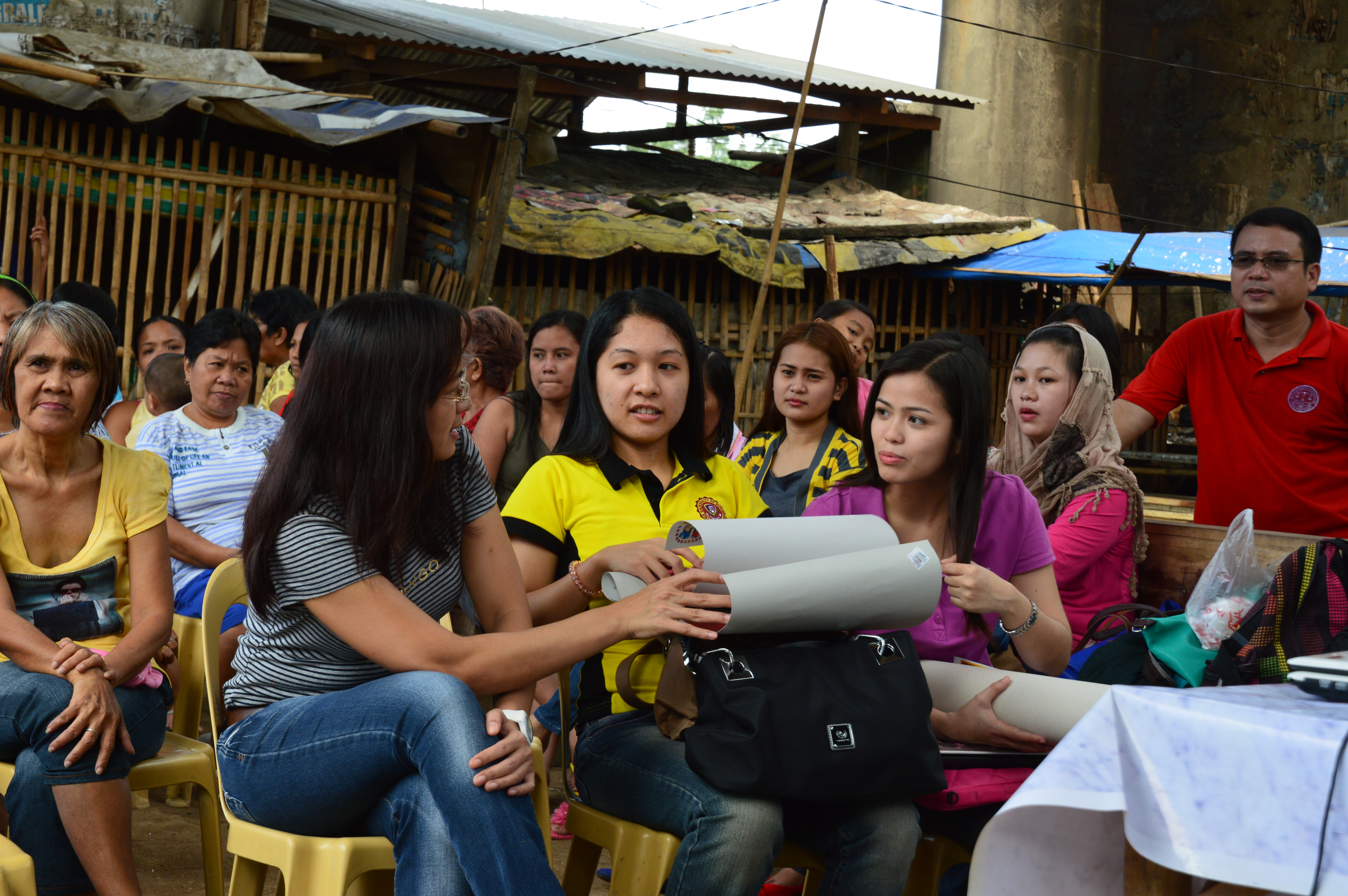
[caption id="attachment_2517" align="aligncenter" width="521"]L-R: Atty. Eliza Lapina, Jing Remolar, Dr. Tessa Mae Bongyan L-R: Atty. Eliza Lapiña , Jing Remolar, Dr. Tessa Mae Bongyan[/caption]

The nascent University of Mindanao Legal Aid Center (UMLAC) was at Barangay 40-D, Bolton Extension on March 9, 2013 to conduct a forum on women's health and related laws on women's welfare in line with the celebration of the International Women's Day.


Held literally under the Bolton Bridge where the noise of passing vehicles is deafening, the forum was nevertheless well-attended. Almost a hundred women from the Barangay came. Most of them are mothers themselves.

IMG_20130309_095654At the forum, Dr. Tessa Mae Bonguyan talked of the basic issues on women's health while Atty. Eliza Lapiña talked especially about R.A. 9262 or the Anti-Violence Against Women and their Children Act (VAWC).

Sunday, March 10, 2013

Due Process in the Garden of Eden

[caption id="attachment_2510" align="aligncenter" width="670"]Expulsion from the Garden of Eden by Giacinto Gimignani Expulsion from the Garden of Eden by Giacinto Gimignani[/caption]

Human rights are recognized here and elsewhere in the world. These human rights include the right to life, liberty, and property. In these modern times, there are various safeguards against the arbitrary and whimsical deprivation of these rights.

In our Constitution, for example, Sec. 1, Art. III provides, "No person shall be deprived of life, liberty or property without due process of law, nor shall any person be denied the equal protection of the laws."

Due process of law, in the classic definition by Daniel Webster, is a "law which hears before it condemns, proceeds upon inquiry and renders judgment only after trial."

The religious among us say that the concept of due process dates as far back as to the time of Adam and Eve. In Genesis, we first heard of the story of Adam and Eve.

Saturday, February 25, 2012

Embittered over 'tweets' in Twitter, or How not to deal with controversial digital speech?

You updated your Twitter. You made a comment about your school. You are sure your school administrators wouldn't like. But, you think, it's a fair and valid comment. And to be scientific, it's a comment that is based on empirical evidence.

Then somebody print-screened your and your friends' tweets. The print-screened tweets found their way to your school administrator's table. The next day, you and those who made "negative" comments were called by school administrators.

You asked why. Nothing, they replied. The admin just wanted to talk to your group. Then you found out why. The admin was disappointed, nay, offended by you and your group's tweets. You were reminded not to do it again and to be careful with your tweets.

Worse is, just when you thought it's over, you found out you were punished. Your conduct grades were decreased. Why? For making such comments.

Too often, students find themselves embroiled in this situation. And too often, school administrators take punitive steps to respond to this.

It can't be denied that the Internet and the social networking sites are now the new plaza. That's where most of the young people stay and hang out, though they don't necessarily have to leave their homes. That's where students talk, send Private Message, Comment, Like,  Tweet and Retweet, search, select and invite Friends, and Share stories, photos and links.

Indeed, that's where everything gravitates towards, at least for the "Digital Natives."

The pervasiveness of the Internet and especially the social networking sites in the lives of young people poses several challenges, among others, to the school administrators.

The Internet has given young people another venue where they can exercise their freedom of speech and expression. Through the Internet, they voice out their opinions. They comment on issues which they think matter---the impeachment trial of CJ Renato Corono, the deluge of concert by foreign artists this Valentine season, the death of Whitney Houston, and, yes, the improvements or lack thereof in their school. They express their disgust over everything else they find disgusting.

No less than the Constitution guarantees and protects that freedom. And the students can enjoy that same freedom, and indeed a robust exercise of that freedom must be encouraged, provided they are forewarned not to go beyond the ambit of the law. As Justice Dante Tinga said, in his separate opinion on Chavez vs. Gonzales, "For as long as the expression is not libelous or slanderous, not obscene...it is guaranteed protection by the Constitution. I do not find it material whether the protected expression is of a political, religious, personal, humorous or trivial nature - they all find equal comfort in the Constitution. Neither should it matter through what medium the expression is conveyed, whether through the print or broadcast media, through the Internet or through interpretative dance. For as long as it does not fall under the above-mentioned exceptions, it is accorded the same degree of protection by the Constitution."

This freedom of speech, however, like all other freedoms, can be potentially abused. And if it is abused or seem to be abused, how then should we deal with it?

Should we punish students or threaten them with suspension or deduction of grades for posting innocuous remarks in Twitter or Facebook? Should we berate the students and give them a mouthful of reminders?

Wednesday, April 28, 2010

Is Talk 'N Text stealing from its cash-strapped subscriber?

Is Talk 'N Text, "a wholly owned subsidiary of SMART," stealing from a cash-strapped subscriber?

This morning I loaded Gaantxt 10 onto my cellphone, a load equivalent to 55 texts to Talk ‘N Text/Smart + 5 texts to all networks! But when I replied to a very urgent text message, what appeared was not "Message Sent." It was "Check Operator Services." This happened before. Maybe my phone is so dumb that it needs a little time to absorb the fact that I have just loaded onto it. So I waited for about five minutes. Then I resent the message. Still, it was "Check Operator Services."

I refer the matter to my sister, who said maybe I just need to reload it. So I loaded it again with P30 ECONOMY Pack. Still, I was told to "Check Operator Services."

Now, I started to get irritated. No, naglagot na ko. Kita pa nga gatipid, kita pay kuwaan ug load.

I inquired 15001. Then I received a text message informing me that as of 29April 09:03 I have a "Load Bal: P30 Free Txt to Smart/TNT:100 Free Txt to all networks:5.

If so, why can't I text? And every time I do, why am I always told to "Check Operator Services?" Is Talk 'N Text suffering from a Dr.Jekyll-and-Mr.Hyde syndrome? It says that I still have a load, but in truth I don't.

Did Talk 'N Text, "a wholly owned subsidiary of SMART," just steal from me, a cash-strapped subscriber?

I'm afraid it did. The bad news is that I'm one of the many victims of this "cellphone load robbery," as Senator Juan Ponce Enrile put it. The good news is that I'm one of the many victims of this "cellphone load robbery."

I recall that no less than Senator Juan Ponce Enrile also fell prey to this "cellphone load robbery."

Now I begin to wonder: if Senator Enrile fell prey to this, how much more if the subscriber is a lowly one like me, a cash-strapped subscriber?

Update: Talk 'N Text is now back to normal. Which is to say, I can now send messages. But I won't delete this post. Let this be a reminder that once upon a time, Talk 'N Text went awry.

Sunday, March 14, 2010

CHR's 'unfinished' investigations

Published in the Philippine Daily Inquirer on March 13, 2010.

WHEN THE COMMISSION ON Human Rights (CHR) started looking into the extrajudicial killings in Davao City, I was one of those who cheered. At long last, I thought then, we have started talking about it publicly.

In my blog (killthesilencenow. blogspot.com), I even defended that CHR initiative from criticisms. “Some people do not get the point why the CHR had to investigate what CHR Chair Leila de Lima described as ‘one of the most audacious violations against the right to life in our times,’” I said. “Critics of the CHR construed the commission’s move to investigate the spate of killings as coddling the criminals. They narrowly perceived it as only favoring the rights of the criminals and ignoring the other side of the equation, which is the rights of the civilians. The public inquiry the CHR initiated struck them as disturbing the city’s serene status quo, which Davaoeños enjoyed. They even branded the CHR chair as pakialamera. These critics, however, are off the mark. The CHR is first and foremost for human rights. Its job is to ensure that human rights are always respected and protected, regardless of whose human rights it is. It is thus unwise to berate the CHR when it’s merely doing its job.”

Today, however, I begin to wonder what the CHR is really up to. The CHR inquiry, it seemed to me, produced only more heat and less light. The CHR said it is going to release its report after it is done with the inquiry. But until now the report is still to be released.

And yet, where’s the CHR now? Off it went to Maguindanao, investigating another incident. After that, it is now poised to inquire into the case of the “Morong 43.”

I don’t have a problem if the CHR will investigate here and there. It is, after all, its job. But my only question is: Why can’t it seem to finish what it has started? I need an answer. The people need an answer—and fast.

Tuesday, January 26, 2010

Thou shall not block

If it were not for Mr. Felix Bolocon, the head of HCDC's Instructional Media Center who also gave us an enhancement on Educational Technology, I wouldn't have known that there is this animal called "IFLA/UNESCO Internet Manifesto Guidelines."

The manifesto has a portion that deals with "Barriers." You-who-once-blocked-Facebook-Friendster-etc., listen. The manifesto says:
Access to the Internet and all of its resources should be consistent with the United Nations Universal Declaration of Human Rights and especially Article 19:

Everyone has the right to freedom of opinion and expression; this right includes freedom to hold opinions without interference and to seek, receive and impart information and ideas through any media and regardless of frontiers.

The global interconnectedness of the Internet provides a medium through which this right may be enjoyed by all. Consequently, access should neither be subject to any form of
ideological, political or religious censorship, nor to economic barriers.

Barriers to the flow of information should be removed, especially those that promote inequality, poverty, and despair.

In short, you cannot just block Facebook, Friendster, etc. like you did before. Understand?

Monday, January 4, 2010

After the inquiry, what?

When the CHR started looking into the extrajudcial killings in Davao City, I was one of those who cheered. At long last, I thought then, we started talking about it publicly.

Today, however, I begin to wonder what the CHR is really up to. The CHR inquiry, it seemed to me, produced only more heat and and less light. It said it's going to release its report after it's done with the inquiry. But until now, the report is still to be released.

And yet...where's the CHR now? Off it goes to Maguindanao, investigating another incident. Tsk...tsk...tsk...

Thursday, December 10, 2009

Human Rights Day


Today, December 10, is declared as the "Human Rights Day."

From the Office of the High Commissioner for Human Rights: "Human Rights Day 2009 on 10 December will focus on non-discrimination. “All human beings are born free and equal in dignity and rights”. These first few famous words of the Universal Declaration of Human Rights established 60 years ago the basic premise of international human rights law. Yet today, the fight against discrimination remains a daily struggle for millions around the globe."

***

Nowhere is this discrimination more glaring than in the recent decision of the Commission on Election (COMELEC) to junk the petition of Ang Ladlad to be accredited as a party-list group. Not only is the decision unconstitutional, it also smacks of backwardness, in thought and in action.

Thursday, October 1, 2009

Absurd

After insinuating the last time that the CHR 's public inquiry into the vigilante-style killings in Davao City is but politically motivated, a demolition job, a political harassment, 2nd District Councilor Danny Dayanghirang has now an absurd theory why the killings continue until today.

"The number of law violators in our city has not dwindled down, in fact, it is only increasing," said Dayanghirang in his Mindanao Times Op-Ed piece, "Davao residents in the losing end," which appeared on October 01, 2009. "This could be attributed to the never-ending investigation of the Commission on Human Rights (CHR) on the crimes in our city. The investigation of the CHR has made publicity to our city. Although we welcome the investigation of the CHR in order to purge the city from any misconception and to clear the name of the city, the slow paced investigation has only made the crime rate in the city grow. The criminal elements have shown its ugly head again, knowing that the investigation of the CHR would weaken the efficency of our police force."

Tuesday, September 15, 2009

Come out in the open

silence kills3When I established Silence Kills, a blog dedicated to the issue on extrajudicial killings in Davao City, I thought I would be a voice in the wilderness. I thought no one would give a damn with what I say.

But when I started to receive comments from the readers (there are only few), I realized I'm not alone. I'm happy to note that there are people who share my views regarding extrajudicial killings in Davao City. Take this comment from Anonymous on my post about Mayor's Duterte challenge to CHR Chair Leila de Lima:
Even if Duterte ostentatiously relinquished his supervision over the DCPO, no policeman would dare disobey his orders – legal or otherwise. And the beauty of it is that he can actually sabotage Davao's peace and order by allowing crimes to happen so that the Davaoeños will blame the CHR for attacking their mayor and causing his 'resignation' as deputized Napolcom representative, resulting in criminals gaining courage to walk the streets again. Who are you kidding, Mayor?

But I'd be happier if those who speak against Duterte won't hide from the cloak of anonymity. I know it's not easy to be identified as anti-Duterte. It's like going against the tide. But this is not about who's  pro-Duterte and who's anti-Duterte.

It's about fighting for our deeply held principles: truth and justice.

Thursday, September 10, 2009

'Exile from human memory'

[caption id="attachment_885" align="alignleft" width="188" caption="Clarita Alia"]Clarita Alia[/caption]

What are the perils of indifference?

That was the question around which Elie Wiesel's speech, “The Perils Indifference,” revolves. “The political prisoner in his cell, the hungry children, the homeless refugees —not to respond to their plight, not to relieve their solitude by offering them a spark of hope is to exile them from human memory…,” Elie Wiesel said at a Millennium series lecture held in White House and hosted by then US first couple Mr. and Mrs. Bill Clinton.

When Wiesel, a 1986 Nobel Peace Prize Laureate, spoke those words, he had in mind the victims of the tragic episode in humanity's history that was the Holocaust.

But it is not too far off the mark to include Clarita Alia among those exiles from “human memory.” Call it inflated, but that is where Clarita Alia is right now: Gone from the memory of the people. Her cries remain unheeded; her demands seemed to fall on deaf ears. Over the years, Clarita Alia has been clamoring that justice be served for the death of her four children: Richard, 18; Christopher, 16; Bobby, 14; Fernando, 15—all were knifed to death. But she seemed clamoring in vain.

Already in her 50s and now a widow, she single-handedly raised her eight children by selling vegetables at Bankerohan, one of Davao City’s largest public markets. Like all mother, she dreamed of giving her children a bright future. But the environment Mayor Rodrigo Duterte created would make that dream just that: a dream.  

Birds of the same feather won't catch each other

Now this one is really De Lima’s dilemma:

In the September 6 episode of “Gikan sa Masa, Para sa Masa,” where Mayor Rody Duterte sometimes settles scores with his enemies, Mayor Duterte urged the Commission on Human Rights (CHR) to come back and investigate the resurgence of killings in the streets.

“Wala na ko mogunit sa pagkasupervisor sa DCPO [Davao City Police Office],” Duterte said. “Though my resignation was not accepted, I told them that I consider myself resigned. Sukad sa CHR inquiry, wala na ko misulod sa DCPO. Pero natingala ko ngano man padayon gihapon ang patay?”

On March 30, 2009, the CHR conducted a highly publicized public inquiry into the killings in Davao City that have gone unabated since 1998. Leila De Lima, the CHR’s feisty chairperson, squarely put the blame on Mayor Duterte’s shoulders for his failure to stop the killings, if not for his tacit support to the DDS.

To give the CHR a free hand in its inquiry, Mayor Duterte resigned as a supervisor of the DCPO on March 31, the second day of the public inquiry. His resignation, however, was rejected by DILG Secretary Ronaldo Puno, saying it’s against the mandate of the law.

Now five months after the CHR started the public inquiry, it seems Mayor Duterte is laying the blame at the feet of CHR Chair Leila De Lima.

In August alone, there were 13 people killed; in September, seven. Mayor Duterte asked the CHR to explain the killings. Surely somebody else is responsible for them, and, contrary to popular belief, it certainly not him because he has already given up control over the police.

“Mangutana ko karon, ngano man padayon lang gihapon ang patay?” Mayor Duterte asked. “Is there somebody behind it? Is there somebody trying to create a chaotic condition? Is there somebody who wants to pain a picture of Davao City as killing fields?

“I leave it to the CHR to please come back to Davao City and investigate more. I’d like the human rights to come back and tell us what is this all about?”

It’s clever of him to say those words because it effectively cast the CHR in a bad light. It’s as if Mayor Duterte is saying that the commission made a wrong decision by asking him to distance himself from the police, from whose ranks the DDS gunmen allegedly come. It’s as if he’s saying that the commission should let him do his own thing because it’s the only way to deal with the city’s criminality. Otherwise, the situation just might go berserk.

Yet Mayor Duterte’s remarks have only exposed an anomaly in his administration. The City Mayor’s Office has at its disposal a P450 million budget for Peace and Order. If needed, the mayor can disburse as much as P1.2 million daily. “With this enormous sum of public funds given to…the city mayor to maintain peace and order in the community,” said Mindanao Daily Mirror columnist Bert Tesorero, “there is no reason why street killings would go unabated for almost a decade now without a single case solved by the police.”

The police cannot be accused of ineptitude, either.

I can think of only one reason why the police find it hard to stamp out the killings. According to the report of the New York-based Human Rights Watch, “You Can Die Anytime,” most members of the DDS are policemen, ex-policemen, rebel returnees, military personnel, and jobless youths who were involved “in a bit of drug pushing.”

“The DDS…,” it further noted, “is run by handlers. Such a handler is called the amo (boss). The amo is usually a policeman or ex-policeman, and in some cases, a barangay official…A local journalist, who has been investigating extrajudicial killings in Davao City for almost ten years, believed that all handlers report to the police precinct commander in their area who distributes money for “operations” and reports, in turn, to an official in the city government—‘the big boss.’”

Despite these damning revelations, police and military officers denied that they are by no means involved in the killings.

If, however, they are involved in the killings, as claimed by the Human Rights Watch, then how can we expect them to get after the criminals if the criminals themselves come from their own ranks?

Thursday, July 2, 2009

More than a political harassment

Although the mayor can very well defend himself and dodge critics, local and foreign alike, with such ingenuity, he has found an additional support in the person of 2nd District Councilor Danny Dayanghirang.

In his Op-Ed pieces, which appeared yesterday and today in Mindanao Times, Councilor Dayanghirang extolled, among others the virtues of the Dutertes---from the late Gov. Duterte down to Mayor Duterte to Inday Sara Duterte to Polong Duterte---and proceeded to say that the continuing investigation of the CHR is but politically motivated.

Reason? The 2010 election is drawing near and those who have plans to take over Duterte's post, which will likely be taken by another Duterte, are scrambling to find ways on how to break the Duterte dynasty. To Councilor Dayanghirang's logic, the spate of killings that have taken place under Duterte's watch might be one of the issues Duterte's political opponents are using to carry out their demolition plan.

That the Dutertes are virtuous, ably handled the city government throughout the years, bring the city to where it is today, is no matter. No question about that. In fact, I wrote an Op-Ed piece some months ago, praising "...the seriousness and conscientiousness with which he takes his job as mayor of Davao City..."

What matters, however, is how Councilor Dayanghirang and indeed the apologists of Mayor Duterte perceived the CHR investigation on extrajudicial killings. To them, this is nothing but a handiwork of people envious of Mayor Duterte's remarkable feat.

I'm sorry, but, as I said somewhere, "This...is not just a political criticism being leveled against Mayor Duterte by his political opponents in order to upset his long-standing domination of Davao politics. It’s more than that. It’s a very serious issue..."

Monday, June 22, 2009

DDS brings no good

Whether in the digital or in the real world, it is not rare at all to read or hear words of praises for the (dis)service the Davao Death Squad (DDS) has been doing for the city. In YouTube, for example, where a report on DDS by Chris Rogers of ITV-CNN is posted, one reads from a certain darkskyBAO this comment:
I'm a firm believer when it comes to absolute justice. Despite many would detest their disapproval over the "shadowy" group we have to admit that the things they do greatly benefit the safety and order of Davao. The end justifies the means; all criminals no matter how big or just petty hooligans, be it a underage delinquent or not as long as they are deemed a threat in the face of our country. We must not hesitate more. I wish some one like these would be placed in Sulu and Metro Manila.

Many people--Davaoeños and non-Davaoeños alike--share this most cherished belief of darkskyBAO. Since the DDS, they are led to believe, started to complement or take over--not sure which one--the job (that of busting criminals) that solely belongs to the state, the crime rate in the city decreased. No less than the city government is proud of this feat.

But has the city's crime rate really dropped down since DDS began its operation?

No, said Human Rights Watch in its report "You Can Die Anytime." Rebutting the city's claim that "From a 3-digit crime rate per 10,000 people in 1985, Davao has reached an almost Utopian environment with a monthly crime volume of 0.8 cases per 10,000 persons from 1999 up to 2005", the HRW report said:
These descriptions attempt to conceal a rampant crime wave—namely, the murder of hundreds of alleged drug dealers, petty criminals, and street children.

More importantly, by averaging out years of statistics and omitting most recent years, they belie the city’s sharp upward trend in crime rates over the last decade. According to statistics from the police, between 1999 and 2008, the population in Davao City grew from 1.12 million to 1.44 million, or by 29 percent. Meanwhile, the number of annual crime incidents during this period rose from 975 to 3,391, or by 248 percent.21 These numbers show that, contrary to the city government’s self-proclaimed success, its tough anti-crime campaign has failed to curve crime rates. An increasing number of death squad killings appears to have contributed to worsening crime rates in the city.

If it were true, and I believe it is, it only shows that, contrary to many a people's belief, lawlessness only breeds further lawlessness. So we must disabuse ourselves from thinking that the presence of DDS is good because, in reality, it's not.

Extrajudicial killings in Davao City: A timeline

There have been many developments since the Commission on Human Rights came here on March 30 to look into the flagrant extrajudicial killings in the city. But I wasn't able to blog about them because I have been up to something else lately. I am glad, though, that I was still able to keep track of them, thanks to the ever-reliable Google Alerts.

Here then is an attempt to put together the events that ensued since the CHR's visit:

Carlos Latuff on DDS

Davao Death Squads


Carlos Latuff--yes, the controversial Brazilian political cartoonist--has made a cartoon on Davao Death Squad and the public's response to the mayhem this ghostly group is sowing.

Wednesday, May 27, 2009

Back on the fringe, again

Published in Mindanao Times 06/02/09

Davao City’s problem on human rights has been around for a long time now, but one that’s often left unnoticed. Fortunately, it was pulled out on the fringe and brought into the mainstream when the Commission on Human Rights (CHR) launched a widely publicized public inquiry on the unchecked killings. But from the looks of it, it seems to be back again to where it was before: on the fringe.

Just two months ago, when the CHR came here to investigate the series of killings in the city allegedly done by the Davao Death Squad (DDS), Davao City became the talk of the town. National broadsheets ran headlines regarding the CHR investigation. Newspaper columnists and cartoonists, human rights advocate and full fledged activists, street philosophers and street sweepers also joined the fray.

Monday, April 20, 2009

What do we stand for?

From Mindanao Times 5/24/09

Since the Commission on Human Rights (CHR) began on March 30 its investigation on the extrajudicial killings in Davao City, a cloud of doubt hung over the CHR. Many Davaoeños cannot seem to understand why the CHR is investigating the killings in Davao City that, according to the latest count, have claimed more than 800 victims—most of whom have criminal records.

They can’t help asking: Which human rights is the CHR favoring? Is it the human rights of the criminals or the human rights of the innocent civilians? Why shine a bright light on the killings when the city and its citizens are enjoying peace and prosperity? Can the CHR not leave this dark side of the city since Davaoeños can live with it anyway? Don’t these criminals deserve to be killed in the first place?