Showing posts with label Writing amp; Literature. Show all posts

Wednesday, January 2, 2013

Blogging in 2012: A Review

Since I started my law studies in June, 2012, I thought 2012 would mean death for my blog. On the contrary, I became more active in blogging. I found a new source of material from studying law. Thus, most of the posts for 2012 have something to do with the law. How did my blogging activity fare in 2012? Here's a review the guys at Wordpress did:

The WordPress.com stats helper monkeys prepared a 2012 annual report for this blog.


Here's an excerpt:
600 people reached the top of Mt. Everest in 2012. This blog got about 7,300 views in 2012. If every person who reached the top of Mt. Everest viewed this blog, it would have taken 12 years to get that many views.

Click here to see the complete report.

Wednesday, December 5, 2012

Victims of Love

To be a lawyer in this country is never easy. It takes eight years of formal study (4 years of Pre-Law & 4 years of Law proper), a year of preparing for the Bar Exam, and an eternity of reading, reading, and reading. It also takes a lot of sacrifices, many are supreme but some are trivial. Thus, being disbarred is perhaps the most painful thing that can ever happen to a lawyer.

That is why, in Buado vs. Layag, the Supreme Court said, "Disbarment is the most severe form of disciplinary sanction.  The power to disbar must always be exercised with great caution, for only the most imperative reasons, and in clear cases of misconduct affecting the standing and moral character of the lawyer as an officer of the court and a member of the bar."

Yet in the case of former PBA Commissioner Atty. Noli Eala, that's the price he had to pay for having the right love at the wrong time.

Sunday, December 2, 2012

Better Handwriting, Better Chances at the Bar Exam

No one can tell for sure because no one stands behind the examiner, looks over his shoulder, and see how he checks the exams. But rumor has it---and in fact it's an oft-repeated warning by law professors---that if an examiner doesn't find your handwriting palpable to read, they'll toss off your exam booklet and give you a failing grade.

"Remember class," law professors would say, "most of the Bar examiners are already old." By old they probably meant grandfather old. They don't have the luxury of time to decipher what you wrote in the booklet. Neither do these examiners possess the Rosetta Stone which could help them understand Hieroglyphics. This belief is not baseless at all. Every year there are at least 5,000 Bar takers. Imagine if one examiner would spend half an hour reading one exam booklet, he won't meet the deadline.

Thus, law professors constantly remind first year law students to improve their handwriting. If not, forget about being a lawyer. Trivial as it may be, one's handwriting could pose a great obstacle to one's ambition.

The story may be apocryphal, but they say that there are those who took the bar twice or thrice before they passed. The defect has nothing to do with their knowledge of the law, but it has everything to do with their handwriting.

What then should the proper handwriting be? Or is there a prescribed or preferred handwriting? Should we write in cursive or in print?

There's I think no proper or prescribed form of handwriting when taking the Bar Exam. All handwriting, however, should have the same characteristic---legibility.

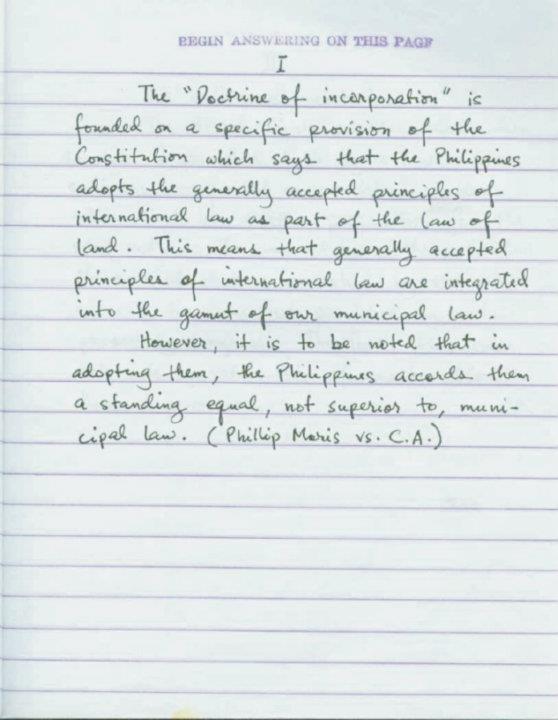
Now this is an example of legibility.

5


This is the actual Bar exam notebook of Atty. Ralph Sarmiento, Dean of University of St. La Salle, College of Law. He was Top 10 in the 1997 Philippine Bar Exam.


It may not be true that Bar examiners checked exam booklets solely on the taker's handwriting, but it doesn't hurt to improve one's handwriting.

Friday, November 30, 2012

Digest A Case Your Way

There's a marked difference between the law students then and the law students now. Of course, the law students then are probably lawyers now.

What I mean, though, is the way the Internet affects the study of law today. One of the wonders of the Internet is its power to connect people across different time zones and places. For instance, a law student studying in Manila can talk to a law student studying in Davao, thanks to Skype, YM, Facebook, Twitter, etc. A law student can share his digested cases by posting it in his blog or website. And everyone is free to copy it.

When a professor assigns a case or two for the students to read, it's tempting to seek the aid of the Internet. Just type the case title. Then voila! There you have it. Google, or whatever search engine you're using, will provide everything for you----the case digest with a link to the full text of the case.

I've done this many times myself. When I don't have enough time to read the case in its entirety, I read the case digest people in the cyberspace provide. But I find it counterproductive because after reading the case I'm left with more questions than answers. How did the RTC justify its ruling? What was the CA's rationication (I hate this word) in granting or dismissing the appeal? How did the Supreme Court rule on the CA's ruling?

Of course, the exact answers to those questions can only be had if one were to read the entire case. Yes, reading digested cases saves me a lot of time. But it doesn't save me from the grueling question and answer portion law professors like to subject their students.

That is why I think it's better to read the entire case and make your own case digest. Reading a case in its entirety gives you a better grasp of the case. And making your own digest allows you to present the case in a manner that fits your style and frame of mind the most because you made the digest yourself.

Tuesday, November 27, 2012

Strive for Simplicity, Not Legal Pugnacity

Justices, judges, lawyers, and law students are a brilliant lot. Too often, however, their brilliance is lost when they start writing down their ideas. The case of Leonor vs. CA  drives home this point.

The decision of the Trial Court regarding the merits of the case is as repugnant as the manner by which the decision was written. This is the first paragraph of the judge's decision, quoted in Footnote 13:
This is an action for “Cancellation of Entry in the Civil Registry” particularly on the marriage contract of one Mauricio Leonor, Jr. and Virginia Amor supposedly to have taken place in a long distance past on March 13, 1960 and after a Rip Van Winkle sleep and dormancy liken to a Mt. Pinatubo explosion that rocked the peace and quiet in the lives of the supposedly participants to this drama in Calatrava and San Carlos City, Negros Occidental when out of the blue one party in the person of an aggrieved left-behind spouse revived and revealed an ancient piece of marital bond between her and a reluctant spouse.

What's wrong with the paragraph? Everything, except perhaps for the spelling.

No less than the Supreme Court, through Justice Panganiban, called the language of the decision "convoluted," "painfully a sophomoric and pathetic portrayal" of Virginia, the petitioner in this case.

Further, the Court tersely remarked, "The said decision’s crude attempt at literary sophistication is matched only by its jarring syntax and grammatical incongruencies."

In his essay "On Developing My Decision-Writing Style," former Chief Justice Artemio Panganiban, this time not writing for the Court, shared the motive behind every decision he wrote.

"Even though my decisions are written primarily to resolve legal issues and are thus emblazoned with a considerable amount of legalese," he said, "I have endeavored to write in simple English, comprehensible as much as possible to a high school graduate.  I want to be understood not only by the legal profession but also by the parties themselves, especially by persons accused of crimes, and by the public at large as regards cases involving interpretation of the Constitution."

"More than lingual elegance and even legal pugnacity," he further said, "I strive for simplicity, clarity and precision in nuances and shades of meanings.  I believe the trend in all professions and occupations -- be they medicine, theology, science or music -- is to be understood not just by the members of that particular discipline but by the public at large."

Thus, lawyers and law students alike should strive for the same simplicity, clarity, and precision. After all, writing aims to reveal rather than conceal.

Thursday, November 22, 2012

Sakses!

[caption id="attachment_2366" align="aligncenter" width="510"] The book is published by Central Bookstore.[/caption]

A law student's life is filled with drudgery. But, as Blas Ople said, "Every one of us has his proud moments that seem to recapitulate all past struggles---that lift us from our plain and humdrum lives to an exalted state."

I just recently have one such moment. In August this year, the Philippine Association of Law Schools (PALS) organized a nationwide essay writing contest for law students.

Out of the participants from Luzon, Visayas, and Mindanao, ten finalists would be chosen. Of the ten, three would be declared winners.

Why I said I recently have my proud moment? Lest you be misled, I didn't win. Here are the winners:

  • 1st Place: Archimedes D. Suganob of St. Mary's College of Law, Tagum City.

  • 2nd Place: Julius Caesar Domingo of St. Mary's University, Bayombong Nueva Vizcaya.

  • 3rd Place: Euangeli P. Doromal of Cor Jesu College, Digos City.


I'm proud that two of the winners come from Mindanao. I think they all deserve to win, for how can a lowly man like me beat a mathematician/physicist, a Roman Emperor, and an angel?

Seriously, though, I'm proud because PALS has this little book called "In The Eyes of Law Students: The Secret Formula of Teaching Law," which contains, among others, the essays of the winners and ten other finalists.

What of it?

Nothing, except that I'm one of the finalists and my essay is in the book. If you're someone who has a literary pretensions, seeing your work published  is like releasing the feces that have been inside your stomach for quite a while.

No wonder, people say "Sakses!" after defecating.

Sunday, April 1, 2012

Onyot's Trip: Walang basagan ng trip!

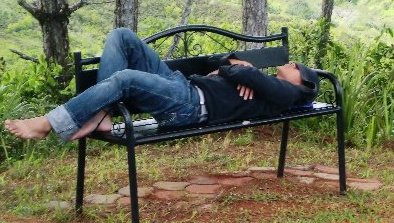
[caption id="attachment_2201" align="aligncenter" width="394" caption="Taken during our trip to Seagull Mountain Resort (Seagull 3), located on the outskirts of Bukidnon and Davao City (BuDa)."][/caption]

I have many nicknames. But it's "Onyot" that survived the test of time. I don't mind if you call me Onyot. I have become used to it anyway. In fact, now I like it when you call me Onyot. It's as if you and I have known each other for so long a time.

So I'm Onyot, and ito ang trip ko.

Trip, in English, denotes a "voyage," a "journey." But from the dingy and squalid kanto and looban of Philippine slums to the posh and bongga subdivisions, the word "trip" takes on a different meaning.

It refers to the things you do to break your humdrum routine, to express your in-ordinariness in this ordinary world, to wean yourself from a stressful work, or to try things for the sake of trying them.

Someone's trip might be food, manicure, or, uh, saving Mother Earth.

But sometimes if you do something as outrageous and bizarre as the acts of Jesse Caigoy,"Master of Pain," something as outlandish as having a Winnie The Pooh tattoo on your back, something as banal as planking, people would ask you this standard question, "Anong trip mo?"

"Wala lang!," or "Walang basagan ng trip!" is, of course, the standard retort.

When I started teaching, in 2010, I thought my teaching experience would be a fodder for my blog. I thought the bouts with students in particular and school life in general would be a well from which I can draw inspiration to blog. But no, I was caught in the thick of making lesson plans, preparing slide presentations for class, making test papers, checking test papers, recording and computing grades, reading essays, accompanying students to contests and conferences, meeting with parents, and complying with a host of other paper-works.

As a result, blogging became less frequent. Blog posts were sparse, mostly limited to announcements, slide shows for students to download, and a few lousy write-ups---lame attempts at reminding people who stumble upon this blog that its owner still exists. Soon, all I wanted was not to blog more often, but to have a goodnight's sleep.

Nevertheless, I continue to write. Sometimes, if I have time I write about teaching. I never write about sleeping. Most often I write about my activities in between---mga bagay na trip kong gawin.

That explains why I found the name of this blog---Onyot's TRIP---most fitting because this blog has been, is, and will always be about my trip: trip as a journey and voyage, and trip as wala lang, I just feel like doing it.

So welcome to Onyot's TRIP. And please walang basagan ng trip!

Sunday, July 17, 2011

If I weren't teaching, I could've been reporting

Before I applied for a teaching job, before I decided that my uncle no long has an interest to send me to law school, before someone texted me that the school where I'm teaching now needed a Social Studies teacher----before all that, I once submitted my application to SunStar Davao. The job I was looking for: Reporter.

One  afternoon, the administrative assistant of the paper sent me a text message, asking me if I could go to the SunStar office for an interview and entrance exam. I said yes.

There, I was interviewed and was asked to take a test. But I wasn't informed I was to take a battery of tests. I started at 10 am, and ended at 2 pm.

By the time the administrative assistant sent me another text message, I was already applying at Stella Maris Academy of Davao.

Part of the reason I did not become a reporter was also my own doing. I was not brave enough to accept the job because of the insecurity---financial insecurity---it gives me. The pay was so small it's equivalent to half of the salary I'm receiving now. The work is so hard---I have to turn in four stories a day.

But it doesn't mean I hate to be a reporter. I love to be a reporter, because as a reporter you get to be paid for your writing. And I love writing. Yet I have to get real about my situation.

Ah, the tension of opposites.

Thursday, June 10, 2010

Remembrance of the workshop past (Part 2)


What I was in for I really didn't know, until I threw myself into the sometimes shattering and sometimes enriching---depending on one's own experience---world of the writing workshop.


In the early morning of May 3, the first day of the workshop, I arrived in the conference room of Lispher Inn where the Davao Writers Workshop would be held. There was only one person present yet. By my estimate, he's somewhere between seventy and eighty. He's wearing floral long sleeves; his attache case was placed on the table.

The old man turned about, and when he saw me, he greeted me and offered me a seat near him. When he began to talk, I thought maybe this old man is a writer because writers are generally talkative.

It's not in my book to ask people's name first lest they'll get offended, but the old man saved me the burden of having to ask his name because he introduced himself.

"I am Satur," he said in Bisaya. "Satur Apoyon."

I just sat there with amazement. I couldn't believe that I was seating beside a real writer. All these years, I have not met a real writer, he who makes writing a living. But now there was something in me that told me not to let this opportunity slip by me, and so I tried as hard as I could to get the conversation between us going.

Satur and I talked about many things, from the difference of Cebuano and Mindanao Bisaya to the seven-year ordeal he had while completing his fantasy novel, "Ang Karibal ni Pilemon," from the difficulty he finds whenever he reads today's writings in Bisaya to the dearth of writers in Bisaya.

Not long afterward, people started to crowd the conference room, and then the workshop started (without a prayer), and Jhoanna Lynn Cruz, the Workshop Director, welcomed everyone. Then Rick de Ungria, being the president of Davao Writers Guild, gave a message. And so did Gilda Rivero, UP Mindanao's Chancellor. Then Dominique Cimafranca introduced the fellows and the panelists.

Four men and a woman served as panelists: Dr. Anthony Tan, who has the loudest voice of them all and was asked by Tita Lacambra-Ayala "Are you going to die?" when he told us, as a preface to his lecture, that he's going to retire from sitting as a workshop panelist; Mac Tiu, who, if not mean, was mild; Ric de Ungria, who was either the fellows' tormentor or defender; Genevieve Quintero, whose curly hair is as memorable as her positive comments; and Tim Montes, who was at one time very serious and at another naughty---he once said that poems must sometimes have the comic punch of this Bisaya verse: "Ay kakapoy/ Naay bata gatutoy/ Naay o**n gataroy/ Ay kakapoy."

There were also those who served as guests panelists: Satur Apoyon, who received the "Ug-Og" Palangga award, a parody of the Palanca award, for his emphasis on the difference between the words "ug" and "og"; Arnel Mardoquio, director of Hunghong sa Yuta, who just went to the workshop to critique the plays of Hiyasmin Espejo, the lone fellow for play; and Jhoanna Lynn Cruz, a Palanca awardee, who once took the place of Tim Montes.

15 slots were allotted for this workshop, but there were only 12 fellows who attended: James Pascual of ADDU, fellow for poetry; Gino Dolorzo of Xavier Univerity, poetry; Reymond Pepito of ADDU, poetry; Hiyasmin Espejo of UP Mindanao, play; Fred Layno of UP Mindanao, poetry; Ella Ismael of UP Mindanao, essay; Erika Navaja of UP Mindanao, poetry; Jayson Parba of Capitol University of CDO, fiction; Freeda Ko, granddaughter of Tita Lacambra-Ayala, fiction; Iryne Kaamino of Mindanao Medical School Foundation, poetry; Seneca Pellano of UP Mindanao, essay; and I, who came from Holy Cross of Davao College and was damn fortunate to have been chosen as a fellow for fiction, though I should have applied for essay because I like to style myself as an essayist.

Before the workshop, while looking at the roster of panelists and imagining the prospect of being inside a room full of writers of no mean achievement, I felt as though I were a speck whose presence would not make anyone budge, or whose absence would not be sorely missed by everyone.

And then Ms. Jhoanna introduced our keynote speaker, Dr. Anthony Tan, who would be giving a lecture on "Tension in Poetry." Oddly, while he's discussing tension in poetry, there was also a tension in me. That tension, I was sure, was due to the fact that my first piece, "The Young Sultan and the Plague," was slated to be critiqued first in the afternoon of that day.

The moment it was critiqued, all I did was prepare myself for the worst of comments. I didn't hold any illusions that it would come out unscathed. And true enough, it did come out strangled, stabbed, sliced, torn, lacerated, and hacked into pieces.

Sir Tim Montes called it "hilaw." The plot, he said, was not clear. Neither were the characters. Rick de Ungria said it's an "ambitious" piece, as though the writer wanted to cram so many things in so limited a form as short story.

It's hard to keep up with the pace of the panelists and take notes, but whatever they say, it only led to one irreversible conclusion: My piece didn't make it.

My second piece, "Badge of Honor," didn't make the grade either. Sir Mac Tiu said it's "novelistic," whose scenes "flits from one to another." He said, too, that the point of view needed to be fixed. There were so much background information that should not be included. Ms. Gen Quintero prepared to like the story because it started with the history of an indigenous people, and the IP is her area of interest. But she was left with no choice but to dislike it, for while reading it she had more "Huh?" moments than "Aha!" moments. Sir Rick de Ungria said my story is a good example of a story...that needed revision. There was, he said, a story, but no plot. The two, he reminded, should go together. He also said that I have this tendency to show instead of tell, and tell instead of show. Ms. Jhoanna was peeved by my use of triple asterisks to signal the reader of the new scene. It shows, she said, that the writer is immature. She suggested that I should read more, and even added that I ask a syllabus from Sir Tim Montes.

Their comments are enough to make you loathe them, and loathe them till you run out of cuss words. They can be so brutal that there was, in fact, one time that one fellow left the next day after his piece had been critiqued. They said the fellow wasn't just feeling well at that time, but it could be that the fellow couldn't stomach anymore the things the panelists were saying of his work.

To me, however, their comments are secondary; the experience itself primary. Not that I'm downplaying or belittling their comments, which were fair and well-thought-out in the first place, but the wonder of this all is that the utterly harsh comments are balanced and obliterated by the refreshingly congenial experience that the entire workshop provides for a novice writer.

Today, our society has little appreciation for writers. It is discouraging to writers, if not outright hostile. In school, students are mocked as "Emo" for turning their passions into prose. They are scoffed at if they keep a diary. At home, a son's or daughter's plan to be a writer is nipped right in the bud.

But at the writing workshop, there was not a slightest rebuke. Talks about writing are not discouraged; they are encouraged. It's as if writing is just like any other things in the world. Like PBB, like Rubi, like FB.

It is at the writing workshop, too, where I felt that I can be Arvin The Writer. It's there that I found it not strange to talk about writing being my passion. It's there where I was not questioned why I write. It's there where I was not considered quirky just because I see myself as a writer.

But the whole thing, after all, may be put very simply. The genius of a writing workshop does not lie in the panelists ability to issue an advice to young writers---sometimes it helps, and sometimes it thwarts, if not destroys, the writer's development. It lies in its ability to gather like-minded individuals, who are as passionate about writing as you are.

It sometimes get so frustrating when you find little support for the things you are most passionate about, but being in the company of such kindred spirits as the fellows and panelists, who think just what exactly you think, who feel just what exactly you feel, and who do just what exactly you do---it somehow buoys me.

Wednesday, June 2, 2010

Remembrance of the workshop past (Part 1)

Almost two decades ago, writer Doreen Fernandez, a noted critic herself, pleaded that this country should have more critics. They do an important work. They tell the readers which stories are good and which are not; which plays are worth watching and which are not; which books are worth buying and which are not.

Yet to us Filipinos whose sensibilities are not like the Americans’, it is but hard to have these critics around. We cannot withstand to have our work, the mere completion of which took us a long time and hard work, being subjected to criticism. We take the criticisms, however constructive, personally. We mistake criticism as an assault on our very being.

It is in writing workshop where much criticism takes place; although criticizing books or stories or plays is somewhat different from the criticism at writing workshops, it is criticism nontheless. I have never attended a writing workshop, until recently. But I’ve had a fair idea what goes on at a writing workshop, thanks to Stephen King,.

In his book "On Writing: Memoir of a Craft," King recounted his own experience at a writing workshop he once attended. Despite his harrowing experience at a writing workshop, King would become an established writer himself.

Although he's "doubtful" if a writer can benefit from writing classes and seminars, he's not "entirely against them."

"I knew that if I attend a workshop," he said, "I'd receive no sweet words, unless my works are truly exceptional, and they are not. I knew that my works would be criticized. What are critics for if they don't criticize?"

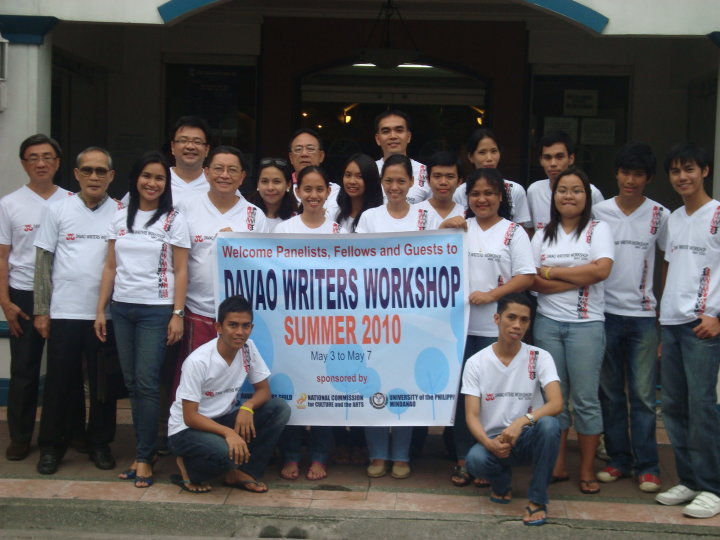
Like King, I knew that if I attend a workshop I would subject myself and wy works to criticisms. I knew that I would receive "no sweet words, unless my works are truly exceptional, and they are not." Nevertheless, on May 3-7, 2010, I attended the Davao Writers Summer Workshop, which was sponsored by the Davao Writers Guild, National Commission for Culture and the Arts, and UP Mindanao.

To be continued...

Thursday, May 13, 2010

Nanos gigantium humeris insidentes

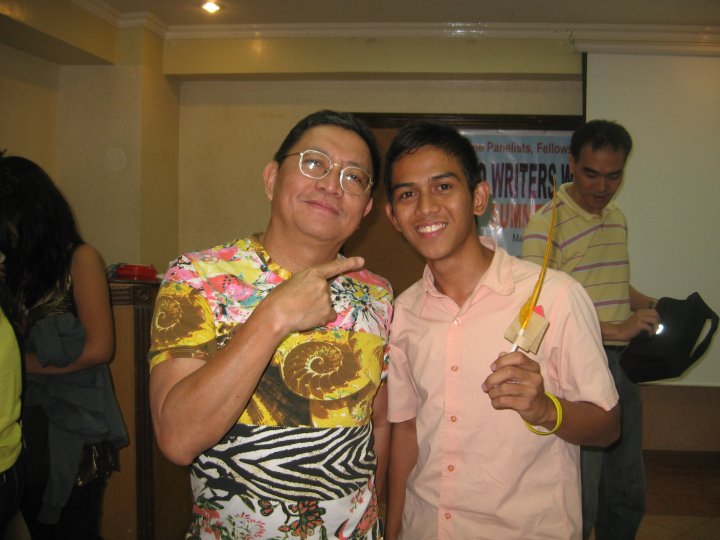
That means "dwarfs standing on the shoulders of giants." According to my ever-reliable source, Wikipedia, it is a Western metaphor that means, "One who develops future intellectual pursuits by understanding the research and works created by notable thinkers of the past." Joining the 2010 Davao Writers Workshop is like standing on the shoulders of giants. Here are some of the photos in which I, well, stood beside the giants (literally and figuratively).

[caption id="attachment_1795" align="alignleft" width="400" caption="Ma'am Aida Rivera-Ford and I."][/caption]

[caption id="attachment_1796" align="alignleft" width="400" caption="Sir Ricky de Ungria and I."][/caption]

[caption id="attachment_1797" align="alignleft" width="400" caption="Sir Mac Tiu and I."][/caption]

[caption id="attachment_1798" align="alignleft" width="400" caption="Sir Tony Tan and I."][/caption]

[caption id="attachment_1799" align="alignleft" width="400" caption="Dominique Cimafranca and I."][/caption]

[caption id="attachment_1800" align="alignleft" width="400" caption="Sir Tim Montes and I."][/caption]

Friday, May 7, 2010

Aida Rivera-Ford recited Sonnet 29


Aida River-Ford is so known she need not be introduced at length. Suffice it to say that the opening ceremony of the 2010 Davao Writers Workshop was made more special by her presence, and by other venerable artists' presences: Tita Lacambra-Ayala, Margot Marfori, and Maria Virginia Yap Morales.

During lunch time, Ma'am Aida seated near us. She didn't eat right away, as everyone else did. Yes, she did get her food. But after putting down her sparsely filled plate on the table, she asked us if we have a copy of Dr. Anthony Tan's lecture, in which Shakespeare's Sonnet 29 was cited.

"I will recite it with feelings," she said.

Gino, one of the fellows for this year's workshop, handed his copy to Ma'am Aida. Then Ma'am Aida stood in front and held the copy in her left hand.

"You know, aside from being a writer, I'm also a performer," she said. "I used to memorize this, but now I forgot this already. But anyway, I will recite it."Ma'am Aida didn't frustrate her listeners. True to her word, she recited Shakespeare's Sonnet 29 with feelings.

When, in disgrace with fortune and men's eyes,
I all alone beweep my outcast state
And trouble deaf heaven with my bootless cries
And look upon myself and curse my fate,
Wishing me like to one more rich in hope,
Featured like him, like him with friends possess'd,
Desiring this man's art and that man's scope,
With what I most enjoy contented least;
Yet in these thoughts myself almost despising,
Haply I think on thee, and then my state,
Like to the lark at break of day arising
From sullen earth, sings hymns at heaven's gate;
For thy sweet love remember'd such wealth brings
That then I scorn to change my state with kings.


Then everyone applauded her.

So beautiful is her rendition that, how shall I say this, nanindog gayod ang akong balahibo paghuman niya ug basa sa poem. As both fellows from CDO, Gino and Kuya Jay, would say, "Chada kaayo bay."

Thursday, May 6, 2010

Notes on the Davao Writers Workshop 2010

[caption id="attachment_1740" align="aligncenter" width="500" caption="The opening ceremony of the 2010 Davao Writers Workshop was graced by Aida Rivera-Ford and Tita Lacambra-Ayala, the grand dames of Philippine Literature"][/caption]

The Davao Writers Workshop Summer 2010 is about to end. There are only few pieces left to be critiqued. Call me sentimental, but this is one of the events in my life that I will never forget. Ages and ages hence, I shall be able to tell this: For once in my life, I brushed elbows with the big-shots of the Philippine Literary scene: Jhoanna Cruz, Tim Montes, Gen Quintero, Mac Tiu, Anthony Tan, and Ric de Ungria, who serve as our mentors, or "tormentors" as some would say.

Merely looking at the roster of this workshop's panelists can be intimidating, what with their accomplishments and intellectual acumen. In fact, before the workshop, I felt as though I was so puny that if ever I'd be absent or present, my presence or absence would not make anyone budge.

Yet, for one reason or another, I didn't feel that way. Here, no one questions me why I do the things I do, which is to write.

Wednesday, April 14, 2010

Fellows for the Davao Writers Workshop 2010

The Davao Writers Guild, in cooperation with the National Commission for Culture and the Arts and University of the Philippines-Mindanao, proudly announces the Fellows for the Davao Writers Workshop 2010:

Short Story
April Dawn M. Paramio
Arvin Antonio V. Ortiz
Freeda Ko Quejada
Jayson E Parba

Essay
Ella Jade Ismael
Seneca Pellano

Play
Hiyasmin Gabriela Espejo

Poetry
Erika Navaja
Friedrich Simon C Layno
Gino Boy Dolorzo
Iryne O. Kaamino
James Roy C. Pascual
Reymond L Pepito

The workshop will take place on May 3 to 7 at Lispher Inn, Juna Subdivision, Matina, Davao City.

Tuesday, March 2, 2010

Davao Summer Writers Workshop 2010

The Davao Summer Writers Workshop 2010 is now accepting applications.

Thursday, January 21, 2010

Erich Segal, 1938-2010

[caption id="attachment_1579" align="aligncenter" width="293" caption="Erich Segal"][/caption]


The one who made me buy a VCD copy  of "Love Story," read "The Class," "Doctors," and "Man, Woman, and Child"----the one who made me do all that died of heart attack.

Sunday, January 3, 2010

Thanks, Mr. Zinsser

Last year, I won. Won where? In the Best Humorous Essay Writing Contest sponsored by Crossroads, the official student publication of our school, HCDC.

Of course, I must---nobody else joined the contest. Nobody, nobody but me. Therefore my winning essay, I told the folks at Crossroads, is not the best choice. It's the only choice.

I suspect the reason no one dared to join the contest, besides me, is not that I can write; the rest cannot. It's more basic than that: Nobody knows just what humor is.

I, for one, grappled with its meaning, so that I have to ask Rowell, the editorial consultant of Crossroads, what do they mean by humor. He isn't of much help either. Did you get me?

Then I remembered I have a copy of William Zinsser's On Writing Well, which has a chapter devoted entirely to humor.

And so, the prize went to me, although until now, I haven't received it yet.

Tuesday, December 1, 2009

Like truth, books shall set us free

[caption id="attachment_1436" align="aligncenter" width="399" caption="Photo by blog.mariyamakiling.com"][/caption]

(The essay below was adjudged as third in the Essay Writing Contest sponsored by the Learning Resource Center of our school, HCDC. Which means this essay's only worth a hundred pesos.)

Books have many purposes. There are books that entertain. There are books that teach us how to cook and plant. But books as weapons for independence? Probably a far-fetched idea. But once upon a time, in the Philippines, books were not just ornaments that adorned the library. Books, which are carriers of ideas, were once used as weapons for independence.

According to the historian Ambeth Ocampo, during the Spanish regime, the Philippines was sealed against liberal ideas. The Filipinos, who were then called indios, were not allowed to read. The Spaniards were so afraid that Filipinos might be enlightened they established a Comision de Censura. Its task was to censor all the books coming in the Philippines. This kept the Filipinos in the dark for well over three centuries.

Fortunately, we have such audacious heroes as Jose Rizal, Andres Bonifacio, and Apolinario Mabini. All were voracious readers. All acquired liberal ideas, which later spurred them to fight for independence from the Spaniards.

Saturday, November 28, 2009

Dealing with defeat my way

I went this afternoon to the Education Student Council's Office, only to be told that I placed third in the Essay Writing Competition sponsored by the Learning Resource Center of our school.

Of course, the news rather disappointed me. I'm not the pseudo-humble person who says that joining the contest is in itself enough for him. Truth to tell, I expected to place first, and I guess the five others who joined the contest did.

And what exactly did I do to, at least, cushion this recent blow on my pride?

A. Pretend that I'm doing a greater good. Perhaps the winner needs to beat a person of my stature in order to raise her morale.

B. Recall my past accomplishments, which the winner obviously didn't achieve.

C. Take note of the fact that she wasn't published in any national broadsheet. I was. She wasn't a finalist in the 2009 Philippine Blog Awards. I was.

D. Take note of another fact that when you google her name, the only result that the search engine will yield is her Friendster or Facebook account and nothing else.

The answer is E: all of the above.

(OK, thus is imitated from Jessica Zafra. I just can't help it. I couldn't find a better way to say what I want to say. My apologies.)

Friday, November 27, 2009

Ang maka-highblood nga mga application letters...

...sa mga adunay plano nga mag-teacher.

Pahibalo: Pardon to those who can't, don't understand Bisaya abd swardspeak.

Kagahapon, samtang nag-istambay ko sa Principal's Office, aksidenteng nabasahan nako ang mga daan na application letters sa mga previous applicants. Uban sa mga applicants, kaila ko.

Naay usa na ni-kuha sa akong attention. Basta babae siya. Ug iyang major kay kargado ug sayaw-sayaw. Mao lang to ang akong masulti bahin sa iyang identity.

Wala nako natingala nganong wa siya madawat. Abi ba nako ug gusto siya mutudlo sa tulunghaan na iyang gi-aplayan. Pero nganong sa latter part sa iyang letter, niingon man siya na:
I'm looking forward to be apart this institution. (Emphasis mine).

Good for her---wa siya nag-inusara. Daghan pang mga letter na kon dili char ang pagkasulat, gina sweet-talk ang recepient, nga mao ang Principal. Aduna pay nag-start sa iyang letter na murag ni-apil ug essay writing contest:
Education is performing the lives of children...May I have the opportunity to submit my application letter...

Naa puy meloera kaayo:
May I have the opportunity to apply  for a vacant teaching position in your...well-established institution.

Ug aduna puy murag nagsulat sa iyang autobiography. Gisaysay ba naman iyang mga kaagi sugod nag-graduate siya, pagtrabaho niyag 3 ka bulan sa usa ka telecommuncations company, pagtrabaho niya ug pipila ka bulan sa gawas, giunsa sa ilang grupo pag-meet sa ilang quota...yada yada yada. Kulang na lang isaysay niya kung, uh, never mind.

Ambot na lang. Wa sila kilati! Kung ako ang mag-vet, dili gyod nako dawaton kadtong mga applicants na sa letter pa lang windang na.

Tag-as ra kaayo sila ug appraisal sa ilang mga sarili. Wa may kaso ni. Kana kung tinuod pud ang ilang appraisal. Meaning: congruent ang imong ginapang-tabi sa kung unsa gyoy imong ikabugha. Naa pay niingon didto na:
I believe my knowledge, competencies, and skills can contribute to the development of the students.

Huh? Nakulbaan ko. Are you sure you want to teach students with your ghastly grammar and egregious English?

On one hand, nag-huna2x pud ko: Husto ba nga i-judge ang usa ka teacher base sa iyang application letter. Malay nimo dili lang gyod siya verbally intelligent. Di ba?

On the other hand, basic man gud na skill ang letter writing. Biskang sa elementary ginatudlo na ang pagsulat ug letters: application letter, invitation letter, letter of aplogy, letter A, B, C, D...

Ug dinhi na natapos ang akong kaligut-got sa mga maka-highblood nga mga applications letters sa mga adunay balak mag-teacher.

Disclaimer: I'm not claiming na my grammar is perfect. Pero, modesty aside, I can say na, at least, I can write passable English.