(Graduation is drawing near. When I was about to graduate from college, I dreamed of delivering a valedictory speech, but that dream would remain just that: a dream. If I were to deliver the valedictory speech, however, I would've given this speech.)
I wish I could talk about how our government manages the public money, so that the accountancy and commerce students could relate to me. I wish I could talk about our criminal justice system, so that the criminology student could relate to me. I wish I could talk about our health care system and child abuse, so that the social work students could relate to me. I wish I could talk about the use of psychology in preventing crime, so that the psychology students could relate to me.
I wish I could talk on those different fields, so that everyone present here could relate to me. But I could not because I don't know any better. And if I do talk about the things I know better, I'm afraid you could not relate to me. If I would talk about Multiple Intelligences or Learning Styles or Teaching Strategies, nobody but the education students would listen to me.
I'm not even sure if they would listen, and listen like their grades depend on it. They've heard enough of them in the classroom. Surely they don't want to recall their harrowing experience in the classroom, not even now that they are wearing toga whose origin they barely know.
So I will talk about my own experience in college. After all, we human beings are by nature chismoso. We always wanted to know something about other human beings.
Yet I won't try to please everybody because I'm afraid that if I try to please everybody, I just might end up pleasing nobody.
Thank you for listening to the introduction. If you have one more minute to spare, do spare it.

Showing posts with label Holy Cross of Davao College. Show all posts
Showing posts with label Holy Cross of Davao College. Show all posts
Sunday, February 19, 2012

Tuesday, February 16, 2010
Do gays have a place in HCDC?
 "Where would we be without beauty contests?" asked Adrian Cristobal in his essay "Footnote to the Judgment of Paris." "They are the staple of festivals and charity affairs, and undoubtedly offer new opportunities and open large vistas for the many young women who participate in them, especially those who win the coveted crowns."
Mr. Cristobal is right: beauty contests are "the staples of festivals" and other celebrations. But he failed to mention that it is not only young women who are joining beauty contests. Gays also join in them.
Today, the sight of beauty pageants whose contestants are gays wearing bikinis, strutting their bodies as curvaceous as the women's, showing their talents, and fielding questions from the judges during the Q&A portion, has become so commonplace that it no longer shocked us.
These contests, though, remain to be the province of the secular society. They are scoffed at especially when held in a conservative place like a Catholic school. Never or rarely do Catholic schools host such beauty contests because, as some would argue, they glorify homosexuality. And homosexuality is anathema to the teachings of the Catholic Church.
Yet the rare thing happened at HCDC. On February 13, 2010, the day the school celebrated the Student's Day, the Supreme Student Government, in cooperation with the Bread Society, included in its roster of activities the "Divas Night."
The title sounds as if it's a singing contest. But it actually is not. It's a Ms. Gay in disguise.
In including this activity, the SSG explained, it does not encourage others to be gays. Rather, it merely wanted to show that this sector exists and that gays are also part of the HCDC community.
For doing the bold thing, I commend the SSG, especially the President, the very audacious Barack Obama, este, Joel Accion.
Monday, December 14, 2009

Tuesday, November 24, 2009
In the library...
[caption id="attachment_1391" align="alignleft" width="618" caption="Reading Tent"] [/caption]
[caption id="attachment_1394" align="alignleft" width="594" caption="High school students of HCDC are playing the "Top 10 of Everything DVD Game.""] [/caption]
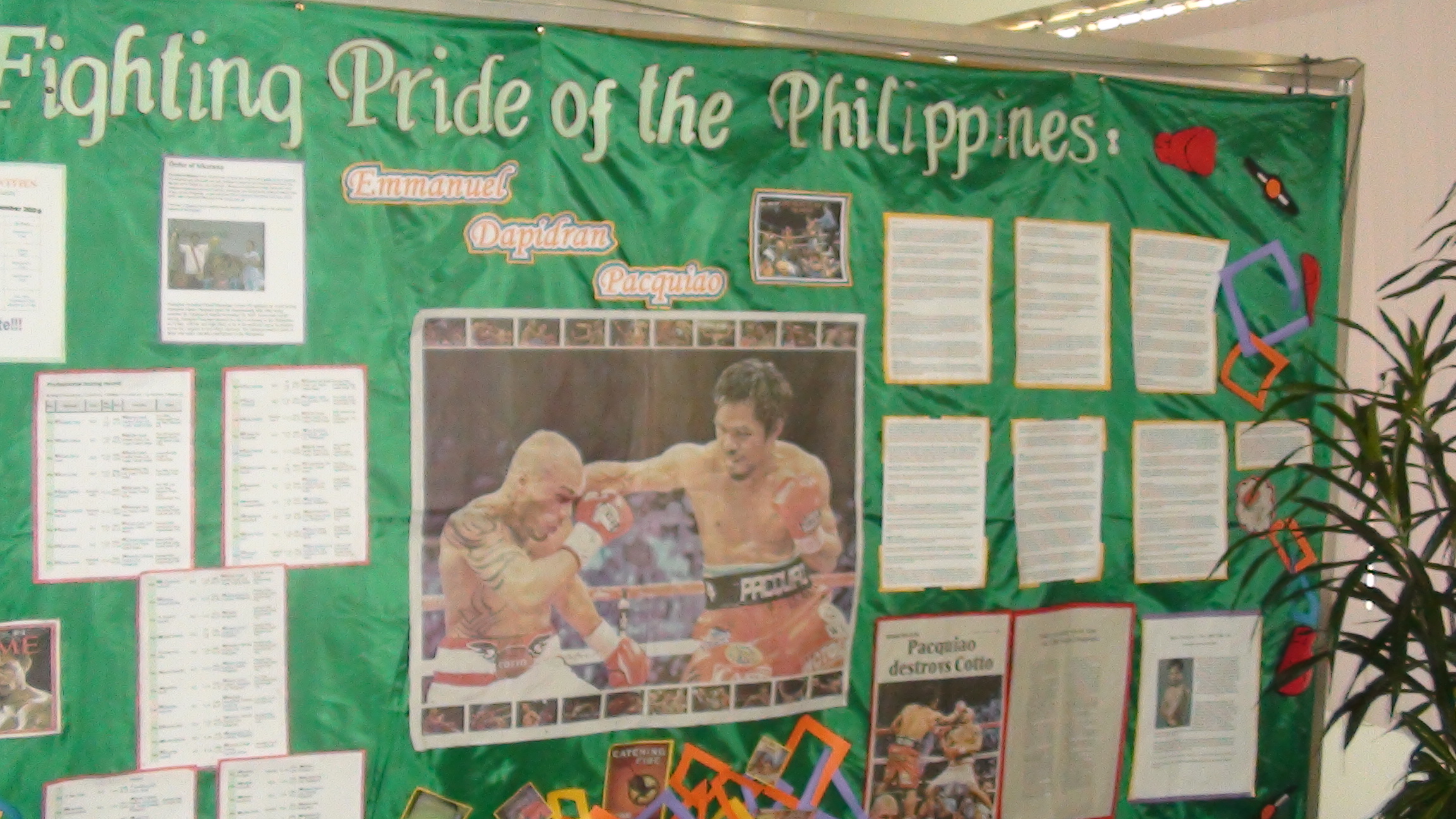
[caption id="attachment_1395" align="alignleft" width="600" caption="The library pays tribute to Manny Pacquiao, the no. 1 pound-for-pound boxer in the world."] [/caption]
It could have been much agreeable had the library also paid tribute to the true pound-for-pound fighter we have right now: Efren Peñaflorida.
 [/caption]
[caption id="attachment_1394" align="alignleft" width="594" caption="High school students of HCDC are playing the "Top 10 of Everything DVD Game.""]
 [/caption]
[caption id="attachment_1395" align="alignleft" width="600" caption="The library pays tribute to Manny Pacquiao, the no. 1 pound-for-pound boxer in the world."]
 [/caption]
It could have been much agreeable had the library also paid tribute to the true pound-for-pound fighter we have right now: Efren Peñaflorida.
Sunday, October 11, 2009
'Cory is beautiful'
(The following essay was written by Mrs. Lourdes "Ma'am Gee" Gamutan, an
English and Literature professor at the Holy Cross of Davao College.)

Cory!
by Ma'am Gee
She held my hand in a warm clasp. I looked into her kind, lit-up face. While it was not yet my turn for her attention, I sized her up. Creamy skin. The kind that speaks of Chinese genes. Open, smiling face. The one that welcomes you without built-in reservation. Simple. Sans make up. In a person who hold number one authority in this land, it's a pleasant absurdity. There is no inclination to arrogance or meanness or claims to power in her aura. This is a wife of a hero. She herself a heroine to democracy in this corner of the earth.
English and Literature professor at the Holy Cross of Davao College.)
Cory!
by Ma'am Gee
She held my hand in a warm clasp. I looked into her kind, lit-up face. While it was not yet my turn for her attention, I sized her up. Creamy skin. The kind that speaks of Chinese genes. Open, smiling face. The one that welcomes you without built-in reservation. Simple. Sans make up. In a person who hold number one authority in this land, it's a pleasant absurdity. There is no inclination to arrogance or meanness or claims to power in her aura. This is a wife of a hero. She herself a heroine to democracy in this corner of the earth.
Tuesday, October 6, 2009
'Bata sa garapon' (Child in the canister)
A spark of insight can happen anywhere, anytime. It can happen while you're in the comfort room. It can happen while you're standing in the waiting shed. Heck, it can even happen in the middle of fornication.
It happened to Paul while he was on his way to Damascus. It happened Archimedes while he's in the bath tub.
Mine was during our Cooperative Learning Strategy Seminar. Our invited resource speaker, Mr. Ritchie Sermon, gave us an activity---the second of the three activities---called "Community Circle."
It happened to Paul while he was on his way to Damascus. It happened Archimedes while he's in the bath tub.
Mine was during our Cooperative Learning Strategy Seminar. Our invited resource speaker, Mr. Ritchie Sermon, gave us an activity---the second of the three activities---called "Community Circle."
Saturday, August 29, 2009
Cyber censorship in HCDC?
 Holy Cross of Davao College always says, almost as an article of faith, that just because it is a Catholic school doesn’t mean that it will only take care of the students’ spiritual aspect. It will also work for the development of the social, mental, and intellectual aspect of the students.
It may have achieved some successes in developing the mental, intellectual, spiritual, and social aspects of the students. But the social aspect? Fuhgeddaboudit!
If the IT Office of Holy Cross will have its way—and it probably has—it is doubtful if Holy Cross will succeed in developing the social aspect of the students.
Friday, January 30, 2009
The Education students' FS saga
Education students are the future teachers of society. But are they up to the challenges of teaching? How will they handle a class of 70 to 80 students when they’ll teach in public schools? Can they make their class interesting given the limited resources?
The training before
Education students before are oblivious to what awaits them in the actual field of teaching, owing perhaps to the fact that their training gives them little opportunity to see the realities of teaching.
Like cloistered monks whose lives are devoted to a life of prayer inside the monastery, education students spend most of their training inside the comfortable confines of the classroom, learning different principles and strategies of teaching.
Like cloistered monks who have shunned the world of men, education students only have an iota of knowledge on the real world of teaching—a world fraught with unexpected twists and turns.
But that was before Field Study (FS) came into the fore.
Enter Field Study
FS is an extended practicum program spearheaded by Basic Education Assistance for Mindanao (BEAM), a project initiated by the Department of Education (DepEd). BEAM is jointly funded by the Philippine Government and the Australian Government through a grant of AUD$36 million from the Australian Agency for International Development (AusAID), according to BEAM’s website.
The entire FS program comprises six stages: FS 1: Learner’s Development and the School Environment; FS 2: Classroom Management Skills in the Teaching and Learning Process; FS 3: Micro-teaching and Use of Technology; FS 4: Team Teaching: Exploring the Curriculum; FS 5: Learning Assessment Strategies; FS 6: On Becoming a Teacher.
FS is one of the major activities of BEAM’s Pre-service Teacher Training in which future teachers, while they are still having their training in Teacher Education Institution (TEI), are already deployed to different schools, especially public schools, either to observe or to practice teaching, depending on what particular stage of FS they are in.
This model, according to BEAM’s website, is consistent with the Commission on Higher Education (CHED) Memo. Order 30, s. 2004, which says, “the deployment of student teachers should begin in second year rather than in their fourth year.” The institution of FS aims to give opportunity to future teachers “to more fully develop their teaching skills through a developmental and sequential approach.”
The FS experience
At first, Education students were clueless what FS is all about. It was as strange to the Education student as Coca-Cola was to Xi, the playful character in the film “Gods Must Be Crazy.” What they knew was that FS is just one of the new subjects in the Education Program’s BEAM Curriculum.
“Prior to enrolling FS, I do not have any idea of what it is all about and what am I going to do in this course,” said Mark Jason Diaz, a senior BSED-Social Studies student.
So when the first batch of FS students, half-jestingly called “The Experimental Batch,” was deployed to their cooperating schools—Bangoy National High School, Sta. Ana National High School, Davao City National High School, etc.—it was only then that they discovered what FS is like. And succeeding batches of FS students soon realized that FS offers opportunities like never before. Some find it exciting. Others find it enriching. Still others find it enlightening.
“Having the FS on the field was a very exciting one,” said Mark Jason Diaz who is now on his FS 5 & FS 6. “I got to meet other people with different personalities.”
Lou Tarranza, a senior BSED-English student, recalled how the members of the school community cordially received them. “I was amazed with the ambiance. The teachers were very approachable and at the same time, I really appreciate their hospitality,” Tarranza said.
Problems, problems
But everything does not always go well for the FS students. Among the problems they experience is how to balance their limited time. It is even doubly difficult for working students. “Being a student assistant,” Mark Jason Diaz said, “it’s really difficult since I need to make some adjustment on my duty hours so that if would fit my FS schedule.”
Though not a working student, Ismael Oledan, a senior BSED-Social Studies student, also experienced juggling between his class schedule and FS. “One of the difficulties I encountered while I was having my FS was how to manage my time between FS and my class schedule,” Oledan said.
Other sources of complaints are the requirements: Portfolios, Lesson plans, FS manuals, visual aids and a host of other requirements. And accomplishing them just eats a great deal of their time, including their precious time for sleep. “We sacrifice many sleepless nights just to finish them,” said Ginalyn Vistal, a senior BSED-English student. “It is really a burden on my part as a student because I also have major subjects, which are equally taxing.”
Not for the faint-hearted
But then, “These are the times that try men’s souls,” said Thomas Paine centuries ago. He was of course referring to the tumultuous times of the American Revolution. But the saying applies as well to the times when Education students are struggling to finish their FS.
Frankly, teaching is not for the faint-hearted. Only those who have the right blend of passion, commitment, altruism and competence can survive in this, well, unglamorous profession. That is why FS is there to expose future teachers as early as possible to the realities of teaching, so it would make them ponder whether they have chosen the right profession or if they deserve to be a teacher to begin with.
Call it a hassle or anything, but no doubt FS taught Education students valuable lessons— lessons they can apply in the actual field of teaching. “In FS, I learned that patience is indeed a virtue,” said Jidelyn Lobino, a senior BSED-Physical Science student. “Some learners are really hard to handle, but keeping your composure and controlling your emotions really help a lot. Patience helps you to not get disappointed of yourself.”
‘Crossing the Rubicon’
“Despite the difficulties, FS courses had given me a lot of learning experiences that I could surely apply once I become a full-fledged teacher,” said Jed I. Bete, a graduating BSED-Social Studies student. “Through FS, I was able to experience and witness the real scenarios in the world of ‘public education’. I also came into a realization that in teaching, it’s good to be idealistic. However, it is better to be realistic.”
Having gone through all the six FS courses, Jed I. Bete knows whereof he speaks. Asked if he was dissuaded by the sorry state of ‘public education’ and of the teachers in the Philippines, Bete replied in the negative. In fact, he is “even more encouraged to fulfill” his dream of becoming a teacher, which will be a dream no more as he will graduate this March 2009.
“Despite those terrible realities,” Bete said, “I still believe that there is happiness and satisfaction in the profession of teaching. Aside from that, being an agent of change, I know I am needed not only by my future students, but also by the society at large. How could I introduce change to the system? I am crossing the Rubicon. I am becoming a teacher.”
The training before
Education students before are oblivious to what awaits them in the actual field of teaching, owing perhaps to the fact that their training gives them little opportunity to see the realities of teaching.
Like cloistered monks whose lives are devoted to a life of prayer inside the monastery, education students spend most of their training inside the comfortable confines of the classroom, learning different principles and strategies of teaching.
Like cloistered monks who have shunned the world of men, education students only have an iota of knowledge on the real world of teaching—a world fraught with unexpected twists and turns.
But that was before Field Study (FS) came into the fore.
Enter Field Study
FS is an extended practicum program spearheaded by Basic Education Assistance for Mindanao (BEAM), a project initiated by the Department of Education (DepEd). BEAM is jointly funded by the Philippine Government and the Australian Government through a grant of AUD$36 million from the Australian Agency for International Development (AusAID), according to BEAM’s website.
The entire FS program comprises six stages: FS 1: Learner’s Development and the School Environment; FS 2: Classroom Management Skills in the Teaching and Learning Process; FS 3: Micro-teaching and Use of Technology; FS 4: Team Teaching: Exploring the Curriculum; FS 5: Learning Assessment Strategies; FS 6: On Becoming a Teacher.
FS is one of the major activities of BEAM’s Pre-service Teacher Training in which future teachers, while they are still having their training in Teacher Education Institution (TEI), are already deployed to different schools, especially public schools, either to observe or to practice teaching, depending on what particular stage of FS they are in.
This model, according to BEAM’s website, is consistent with the Commission on Higher Education (CHED) Memo. Order 30, s. 2004, which says, “the deployment of student teachers should begin in second year rather than in their fourth year.” The institution of FS aims to give opportunity to future teachers “to more fully develop their teaching skills through a developmental and sequential approach.”
The FS experience
At first, Education students were clueless what FS is all about. It was as strange to the Education student as Coca-Cola was to Xi, the playful character in the film “Gods Must Be Crazy.” What they knew was that FS is just one of the new subjects in the Education Program’s BEAM Curriculum.
“Prior to enrolling FS, I do not have any idea of what it is all about and what am I going to do in this course,” said Mark Jason Diaz, a senior BSED-Social Studies student.
So when the first batch of FS students, half-jestingly called “The Experimental Batch,” was deployed to their cooperating schools—Bangoy National High School, Sta. Ana National High School, Davao City National High School, etc.—it was only then that they discovered what FS is like. And succeeding batches of FS students soon realized that FS offers opportunities like never before. Some find it exciting. Others find it enriching. Still others find it enlightening.
“Having the FS on the field was a very exciting one,” said Mark Jason Diaz who is now on his FS 5 & FS 6. “I got to meet other people with different personalities.”
Lou Tarranza, a senior BSED-English student, recalled how the members of the school community cordially received them. “I was amazed with the ambiance. The teachers were very approachable and at the same time, I really appreciate their hospitality,” Tarranza said.
Problems, problems
But everything does not always go well for the FS students. Among the problems they experience is how to balance their limited time. It is even doubly difficult for working students. “Being a student assistant,” Mark Jason Diaz said, “it’s really difficult since I need to make some adjustment on my duty hours so that if would fit my FS schedule.”
Though not a working student, Ismael Oledan, a senior BSED-Social Studies student, also experienced juggling between his class schedule and FS. “One of the difficulties I encountered while I was having my FS was how to manage my time between FS and my class schedule,” Oledan said.
Other sources of complaints are the requirements: Portfolios, Lesson plans, FS manuals, visual aids and a host of other requirements. And accomplishing them just eats a great deal of their time, including their precious time for sleep. “We sacrifice many sleepless nights just to finish them,” said Ginalyn Vistal, a senior BSED-English student. “It is really a burden on my part as a student because I also have major subjects, which are equally taxing.”
Not for the faint-hearted
But then, “These are the times that try men’s souls,” said Thomas Paine centuries ago. He was of course referring to the tumultuous times of the American Revolution. But the saying applies as well to the times when Education students are struggling to finish their FS.
Frankly, teaching is not for the faint-hearted. Only those who have the right blend of passion, commitment, altruism and competence can survive in this, well, unglamorous profession. That is why FS is there to expose future teachers as early as possible to the realities of teaching, so it would make them ponder whether they have chosen the right profession or if they deserve to be a teacher to begin with.
Call it a hassle or anything, but no doubt FS taught Education students valuable lessons— lessons they can apply in the actual field of teaching. “In FS, I learned that patience is indeed a virtue,” said Jidelyn Lobino, a senior BSED-Physical Science student. “Some learners are really hard to handle, but keeping your composure and controlling your emotions really help a lot. Patience helps you to not get disappointed of yourself.”
‘Crossing the Rubicon’
“Despite the difficulties, FS courses had given me a lot of learning experiences that I could surely apply once I become a full-fledged teacher,” said Jed I. Bete, a graduating BSED-Social Studies student. “Through FS, I was able to experience and witness the real scenarios in the world of ‘public education’. I also came into a realization that in teaching, it’s good to be idealistic. However, it is better to be realistic.”
Having gone through all the six FS courses, Jed I. Bete knows whereof he speaks. Asked if he was dissuaded by the sorry state of ‘public education’ and of the teachers in the Philippines, Bete replied in the negative. In fact, he is “even more encouraged to fulfill” his dream of becoming a teacher, which will be a dream no more as he will graduate this March 2009.
“Despite those terrible realities,” Bete said, “I still believe that there is happiness and satisfaction in the profession of teaching. Aside from that, being an agent of change, I know I am needed not only by my future students, but also by the society at large. How could I introduce change to the system? I am crossing the Rubicon. I am becoming a teacher.”
Friday, November 28, 2008
Like father, like son?
[caption id="attachment_109" align="alignleft" width="350" caption="L-R: Arvin Antonio V. Ortiz, JDV III, Jed I. Bete, and Christine Camus"] [/caption]
[caption id="attachment_110" align="alignright" width="331" caption="Dinner with JDV III which was attended, among others, by Joel Virador and Jeppie Ramada---both are from Bayan Muna"] [/caption]
 [/caption]
In the midst of the NBN-ZTE scandal and despite death threats, Jose de Venecia III, son of then House Speaker Jose de Venecia, Jr., had been making campus tours as though he is a telemarketer trying hard to sell his product. Not surprisingly, his product sold like hotcake.
On March 9, 2008 when he came in Davao City, student leaders were invited to have a dinner with him. Christine Camus, then SSG President-elect of HCDC, asked me and my friend Jed to accompany her since her VP was attending a forum which was underway that time. Held at Assumption College of Davao, the dinner started at around 8:00 pm. Student leaders from ADDU and UP Min were invited as well. Among the visitors were Joel Virador and Jeppie Ramada---both are from Bayan Muna.
Together with the Assumption sisters, the younger de Venecia entertained some questions. One thing that lodged in my mind was when Jed, with no-holds-barred, asked de Venecia why he let the cat out of the bag.
[caption id="attachment_110" align="alignright" width="331" caption="Dinner with JDV III which was attended, among others, by Joel Virador and Jeppie Ramada---both are from Bayan Muna"]
 [/caption]
JDV III groped for words. Then he managed to give a few intelligible words; the most memorable were: “Because I am a Filipino.” Or words to that effect.
The older de Venecia might find himself in a similar situation. Recently, Jose de Venecia, Jr. released his book, “Global Filipino: The Authorized Biography of Jose de Venecia, Jr.” written by Brett Decker. There, he talked, among others, about the corruption in the government he himself propped up. Excerpts of the book were published in the Philippine Daily Inquirer.
The question still lingers. Why only now? Someone should ask the older de Venecia why he is exposing the misdeeds of the people he once avidly defended. Like his son, is it because he is a Filipino; and as a Filipino he is duty-bound to do so? Or is he only piqued? Whatever, there seems to be no reconciliation in sight between GMA and JDV.
But who knows? In this country where the impossible becomes possible and today’s enemies become tomorrow’s friends, nobody really knows.
Tuesday, November 25, 2008
Financial or intellectual?
Crossroads, the official student publication of Holy Cross of Davao College (HCDC) is cash-strapped. That is why the paper’s staff is pushing for the increase of the publication fee. Among the student publications in Davao City, the Crossroads of HCDC collects the lowest publication fee, a measly P25.00.
But every time it releases its issue for the semester, I read the paper with displeasure. Its articles, especially its commentaries on specific issues that bedevil the school, reek of shallowness. Its writers’ complaints are platitudinous. Yes, its writers bring up issues, but seldom do they prove them. Add to that the paper’s penchant for dedicating a whole spreadsheet to photos alone.
While money is needed to finance the publication, I wonder if its single most problem is financial. Judging from the quality of the publication’s content, it could be that the Crossroads' biggest challenge is not money but brain.
Subscribe to:
Posts (Atom)