By now those students who will go to college must have already decided what course to take. I've been asking my students about their plans. As with the many Pinoys who answer a question with another question, a few of them ask me back so that the interviewer became the interviewee now.
"What's a good pre-Law course to take, Sir?"
Well, that question could be answered on two different levels.
First, law schools don't prescribe a particular pre-Law course. Whatever course will do, provided your pre-Law course complied with the required number of units in Math, English, and Social Science. But that depends on the university. For example, in the University of Mindanao College of Law, the requirements are: 6 units in Math, 12 units in English, and 9 units in Social Science (History, Psychology, or Sociology).
Second, if by a good pre-Law course means that what course will better prepare your for law school, the answer is there is none.
True some may say it should be AB English or Communication Arts since in law school what matters is not what answers you give, but how to give what you give. Other may say it should be Philosophy, for it trains you to be a critical thinker.
I think it depends on what kind of lawyer you want to be. I have Law professors whose pre-Law courses were varied. My teacher in Constitutional Law 2 took up an Engineering course. My Statutory Construction teacher used to be a MedTech before he took up law. My Persons and Family Relations teacher is a CPA and an MBA holder, then she proceeded to Law.
The field of law is vast. What matters is you have to think first what kind of lawyer you want to be. Then you can fairly determine what pre-Law course to take.
Thus, if you want to be a Commercial Lawyer, a background in Business Administration, Accounting, or Management might come in handy. If you want to enter the government service, a Political Science or a Public Administration course might be useful. Those who relish a courtroom drama and all that verbal brawl might take up AB English or Philosophy.

Showing posts with label University of Mindanao College of Legal Education. Show all posts
Showing posts with label University of Mindanao College of Legal Education. Show all posts
Wednesday, April 3, 2013

Thursday, March 21, 2013
Long Live Justice Cruz
 Former Supreme Court Justice Isagani Cruz is my idol. Cruz is most notable for his well-written ponencia (Supreme Court judicial opinions), which never fail to amuse me, and his defense of individual liberty, which never fail to inspire me. Sadly, Justice Cruz is gone. Long live Justice Cruz.
Wednesday, March 13, 2013
Legal Ethics in 300 Words: Introduction

A lawyer never gets rich, my law professor told me, if he practices law strictly according to the ethics of the legal profession as embodied in the Code of Professional Responsibility (CPR).
That statement is not without implications. That implies that a rich lawyer is necessarily unethical. That also implies that the CPR is meant to impoverish a lawyer.
The truth, however, is that the CPR was put in place, according to Dean Ernesto Pineda, "to guard against the abuses and ill of the profession such as dishonesty, deceit, immorality, negligence, slothfulness, lack of diligence and the many forms of malpractice of the members of the Bar."
Without these rules found in the CPR, Dean Pineda said, "The practice of law which covers a wide range of activities...will be transgressive, anarchic, riotous, lawbreaking, defiant and disobedient to courts..."
Positively, the CPR will "raise the standard of the legal profession, encourage and enhance the respect for the law, assure an effective...administration of justice, assist in keeping and maintenance of law and order..."
"It also provides the basis for the weeding out of the unfit and the misfit in the legal profession for the protection of the public."
Promulgated on June 21, 1988, the CPR provides the rules of conduct for lawyers who are not members of the judiciary. It has twenty-two Canons which are grouped under four Chapters. All four Chapters refer to the four-fold duties of the lawyer to the Society, to the Legal Profession, to the Courts, and to the Client.
In the subsequent posts, I will try to discuss each Canon and provide my own observation in 300 words to also help the public understand the legal profession, and the ethical tenets by which lawyers are, theoretically at least, bound to follow.
Monday, March 11, 2013
Less Fanfare, More Substance: UMLAC Celebrates the International Women's Day 2013
[caption id="attachment_2517" align="aligncenter" width="521"] L-R: Atty. Eliza Lapiña , Jing Remolar, Dr. Tessa Mae Bongyan[/caption]
Held literally under the Bolton Bridge where the noise of passing vehicles is deafening, the forum was nevertheless well-attended. Almost a hundred women from the Barangay came. Most of them are mothers themselves.
 At the forum, Dr. Tessa Mae Bonguyan talked of the basic issues on women's health while Atty. Eliza Lapiña talked especially about R.A. 9262 or the Anti-Violence Against Women and their Children Act (VAWC).
 L-R: Atty. Eliza Lapiña , Jing Remolar, Dr. Tessa Mae Bongyan[/caption]
The nascent University of Mindanao Legal Aid Center (UMLAC) was at Barangay 40-D, Bolton Extension on March 9, 2013 to conduct a forum on women's health and related laws on women's welfare in line with the celebration of the International Women's Day.
Held literally under the Bolton Bridge where the noise of passing vehicles is deafening, the forum was nevertheless well-attended. Almost a hundred women from the Barangay came. Most of them are mothers themselves.
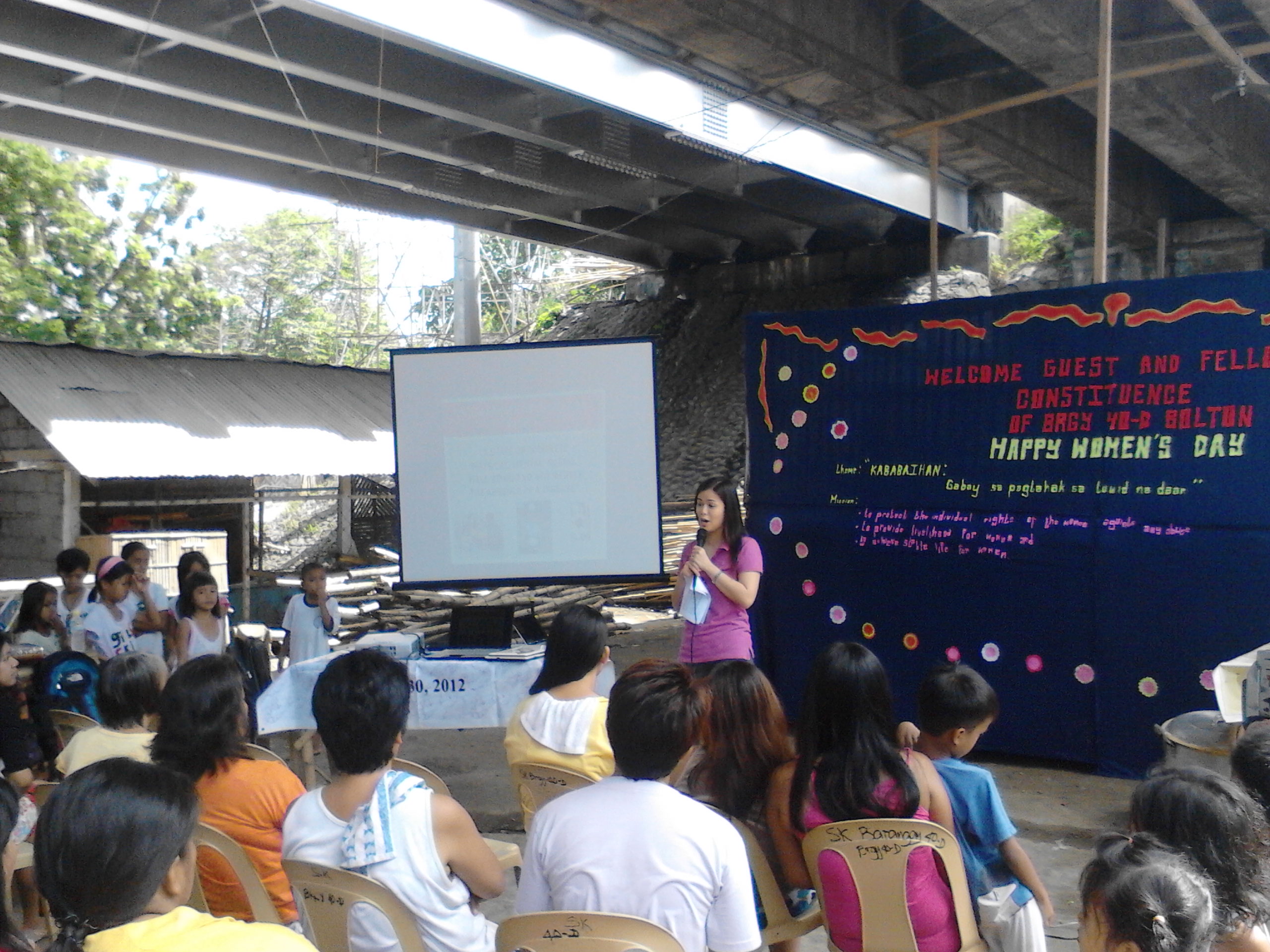 At the forum, Dr. Tessa Mae Bonguyan talked of the basic issues on women's health while Atty. Eliza Lapiña talked especially about R.A. 9262 or the Anti-Violence Against Women and their Children Act (VAWC).
Sunday, March 10, 2013
Due Process in the Garden of Eden
[caption id="attachment_2510" align="aligncenter" width="670"] Expulsion from the Garden of Eden by Giacinto Gimignani[/caption]
Human rights are recognized here and elsewhere in the world. These human rights include the right to life, liberty, and property. In these modern times, there are various safeguards against the arbitrary and whimsical deprivation of these rights.
In our Constitution, for example, Sec. 1, Art. III provides, "No person shall be deprived of life, liberty or property without due process of law, nor shall any person be denied the equal protection of the laws."
Due process of law, in the classic definition by Daniel Webster, is a "law which hears before it condemns, proceeds upon inquiry and renders judgment only after trial."
The religious among us say that the concept of due process dates as far back as to the time of Adam and Eve. In Genesis, we first heard of the story of Adam and Eve.
 Expulsion from the Garden of Eden by Giacinto Gimignani[/caption]
Human rights are recognized here and elsewhere in the world. These human rights include the right to life, liberty, and property. In these modern times, there are various safeguards against the arbitrary and whimsical deprivation of these rights.
In our Constitution, for example, Sec. 1, Art. III provides, "No person shall be deprived of life, liberty or property without due process of law, nor shall any person be denied the equal protection of the laws."
Due process of law, in the classic definition by Daniel Webster, is a "law which hears before it condemns, proceeds upon inquiry and renders judgment only after trial."
The religious among us say that the concept of due process dates as far back as to the time of Adam and Eve. In Genesis, we first heard of the story of Adam and Eve.
Wednesday, February 27, 2013
Broken Promises: Can you sue your fiancé for breach of promise to marry?
[caption id="attachment_2494" align="aligncenter" width="403"] Source: www.diaryofsanjeev.blogspot.com[/caption]
Your boyfriend promises to marry you on different conditions: when he finds a stable job, when he saves enough money for the wedding, when he gets 28, or when he's tired of being single. Whatever it is, you patiently wait for that day to come. Then one day he said he changes his mind. He's marrying you no more.
Can you sue your fiancé for his breach of promise to marry?
Of course, yes.
But another question would be, can you compel your fiancé to pay you for his breach of promise to marry? In legal parlance, is breach of promise to marry an actionable wrong?
 Source: www.diaryofsanjeev.blogspot.com[/caption]
Your boyfriend promises to marry you on different conditions: when he finds a stable job, when he saves enough money for the wedding, when he gets 28, or when he's tired of being single. Whatever it is, you patiently wait for that day to come. Then one day he said he changes his mind. He's marrying you no more.
Can you sue your fiancé for his breach of promise to marry?
Of course, yes.
But another question would be, can you compel your fiancé to pay you for his breach of promise to marry? In legal parlance, is breach of promise to marry an actionable wrong?
Tuesday, February 12, 2013
How I misspelled "case"?
 During our Prelim Exam in Intellectual Property Law, I misspelled a word so simple even a Kindergarten pupil can spell it. A question was asked whether or not Joe Sison, Jr.'s infringement case would prosper.
Then I wrote, "Joe Sison, Jr.'s cas will not prosper."
I admit. I won't even try to rationalize how I did it. It was sheer carelessness that I misspelled the word "case" and instead wrote "cas."
This must be one of the downside of relying too much on Spellchecker in MS Word. I have become so much dependent on it I expect red jagged lines would appear under the word every time I misspell a word.
My consolation was that only one point is deducted from my score.
Thursday, January 3, 2013
5 Law Student Must-Haves
There are people who use a lot of tools to do their work. And there are those who use nothing at all.
As for law students?
Well, there are lots of things a law student brings every day to class. But there are five things that I consider a law student list of must-haves. To be sure, law students could live without these things. But these things are so common a property among law students that they seemed to have become part of what a law student must have:
As for law students?
Well, there are lots of things a law student brings every day to class. But there are five things that I consider a law student list of must-haves. To be sure, law students could live without these things. But these things are so common a property among law students that they seemed to have become part of what a law student must have:
Wednesday, January 2, 2013
Blogging in 2012: A Review
Since I started my law studies in June, 2012, I thought 2012 would mean death for my blog. On the contrary, I became more active in blogging. I found a new source of material from studying law. Thus, most of the posts for 2012 have something to do with the law. How did my blogging activity fare in 2012? Here's a review the guys at Wordpress did:
The WordPress.com stats helper monkeys prepared a 2012 annual report for this blog.

Here's an excerpt:
Click here to see the complete report.
The WordPress.com stats helper monkeys prepared a 2012 annual report for this blog.
Here's an excerpt:
600 people reached the top of Mt. Everest in 2012. This blog got about 7,300 views in 2012. If every person who reached the top of Mt. Everest viewed this blog, it would have taken 12 years to get that many views.
Click here to see the complete report.
Wednesday, December 5, 2012
Victims of Love
To be a lawyer in this country is never easy. It takes eight years of formal study (4 years of Pre-Law & 4 years of Law proper), a year of preparing for the Bar Exam, and an eternity of reading, reading, and reading. It also takes a lot of sacrifices, many are supreme but some are trivial. Thus, being disbarred is perhaps the most painful thing that can ever happen to a lawyer.
That is why, in Buado vs. Layag, the Supreme Court said, "Disbarment is the most severe form of disciplinary sanction. The power to disbar must always be exercised with great caution, for only the most imperative reasons, and in clear cases of misconduct affecting the standing and moral character of the lawyer as an officer of the court and a member of the bar."
Yet in the case of former PBA Commissioner Atty. Noli Eala, that's the price he had to pay for having the right love at the wrong time.
That is why, in Buado vs. Layag, the Supreme Court said, "Disbarment is the most severe form of disciplinary sanction. The power to disbar must always be exercised with great caution, for only the most imperative reasons, and in clear cases of misconduct affecting the standing and moral character of the lawyer as an officer of the court and a member of the bar."
Yet in the case of former PBA Commissioner Atty. Noli Eala, that's the price he had to pay for having the right love at the wrong time.
Sunday, December 2, 2012
Better Handwriting, Better Chances at the Bar Exam
No one can tell for sure because no one stands behind the examiner, looks over his shoulder, and see how he checks the exams. But rumor has it---and in fact it's an oft-repeated warning by law professors---that if an examiner doesn't find your handwriting palpable to read, they'll toss off your exam booklet and give you a failing grade.
"Remember class," law professors would say, "most of the Bar examiners are already old." By old they probably meant grandfather old. They don't have the luxury of time to decipher what you wrote in the booklet. Neither do these examiners possess the Rosetta Stone which could help them understand Hieroglyphics. This belief is not baseless at all. Every year there are at least 5,000 Bar takers. Imagine if one examiner would spend half an hour reading one exam booklet, he won't meet the deadline.
Thus, law professors constantly remind first year law students to improve their handwriting. If not, forget about being a lawyer. Trivial as it may be, one's handwriting could pose a great obstacle to one's ambition.
The story may be apocryphal, but they say that there are those who took the bar twice or thrice before they passed. The defect has nothing to do with their knowledge of the law, but it has everything to do with their handwriting.
What then should the proper handwriting be? Or is there a prescribed or preferred handwriting? Should we write in cursive or in print?
There's I think no proper or prescribed form of handwriting when taking the Bar Exam. All handwriting, however, should have the same characteristic---legibility.
Now this is an example of legibility.
"Remember class," law professors would say, "most of the Bar examiners are already old." By old they probably meant grandfather old. They don't have the luxury of time to decipher what you wrote in the booklet. Neither do these examiners possess the Rosetta Stone which could help them understand Hieroglyphics. This belief is not baseless at all. Every year there are at least 5,000 Bar takers. Imagine if one examiner would spend half an hour reading one exam booklet, he won't meet the deadline.
Thus, law professors constantly remind first year law students to improve their handwriting. If not, forget about being a lawyer. Trivial as it may be, one's handwriting could pose a great obstacle to one's ambition.
The story may be apocryphal, but they say that there are those who took the bar twice or thrice before they passed. The defect has nothing to do with their knowledge of the law, but it has everything to do with their handwriting.
What then should the proper handwriting be? Or is there a prescribed or preferred handwriting? Should we write in cursive or in print?
There's I think no proper or prescribed form of handwriting when taking the Bar Exam. All handwriting, however, should have the same characteristic---legibility.
Now this is an example of legibility.
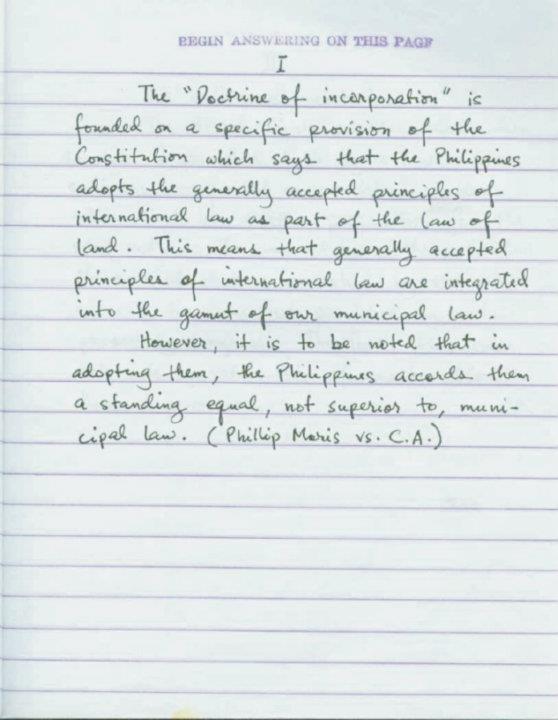
This is the actual Bar exam notebook of Atty. Ralph Sarmiento, Dean of University of St. La Salle, College of Law. He was Top 10 in the 1997 Philippine Bar Exam.
It may not be true that Bar examiners checked exam booklets solely on the taker's handwriting, but it doesn't hurt to improve one's handwriting.
Friday, November 30, 2012
Digest A Case Your Way
There's a marked difference between the law students then and the law students now. Of course, the law students then are probably lawyers now.
What I mean, though, is the way the Internet affects the study of law today. One of the wonders of the Internet is its power to connect people across different time zones and places. For instance, a law student studying in Manila can talk to a law student studying in Davao, thanks to Skype, YM, Facebook, Twitter, etc. A law student can share his digested cases by posting it in his blog or website. And everyone is free to copy it.
When a professor assigns a case or two for the students to read, it's tempting to seek the aid of the Internet. Just type the case title. Then voila! There you have it. Google, or whatever search engine you're using, will provide everything for you----the case digest with a link to the full text of the case.
I've done this many times myself. When I don't have enough time to read the case in its entirety, I read the case digest people in the cyberspace provide. But I find it counterproductive because after reading the case I'm left with more questions than answers. How did the RTC justify its ruling? What was the CA's rationication (I hate this word) in granting or dismissing the appeal? How did the Supreme Court rule on the CA's ruling?
Of course, the exact answers to those questions can only be had if one were to read the entire case. Yes, reading digested cases saves me a lot of time. But it doesn't save me from the grueling question and answer portion law professors like to subject their students.
That is why I think it's better to read the entire case and make your own case digest. Reading a case in its entirety gives you a better grasp of the case. And making your own digest allows you to present the case in a manner that fits your style and frame of mind the most because you made the digest yourself.
What I mean, though, is the way the Internet affects the study of law today. One of the wonders of the Internet is its power to connect people across different time zones and places. For instance, a law student studying in Manila can talk to a law student studying in Davao, thanks to Skype, YM, Facebook, Twitter, etc. A law student can share his digested cases by posting it in his blog or website. And everyone is free to copy it.
When a professor assigns a case or two for the students to read, it's tempting to seek the aid of the Internet. Just type the case title. Then voila! There you have it. Google, or whatever search engine you're using, will provide everything for you----the case digest with a link to the full text of the case.
I've done this many times myself. When I don't have enough time to read the case in its entirety, I read the case digest people in the cyberspace provide. But I find it counterproductive because after reading the case I'm left with more questions than answers. How did the RTC justify its ruling? What was the CA's rationication (I hate this word) in granting or dismissing the appeal? How did the Supreme Court rule on the CA's ruling?
Of course, the exact answers to those questions can only be had if one were to read the entire case. Yes, reading digested cases saves me a lot of time. But it doesn't save me from the grueling question and answer portion law professors like to subject their students.
That is why I think it's better to read the entire case and make your own case digest. Reading a case in its entirety gives you a better grasp of the case. And making your own digest allows you to present the case in a manner that fits your style and frame of mind the most because you made the digest yourself.
Thursday, November 22, 2012
Sakses!
[caption id="attachment_2366" align="aligncenter" width="510"] The book is published by Central Bookstore.[/caption]
A law student's life is filled with drudgery. But, as Blas Ople said, "Every one of us has his proud moments that seem to recapitulate all past struggles---that lift us from our plain and humdrum lives to an exalted state."
I just recently have one such moment. In August this year, the Philippine Association of Law Schools (PALS) organized a nationwide essay writing contest for law students.
Out of the participants from Luzon, Visayas, and Mindanao, ten finalists would be chosen. Of the ten, three would be declared winners.
Why I said I recently have my proud moment? Lest you be misled, I didn't win. Here are the winners:
I'm proud that two of the winners come from Mindanao. I think they all deserve to win, for how can a lowly man like me beat a mathematician/physicist, a Roman Emperor, and an angel?
Seriously, though, I'm proud because PALS has this little book called "In The Eyes of Law Students: The Secret Formula of Teaching Law," which contains, among others, the essays of the winners and ten other finalists.
What of it?
Nothing, except that I'm one of the finalists and my essay is in the book. If you're someone who has a literary pretensions, seeing your work published is like releasing the feces that have been inside your stomach for quite a while.
No wonder, people say "Sakses!" after defecating.
 The book is published by Central Bookstore.[/caption]
A law student's life is filled with drudgery. But, as Blas Ople said, "Every one of us has his proud moments that seem to recapitulate all past struggles---that lift us from our plain and humdrum lives to an exalted state."
I just recently have one such moment. In August this year, the Philippine Association of Law Schools (PALS) organized a nationwide essay writing contest for law students.
Out of the participants from Luzon, Visayas, and Mindanao, ten finalists would be chosen. Of the ten, three would be declared winners.
Why I said I recently have my proud moment? Lest you be misled, I didn't win. Here are the winners:
- 1st Place: Archimedes D. Suganob of St. Mary's College of Law, Tagum City.
- 2nd Place: Julius Caesar Domingo of St. Mary's University, Bayombong Nueva Vizcaya.
- 3rd Place: Euangeli P. Doromal of Cor Jesu College, Digos City.
I'm proud that two of the winners come from Mindanao. I think they all deserve to win, for how can a lowly man like me beat a mathematician/physicist, a Roman Emperor, and an angel?
Seriously, though, I'm proud because PALS has this little book called "In The Eyes of Law Students: The Secret Formula of Teaching Law," which contains, among others, the essays of the winners and ten other finalists.
What of it?
Nothing, except that I'm one of the finalists and my essay is in the book. If you're someone who has a literary pretensions, seeing your work published is like releasing the feces that have been inside your stomach for quite a while.
No wonder, people say "Sakses!" after defecating.
Subscribe to:
Posts (Atom)