Showing posts with label law school. Show all posts

Tuesday, April 15, 2014

What law students may do this summer?


Law students—the really serious ones—are such a stressed lot. They study hard. They lack sleep. They are poked and pressured everywhere by everyone: professors surprise them by giving surprise recitations; friends keep on inviting them for a drinking spree; bosses keep on asking for that assignment way before the deadline.

But summer is here. It’s time to drop that thick, hard-bound, incomprehensible law book. And if you’re a law student, you may want to do these things this summer:

1. CATCH UP SOME SLEEP. Scientists say that an adult brain needs at least six hours of sleep. But you only get to sleep for an average of four to five hours a day. It’s ironic because your brain is supposed to function well all the time, and yet the lack of sleep precisely disables your brain from functioning well. If you have nothing else to do this summer, you might as well get a six or eight hours of sleep.

2. JOIN AN INTERNSHIP PROGRAM. Supplement your classroom experiences with real-world experiences by joining an internship program. Some organizations enlist law students as interns in which they are given tasks where their legal education is of great help. Last year, the Alternative Law Groups conducted a month-long internship program. This year, the Asia Foundation is inviting law students to participate in its Hustisyeah! Program, a case decongestion initiative whose aim is to, well, decongest the congested court dockets.

3. ENROLL IN A COURSE NOT RELATED TO LAW. They say working on something you’re not familiar with enhances your creativity. I don’t know how that works. But if there’s no harm in trying, why not enroll in, say, a two-month culinary course?

4. READ YOUR UNREAD CLASS MATERIALS. I know, you’re supposed to enjoy your summer time. So how can you enjoy if you read your class materials? You cannot. But if you derive joy from learning, you actually can. And summer is the best time to catch up on your readings because there’s no pressure. When you read either the textbook or the cases minus the pressure, haven’t you noticed that you retain more information; you learn better?

5. TAKE SUMMER CLASSES. But if you don’t want to break your momentum, enroll in a subject or two. It’s true that a long summer break can make the students sink into sloth. So by the time they go back to school, they need to find again their rhythm, which takes some time. And for busy law students, they cannot afford to waste their time finding their rhythm.

These are just suggestions. Hence, the use of the word “may.” In Statutory Construction, the use of the word “may” denotes discretion, and cannot be construed as having mandatory effect. If you have a better idea, go for it. Share it with others.

Friday, April 5, 2013

The Secret to Passing the CEM-LSQT: Prepare Like Pacquiao The Boxer

LSQT
It's the time of the year when fresh college graduates are mulling over whether to take that law school entrance exam. Obviously for anyone who wants to be a lawyer, it's the first exam that one needs to hurdle.

I'm not familiar with other law schools' entrance exam, but here in Davao City, the University of Mindanao-College of Law and ADDU-College of Law both require prospective law students to pass the LSQT (Law School Qualifying Test) provided by CEM (Center for Educational Measurement).

Having taken the test myself and passed it, I know how it feels when your family is constantly egging you on to take the test, and the pressure is building up as the entrance exam date is getting nearer.

Relax! Just prepare. Only if you prepare, and prepare like Pacquiao The Boxer, you can pass the test. The old Manny Pacquiao used to prepare way ahead of his fight. He used to spend long hours of grueling drills and exercises. Here are five steps you might want to take:

1. Research on the nature of exam.

What sort of questions are asked in the exam? How long is the exam?  How is the exam scored? What score should I get to pass the exam?

You must be familiar with the nature of the exam before taking it. Think of how Pacquiao studies his opponent before going up on the boxing ring. Prepare like Pacquiao the boxer.

According to CEM,  the "LSQT, a 240-item test administered for 2 hours and 50 minutes...consists of sub-tests in Verbal Reasoning, Critical Thinking, Quantitative Ability, and Figural Reasoning. It also features an Essay Test designed to assess an applicant's ability to present ideas in written form. Intended users are graduates or graduating students of degree programs.

For additional information on CEM-LSQT, read this LSQT Guide.

2. Determine your strong and weak points.

Remember that the LSQT has four sub-tests:

a. Verbal Reasoning (Don't be bogged down by the jargon, language lang ito.)

b. Critical Thinking (Logic)

c. Quantitative Ability (Math)

d. Figural Reasoning (Abstract)

Of the four, ask yourself where are you good at, and where are you weak at.

3. Make your strong points stronger, but focus most on your weak points.

Give more time to that which you're not good at. But never disregard the others, lest what is formerly your strong point becomes your weak point now.

For instance, I'm not good at Math. So what I did was I asked my Math major friends to tutor me. Talk about tapping human resources.

4. Test yourself.

There is this thing people are addicted to. It's called the Internet. And in the Internet, there are lots of practice tests for each sub-tests of the LSQT. Almost all of them can be had for free.

5. Show up!

Of course, all these things don't mean anything if, because you're crippled by your fear of failing the test, you don't show up. In the first place, how would you know you fail or pass if you haven't taken the test. Take the test by all means.

If, after all, you fail, no big deal. It's better to be an LSQT flunker than a Bar flunker.

Wednesday, April 3, 2013

What pre-Law course is best to take?

By now those students who will go to college must have already decided what course to take. I've been asking my students about their plans. As with the many Pinoys who answer a question with another question, a few of them ask me back so that the interviewer became the interviewee now.

"What's a good pre-Law course to take, Sir?"

Well, that question could be answered on two different levels.

First, law schools don't prescribe a particular pre-Law course. Whatever course will do, provided your pre-Law course complied with the required number of units in Math, English, and Social Science. But that depends on the university. For example, in the University of Mindanao College of Law, the requirements are: 6 units in Math, 12 units in English, and 9 units in Social Science (History, Psychology, or Sociology).

Second, if by a good pre-Law course means that what course will better prepare your for law school, the answer is there is none.

True some may say it should be AB English or Communication Arts since in law school what matters is not what answers you give, but how to give what you give. Other may say it should be Philosophy, for it trains you to be a critical thinker.

I think it depends on what kind of lawyer you want to be. I have Law professors whose pre-Law courses were varied. My teacher in Constitutional Law 2 took up an Engineering course. My Statutory Construction teacher used to be a MedTech before he took up law. My Persons and Family Relations teacher is a CPA and an MBA holder, then she proceeded to Law.

The field of law is vast. What matters is you have to think first what kind of lawyer you want to be. Then you can fairly determine what pre-Law course to take.

Thus, if you want to be a Commercial Lawyer, a background in Business Administration, Accounting, or Management might come in handy. If you want to enter the government service, a Political Science or a Public Administration course might be useful. Those who relish a courtroom drama and all that verbal brawl might take up AB English or Philosophy.

Tuesday, February 12, 2013

How I misspelled "case"?

IMG_20130213_071750During our Prelim Exam in Intellectual Property Law, I misspelled a word so simple even a Kindergarten pupil can spell it. A question was asked whether or not Joe Sison, Jr.'s infringement case would prosper.

Then I wrote, "Joe Sison, Jr.'s cas will not prosper."

I admit. I won't even try to rationalize how I did it. It was sheer carelessness that I misspelled the word "case" and instead wrote "cas."

This must be one of the downside of relying too much on Spellchecker in MS Word. I have become so much dependent on it I expect red jagged lines would appear under the word every time I misspell a word.

My consolation was that only one point is deducted from my score.

Sunday, December 2, 2012

Better Handwriting, Better Chances at the Bar Exam

No one can tell for sure because no one stands behind the examiner, looks over his shoulder, and see how he checks the exams. But rumor has it---and in fact it's an oft-repeated warning by law professors---that if an examiner doesn't find your handwriting palpable to read, they'll toss off your exam booklet and give you a failing grade.

"Remember class," law professors would say, "most of the Bar examiners are already old." By old they probably meant grandfather old. They don't have the luxury of time to decipher what you wrote in the booklet. Neither do these examiners possess the Rosetta Stone which could help them understand Hieroglyphics. This belief is not baseless at all. Every year there are at least 5,000 Bar takers. Imagine if one examiner would spend half an hour reading one exam booklet, he won't meet the deadline.

Thus, law professors constantly remind first year law students to improve their handwriting. If not, forget about being a lawyer. Trivial as it may be, one's handwriting could pose a great obstacle to one's ambition.

The story may be apocryphal, but they say that there are those who took the bar twice or thrice before they passed. The defect has nothing to do with their knowledge of the law, but it has everything to do with their handwriting.

What then should the proper handwriting be? Or is there a prescribed or preferred handwriting? Should we write in cursive or in print?

There's I think no proper or prescribed form of handwriting when taking the Bar Exam. All handwriting, however, should have the same characteristic---legibility.

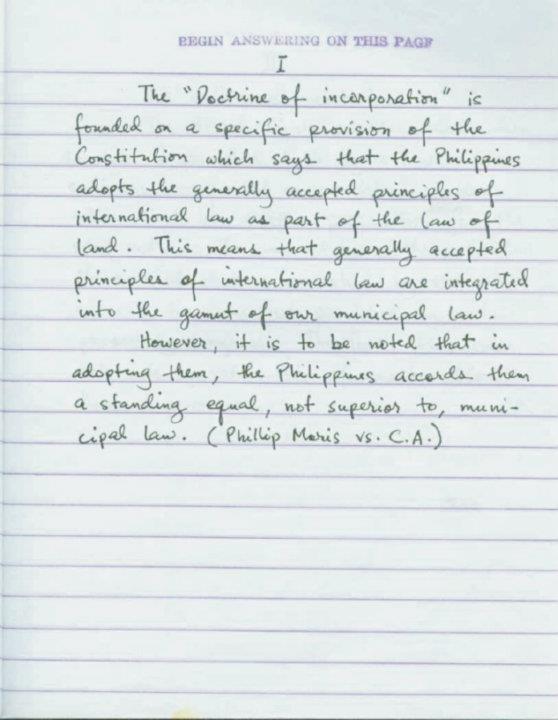
Now this is an example of legibility.

5


This is the actual Bar exam notebook of Atty. Ralph Sarmiento, Dean of University of St. La Salle, College of Law. He was Top 10 in the 1997 Philippine Bar Exam.


It may not be true that Bar examiners checked exam booklets solely on the taker's handwriting, but it doesn't hurt to improve one's handwriting.

Friday, November 30, 2012

Digest A Case Your Way

There's a marked difference between the law students then and the law students now. Of course, the law students then are probably lawyers now.

What I mean, though, is the way the Internet affects the study of law today. One of the wonders of the Internet is its power to connect people across different time zones and places. For instance, a law student studying in Manila can talk to a law student studying in Davao, thanks to Skype, YM, Facebook, Twitter, etc. A law student can share his digested cases by posting it in his blog or website. And everyone is free to copy it.

When a professor assigns a case or two for the students to read, it's tempting to seek the aid of the Internet. Just type the case title. Then voila! There you have it. Google, or whatever search engine you're using, will provide everything for you----the case digest with a link to the full text of the case.

I've done this many times myself. When I don't have enough time to read the case in its entirety, I read the case digest people in the cyberspace provide. But I find it counterproductive because after reading the case I'm left with more questions than answers. How did the RTC justify its ruling? What was the CA's rationication (I hate this word) in granting or dismissing the appeal? How did the Supreme Court rule on the CA's ruling?

Of course, the exact answers to those questions can only be had if one were to read the entire case. Yes, reading digested cases saves me a lot of time. But it doesn't save me from the grueling question and answer portion law professors like to subject their students.

That is why I think it's better to read the entire case and make your own case digest. Reading a case in its entirety gives you a better grasp of the case. And making your own digest allows you to present the case in a manner that fits your style and frame of mind the most because you made the digest yourself.

Tuesday, November 27, 2012

Strive for Simplicity, Not Legal Pugnacity

Justices, judges, lawyers, and law students are a brilliant lot. Too often, however, their brilliance is lost when they start writing down their ideas. The case of Leonor vs. CA  drives home this point.

The decision of the Trial Court regarding the merits of the case is as repugnant as the manner by which the decision was written. This is the first paragraph of the judge's decision, quoted in Footnote 13:
This is an action for “Cancellation of Entry in the Civil Registry” particularly on the marriage contract of one Mauricio Leonor, Jr. and Virginia Amor supposedly to have taken place in a long distance past on March 13, 1960 and after a Rip Van Winkle sleep and dormancy liken to a Mt. Pinatubo explosion that rocked the peace and quiet in the lives of the supposedly participants to this drama in Calatrava and San Carlos City, Negros Occidental when out of the blue one party in the person of an aggrieved left-behind spouse revived and revealed an ancient piece of marital bond between her and a reluctant spouse.

What's wrong with the paragraph? Everything, except perhaps for the spelling.

No less than the Supreme Court, through Justice Panganiban, called the language of the decision "convoluted," "painfully a sophomoric and pathetic portrayal" of Virginia, the petitioner in this case.

Further, the Court tersely remarked, "The said decision’s crude attempt at literary sophistication is matched only by its jarring syntax and grammatical incongruencies."

In his essay "On Developing My Decision-Writing Style," former Chief Justice Artemio Panganiban, this time not writing for the Court, shared the motive behind every decision he wrote.

"Even though my decisions are written primarily to resolve legal issues and are thus emblazoned with a considerable amount of legalese," he said, "I have endeavored to write in simple English, comprehensible as much as possible to a high school graduate.  I want to be understood not only by the legal profession but also by the parties themselves, especially by persons accused of crimes, and by the public at large as regards cases involving interpretation of the Constitution."

"More than lingual elegance and even legal pugnacity," he further said, "I strive for simplicity, clarity and precision in nuances and shades of meanings.  I believe the trend in all professions and occupations -- be they medicine, theology, science or music -- is to be understood not just by the members of that particular discipline but by the public at large."

Thus, lawyers and law students alike should strive for the same simplicity, clarity, and precision. After all, writing aims to reveal rather than conceal.

Thursday, November 22, 2012

Sakses!

[caption id="attachment_2366" align="aligncenter" width="510"] The book is published by Central Bookstore.[/caption]

A law student's life is filled with drudgery. But, as Blas Ople said, "Every one of us has his proud moments that seem to recapitulate all past struggles---that lift us from our plain and humdrum lives to an exalted state."

I just recently have one such moment. In August this year, the Philippine Association of Law Schools (PALS) organized a nationwide essay writing contest for law students.

Out of the participants from Luzon, Visayas, and Mindanao, ten finalists would be chosen. Of the ten, three would be declared winners.

Why I said I recently have my proud moment? Lest you be misled, I didn't win. Here are the winners:

  • 1st Place: Archimedes D. Suganob of St. Mary's College of Law, Tagum City.

  • 2nd Place: Julius Caesar Domingo of St. Mary's University, Bayombong Nueva Vizcaya.

  • 3rd Place: Euangeli P. Doromal of Cor Jesu College, Digos City.


I'm proud that two of the winners come from Mindanao. I think they all deserve to win, for how can a lowly man like me beat a mathematician/physicist, a Roman Emperor, and an angel?

Seriously, though, I'm proud because PALS has this little book called "In The Eyes of Law Students: The Secret Formula of Teaching Law," which contains, among others, the essays of the winners and ten other finalists.

What of it?

Nothing, except that I'm one of the finalists and my essay is in the book. If you're someone who has a literary pretensions, seeing your work published  is like releasing the feces that have been inside your stomach for quite a while.

No wonder, people say "Sakses!" after defecating.

Saturday, November 3, 2012

1st Sem of Law School, kumusta?

I passed my Persons. I got 2.8 (82). I'm proud of it. I thought I'm going to get a 75 or below. My only concern now is Consti Law and Crim Law. The grades are not yet in.

Now that the semester is over, and another semester is about to begin, maybe I should share, albeit very briefly, what I've been through for the past five months by answering the most frequently asked questions people asked me about studying law.

1. Is law like any other course?

No, it's not. The study of law is like a jealous mistress. It demands so much from you---time, energy, resources---that you wouldn't even notice that you're giving more than what you have. Of course, that's what our professors told us in the beginning. But I must say, it depends on how you take it. If you take it too seriously and impose unnecessary pressures, then you will most likely be unnecessarily pressured. The opposite is just as fatal. If you take it too lightly and do not discipline yourself, then you will most likely fail.

The most important thing is to strike a balance among your many-faceted life. Study hard. Party harder. Go out if you can. Watch a movie. Hangout with your friends. Talk to people. Read newspapers, not just some antiquated cases dating back to the time when our country is still called the Government of the Philippine Islands.

2. Do you memorize all those laws, articles and Republic Acts?

You can if you want. But so far no professor of mine has yet required us to memorize all the laws we discussed. Why? Because that's plainly impossible. And don't tell me about Mike Ross of Suits----he's a figment of someone else's imagination. But there are times when our professor would let us memorize VIP (Very Important Provisions) of the law.

3. Did you join a fraternity?

No, I didn't, and neither did most of my classmates. And we see no reason to change our decision. And the frat is no guarantee that you would pass all your subjects although they say that the frat's a big help. Your "Ka Brod" would provide the materials your subjects required, saving you a lot of time. Still, nothing beats studying, for what good are the materials your frat provides if you don't bother studying them.

4. Is it true that it's a plus if you have a good penmanship?

I think so. The professors are full-time practicing lawyers themselves. They don't have the luxury of time to decipher every student's handwriting, for it's a double burden----first, the prof needs to decipher your handwriting; and second, the prof needs to understand the meaning of what you've written. Yet make no mistake---it's still substance over form. Many of my classmates have some damn good answers but still scored low. And I submit it's because they have a penmanship that looks like a scribbling of a toddler. The good news is that it can still be remedied. How? There's no easy formula for this. My classmates does so by making notes using cursive.

5. How do you manage it?

Studying law while working full-time is really hard, especially during the first few months. I was so stressed out I thought of quitting. But I figured I was so hard on myself. As the months went by, though, I was able to find my learning style and establish my rhythm. Here's my daily routine.

7:30-4:30 - Work, but I sometimes study in-between my classes.

5:30-8:30 - Attend classes.

10:30 -11:30 - Study for the next day's class. I normally don't stay so late at night. If I go beyond 11 or 11:30, my brain absorbs nothing, and it's just a waste of time for time to be awake. So I sleep, and the next day my brain is again ready to work.

Thus far, that's 1st sem. And I'm pretty sure the 2nd sem will be twice difficult. Oblicon is every day. God bless us all.

Wednesday, August 29, 2012

No courtroom drama

According to my professor in Stat Con, there are lawyers who have never really gone inside the courtroom, either to argue for the defense or the prosecution. That is why he required us to attend one court session, and see for ourselves what goes on inside the courtroom. Lucky for us because Judge Pelagio Paguican of RTC  Branch 12 is the first cousin of our classmate. So we were accommodated easily.

Yesterday was our scheduled courtroom visit. There are nine cases slated for the morning session. All are criminal cases. Some are for trial. Others are for arraignment.

When I knew that the cases we were about to witness were for trial, I for one expected to witness a cross-examination of witnesses because it is sometimes the most combative part of the trial process, and it's the part that is often portrayed in films and Pinoy Soap Opera. It's when we often hear the counsels' "Objection Your Honor!"

But I was not able to witness what I expected. Most of the cases up for trial were rescheduled because either the complainant or the witnesses did not show up. There was no courtroom drama.

Nevertheless I'm happy with the outcome of our visit because, at the very least, I understand now why P-noy want to appoint someone who can institute real reforms in the judiciary. Just look around the Benigno S. Aquino Jr. Hall of Justice and notice the facilities and equipment there.

Whether the new Chief Justice is up for the challenge I don't know.

Thursday, July 12, 2012

One month in the College of Law

Exactly a month has gone by since I started my law studies. Many things can be said of law school. Only two points will I make:

1. Raw intellect is not enough

It pays, of course, to have a high level of intelligence and common sense in law school. Professors assign so much reading assignment. Usually these materials include statutes, EOs, memoranda, and Presidential Decrees. And the standard fare in law school---kilometric Supreme Court decisions that are most often than not written in a circumlocutory manner.

Intelligence is therefore needed in reading and understanding those materials. But reading and understanding those materials is one thing. Securing copies and finding time to actually read them is another.

In this case, intelligence can be of little help. Diskarte can be of great help. For example, Supreme Court cases are found either in the internet, in the voluminous Supreme Court Reports Annotated (SCRA). If you are a working student like me, how on earth will you find time in looking for the cases assigned and read them afterwards?

Which leads me to point number two.

2. Selfishness has no place

I find that making friends---especially full-time students---who can share materials with you is key. It must be noted, though, that a mutualistic relationship must be cultivated, not a parasitic one. One must also be ready to share what one has. Otherwise, your friends will soon realize that you're just using them.

And it might spell the end of one's career, even before one has not made such.


Friday, April 23, 2010

Project Law School: Why take up law?

I was twice asked why I want to take up law? My aunt asked me the first time. When she asked me that, I stared at her. Just stared. Then nodded. Then said, "I don't know."

"You have to have a reason," she said. Yes, I have to have a reason. But does everything we do need to have a reason? Can we not do it without being asked why we do it?

The second time I was asked was when I applied for a teaching position in one of the Catholic schools in Davao. (Clue: It's located on Obrero St.). The principal asked me "What would you with the salary?"

Simple. I said, "The salary I will use to support my law studies."

"So you're planning to take up law?" the principal asked. "Yes, ma'am," I said.

"Why do you want to be a lawyer?" Unlike my aunt's question, I thought I was obligated to answer this one. So I said, "I want to be a lawyer because I want to advance good causes. And I believe that the law is a powerful tool by which I can advance good causes. Aside, of course, from teaching."

Anyone who enters law school, I guess, enters with a certain degree of idealism. I am no exemption. I didn't lie to the principal when I said that I want to be a lawyer because I want to advance good causes.

But whether I will be financially rewarded while advancing good causes is another matter.

Friday, March 19, 2010

Project Law School (PLS), launched

I'm going to embark on a new project. I will call it Project Law School or PLS for short.

PLS will basically chronicle my adventures and misadventures as I take up law. In this project, I will write as much as possible about my life in law school (before, during, and maybe after if I'm still alive by that time).

I have actually started writing about law school. Here when I was still mulling over whether to take up law. Here when I was really having trouble deciding what to do after graduation. And here when I found out the result of the Law School Qualifying Test.

But it was only after watching Julie & Julia---in which Julie Powell put up a blog and documented her progress while cooking all the recipes in Julia Child's book, Mastering the Art of French Cooking---that I thought of giving this endeavor a name.

Join me now in this latest project of mine. I don't know how will this end. Nor do I know when will this end. But one thing I know, I will finish what I started.

I will be a lawyer. Soon.

Monday, October 12, 2009

Which is which

CrossroadsI am no poet. But I don’t hate poetry at all. Though I shun the way poets obscure their message, I still like the way they weave the words to produce so beautiful a sound like only a poem can.

I’m just a tepid fan of poetry. That perhaps explains my short list of favorite poems. One such favorite of mine is “The Road Not Taken” by Robert Frost—partly because it’s easy to read and decipher its meaning, but mainly because it resonates with me:

Thursday, September 24, 2009

Me, going to law school?

I don't know why, but law school always fascinates me.


That 's why I read Erich Segal's novel The Class, a story of Harvard men, some of whom went to Harvard Law School.


That's why I watched from the beginning till the end the Koreanovela Love Story in Harvard. Ostensibly set in Harvard but was actually set in University of Southern California and University of California, Los Angeles, Love Story in Harvard is a story between a Harvard Law School student and a Harvard Medical School student.


That's why I like John Grisham's books. That's why I want to watch The Paper Chase.


That's why I read Erich Segal's novel Love Story, a story also set in Harvard and whose protagonist is also a Harvard Law School student.


That's why I bought a VCD of Love Story, the film adaptation of Segal's novel.


At some point in my life, I dreamed of becoming a lawyer. I didn't seriously think, though, about the matter. But my father said something that prompted me to give it a serious thought.


The night before last night, he told me that my uncle asked if I am willing to go to Law School because he's willing to support me.


Tell him yes, I told my father.


I know being a law student is no picnic, or walk in the park if you want. As one blogger, who had gone to law school himself, put it, "law school isn’t easy. It’s a lot of hard work and pain. A lot of sleepless nights and mental anguish. Law school is unlike anything you have ever experienced, unlike anything you could even imagine. Law school requires you to dedicate everything you have to it: your mind, your body and even your soul."


There are some questions, the same blogger said, that one should consider before going to law school:


Do you really want to be a lawyer?


Honestly, I want to be a teacher, but only because I know my parents can't afford to send me to law school.


Can you handle pressure?


I have fared in college, I think I can do the same in law school.


Can you study every day for four years (five if you count the bar)?


I think I can if my mother will exempt me from all the household chores.


Can you handle not having lots of free time (for anything)?


Today, I'm not having lots of free time because I'm a working student---and, thank God, I haven't become anti-social. I think I can do the same feat in law school?


Can you afford law school?


My uncle says he can.