Showing posts with label Katikaran sa Dabaw. Show all posts

Sunday, March 31, 2013

Via Dolorosa, Davaoeño Style

[caption id="attachment_2559" align="aligncenter" width="468"]Photo by Janice Sabnal Photo by Janice Sabnal[/caption]

The Via Dolorosa or Stations of the Cross—the way of the suffering—recalled the fourteen events before Jesus Christ was crucified. Catholics all over the world continue until today to commemorate it. They follow the way Jesus took, if not in the actual road, at least in their own enclaves.

No country celebrates the Holy Week, particularly the Via Dolorosa which falls on Good Friday, with much fanfare, festivity, exuberance, pomp, and energy than the Philippines. Each city or province has its own way of commemorating it, and each seems unabashed in declaring that under its aegis the faith lives on, even if what's on display is far from what the occasion truly means, and its religious significance is lost on the religious themselves.

Sunday, February 3, 2013

Help Mindanao, US Embassy official urged law students

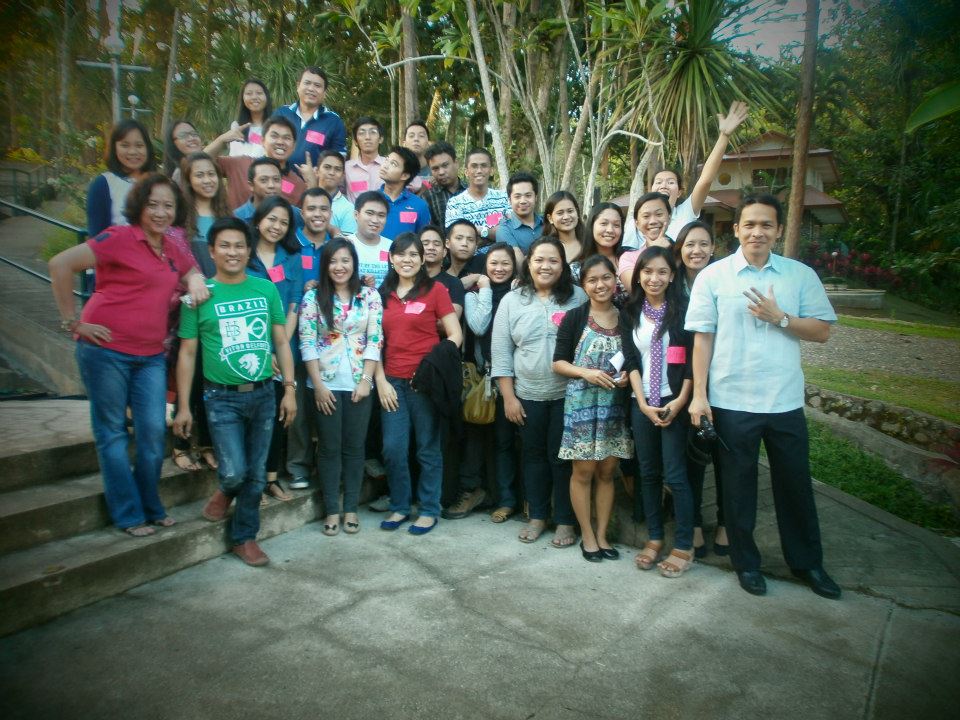
[caption id="attachment_2469" align="alignleft" width="240"]483714_2776201700910_2049610267_n Officials from the US Embassy, US DOJ-OPDAT, UM, and MYVC join the delegates from UM College of Law and ADDU College of Law.[/caption]

"Stop kidding around," intoned Atty. Neil Y. Pacamalan, Cultural Affairs Specialist for Mindanao, Public Affairs Section, of U.S. Embassy. "This is not for the US Embassy, but for Mindanawons."

Atty. Pacamalan was referring to the two-day Basic Orientation Seminar (BOS) on Legal Aid, which was organized by the U.S. Embassy, Manila and the Mindanao Youth Volunteer Corps. The BOS is attended by 31 law students, 21 of which come from University of Mindanao, and 10 are from Ateneo de Davao University.

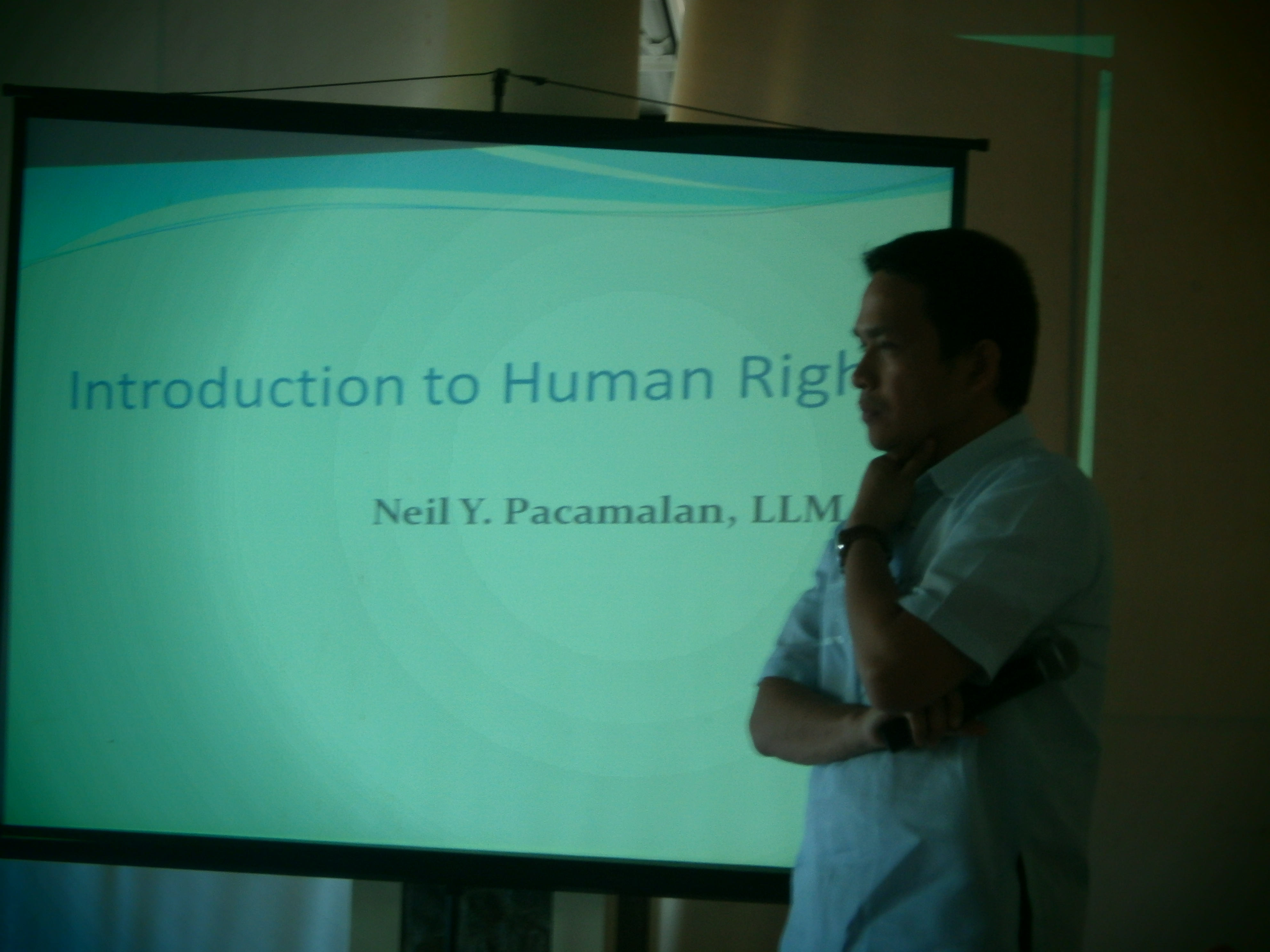
[caption id="attachment_2472" align="alignright" width="240"]Atty. Neil Pacamalan, Cultural Affairs Specialist for Mindanao, Public Affairs Section, US Embassy, Manila. Atty. Neil Pacamalan, Cultural Affairs Specialist for Mindanao, Public Affairs Section, US Embassy, Manila.[/caption]

According to Atty. Pacamalan, who gave an introduction on what the purpose of the BOS is, Mindanao has a lot of problems, legal problems at that. Law students, he said, should lend their knowledge of the law to address these problems.

Acknowledging the heavy workload of a law student, Atty. Pacamalan nevertheless encouraged the students to get involved, and disabuse themselves from worrying over their petty problems.

"If you continue to stick to your selfishness," he said, "if you always think that you have no time to help others because you have to study first, then nothing will happen to Mindanao."

One way of helping the community in which law students are a part of, he said, is through establishing a Legal Aid Office, which is primarily run by law students, and working on it seriously.

"Tell us if you need our help," he said. "We will help you. But if you don't, we are not forcing you. But we are knocking on your door. Help Mindanao."

Sunday, April 1, 2012

Onyot's Trip: Walang basagan ng trip!

[caption id="attachment_2201" align="aligncenter" width="394" caption="Taken during our trip to Seagull Mountain Resort (Seagull 3), located on the outskirts of Bukidnon and Davao City (BuDa)."][/caption]

I have many nicknames. But it's "Onyot" that survived the test of time. I don't mind if you call me Onyot. I have become used to it anyway. In fact, now I like it when you call me Onyot. It's as if you and I have known each other for so long a time.

So I'm Onyot, and ito ang trip ko.

Trip, in English, denotes a "voyage," a "journey." But from the dingy and squalid kanto and looban of Philippine slums to the posh and bongga subdivisions, the word "trip" takes on a different meaning.

It refers to the things you do to break your humdrum routine, to express your in-ordinariness in this ordinary world, to wean yourself from a stressful work, or to try things for the sake of trying them.

Someone's trip might be food, manicure, or, uh, saving Mother Earth.

But sometimes if you do something as outrageous and bizarre as the acts of Jesse Caigoy,"Master of Pain," something as outlandish as having a Winnie The Pooh tattoo on your back, something as banal as planking, people would ask you this standard question, "Anong trip mo?"

"Wala lang!," or "Walang basagan ng trip!" is, of course, the standard retort.

When I started teaching, in 2010, I thought my teaching experience would be a fodder for my blog. I thought the bouts with students in particular and school life in general would be a well from which I can draw inspiration to blog. But no, I was caught in the thick of making lesson plans, preparing slide presentations for class, making test papers, checking test papers, recording and computing grades, reading essays, accompanying students to contests and conferences, meeting with parents, and complying with a host of other paper-works.

As a result, blogging became less frequent. Blog posts were sparse, mostly limited to announcements, slide shows for students to download, and a few lousy write-ups---lame attempts at reminding people who stumble upon this blog that its owner still exists. Soon, all I wanted was not to blog more often, but to have a goodnight's sleep.

Nevertheless, I continue to write. Sometimes, if I have time I write about teaching. I never write about sleeping. Most often I write about my activities in between---mga bagay na trip kong gawin.

That explains why I found the name of this blog---Onyot's TRIP---most fitting because this blog has been, is, and will always be about my trip: trip as a journey and voyage, and trip as wala lang, I just feel like doing it.

So welcome to Onyot's TRIP. And please walang basagan ng trip!

Friday, March 9, 2012

Posting via mobile phone

This is my first time to use my mobile phone to blog. I don't know if this will work. If you'll be able to read this, then it works. If not, then it doesn't.

Wednesday, March 7, 2012

Davao belongs to us all

A city is like a coin. It has two faces: one shows the head; the other, the tail. The head is what the tourists like. It's number one in their itinerary. The tail they hardly visit. Or if they happen to visit it at all, perhaps it's  by accident. Maybe they got lost. Maybe it's a necessary passage, an unavoidable route that they have to take, to get to their actual destination. Either way, it's out of the plan. Tourists, foreigners and Filipinos alike, hardly visit a city to see both faces, unless he happens to be a UN Special Rapporteur mandated to gaze at both head and tail.

Davao City is no different. It has two faces. One is beautiful; the other, ugly. One is serene; the other, noisy. One is hospitable; the other, hostile.

Ask any tourist what they like about Davao, and you get a plethora of answers: Durian and all its by-products (Durian jam, Durian cake, Durian pie, Durian cappuccino, Durian candy, etc.), Mt. Apo, Philippine Eagle, Kadayawan, Crocodile Park, People's Park, the Dutertes, the Central 911, the stability and order, the cleanliness, and the relative peace and quiet of the city.

Then ask the same tourist if they know, drop by, or ever heard of Tionko Avenue where, if night falls, prostitutes trooped and congregate; or Piapi Blvd., Barrio Patay (BarPa for short), and S.I.R. Matina---few places in Davao notorious as a safe haven of petty thieves, drug-users and pushers, and other outlaws---ask that tourist, and you get a point-blank "No."

For tourists they have a choice to visit or not to visit those places. For a Davaoeño like me, who has lived here for 23 years now, it seems that I don't have any choice. I have to live with what Davao has got to offer me whether I like it or not. I have to accept that Davao will always have two faces no matter how I try to make a facelift on it.

But, in fact, I do have a choice. I can, for instance, choose to live in Cebu that is beginning to look like Makati, what with its skyscrapers sprouting like mushrooms here and there. I can choose to live in Ilo-Ilo City where the suffocating and congested city streets and sidewalks are absent.

Yet I choose to live here, although leaving Davao is not an utter impossibility. Some people I know have made that choice, too.

Most of my colleagues in Stella Maris Academy of Davao, where I teach for almost two years now, are not born and raised in Davao City. My two High School Librarian friends are both from Digos, but have been in Davao for more than a decade, though they still go to Digos every now and then. Two of my male colleagues are from Sto. Tomas, Davao del Norte. My co-Social Studies teacher and classmate in college is from Mati. Our principal is from Sta. Cruz, Laguna. One Filipino teacher is from Zamboanga del Norte. One Physics teacher is from Pantukan. I also have co-teachers from mainland China. My girlfriend, who teaches MAPEH in the same school, is from Kapalong.

Though we came from different parts of the country, born and raised under different circumstances and stations in life, what binds us is that we've all found a home here in Davao.

I haven't gone to too many places outside Davao City. The farthest that I've ever been to are Ilo-Ilo and Cebu. And on the two occasions that I was there, I could say that Davao City offers the same wares and wonders, goods and getaways, and scenic spots and services, which those places offer.

But I think what separates Davao City is that it belongs to us all. It belongs as much to me as it belongs to my colleagues from Digos, Sto. Tomas, Pantukan, Mati, Kapalong, Zamboanga, Laguna, and China.

Davao belongs as much to Dawn Zulueta (who lives, by the way, in one of the high-end subdivisions somewhere in Buhangin) as it belongs to the Maranao vendors at San Pedro Street, to the Koreans of DCLA at Uyanguren, to the Filipino-Chinese traders at Monteverde Street, and to the Bajaos on Davao's busy streets.

Davao belongs as much to the Dutertes, Nograleses, Bonguyans, Villa-Abrilles, as it belongs to our favorite kwek-kwek vendors,  to the multicab drivers, to the funny barker in Gaisano Mall who is wont to say "Sit erect," "Sit properly," and "Move sideward."

Davao belongs as much to the prominent Davaoeños as it belongs to the many obscure men and women who make Davao City colorful, vibrant, and throbbing with life.

Davao belongs to everyone, and everyone can live and make a life here if one believes, as I do and as others do, that life is here.
Davao life is here

Submitted as an entry to the 75th Araw ng Dabaw Blog Competition

Friday, December 3, 2010

In search of peace: SMAD celebrates the Mindanao Week of Peace

There were about ten people who stood in the center ground. Each was holding a white balloon. "Those balloons symbolize the prayers, hopes, and aspirations of all Marisians," said Mr. Oliver Calledo, the moderator of the Samahang Araling Panlipunan. "At the count of three, they will release the balloons." Then the balloons were released.

Friday, July 2, 2010

Is a less populous Philippines beneficial?

No, said Fr. Gregory Gaston at the seminar titled "World Population Collapse: Lessons for the Philippines," which was held last night at the Sacred Heart of Jesus Parish.

I was not feeling well last night and yet I was able to take down notes.

But I think it would be better if you read the abstract of his paper World Population Collapse, so that you'll know why the Catholic Church is staunchly opposing the Reproductive Health Bill. Read it, and you'll know where the Catholic Church is coming from.

Thursday, June 10, 2010

Remembrance of the workshop past (Part 2)


What I was in for I really didn't know, until I threw myself into the sometimes shattering and sometimes enriching---depending on one's own experience---world of the writing workshop.


In the early morning of May 3, the first day of the workshop, I arrived in the conference room of Lispher Inn where the Davao Writers Workshop would be held. There was only one person present yet. By my estimate, he's somewhere between seventy and eighty. He's wearing floral long sleeves; his attache case was placed on the table.

The old man turned about, and when he saw me, he greeted me and offered me a seat near him. When he began to talk, I thought maybe this old man is a writer because writers are generally talkative.

It's not in my book to ask people's name first lest they'll get offended, but the old man saved me the burden of having to ask his name because he introduced himself.

"I am Satur," he said in Bisaya. "Satur Apoyon."

I just sat there with amazement. I couldn't believe that I was seating beside a real writer. All these years, I have not met a real writer, he who makes writing a living. But now there was something in me that told me not to let this opportunity slip by me, and so I tried as hard as I could to get the conversation between us going.

Satur and I talked about many things, from the difference of Cebuano and Mindanao Bisaya to the seven-year ordeal he had while completing his fantasy novel, "Ang Karibal ni Pilemon," from the difficulty he finds whenever he reads today's writings in Bisaya to the dearth of writers in Bisaya.

Not long afterward, people started to crowd the conference room, and then the workshop started (without a prayer), and Jhoanna Lynn Cruz, the Workshop Director, welcomed everyone. Then Rick de Ungria, being the president of Davao Writers Guild, gave a message. And so did Gilda Rivero, UP Mindanao's Chancellor. Then Dominique Cimafranca introduced the fellows and the panelists.

Four men and a woman served as panelists: Dr. Anthony Tan, who has the loudest voice of them all and was asked by Tita Lacambra-Ayala "Are you going to die?" when he told us, as a preface to his lecture, that he's going to retire from sitting as a workshop panelist; Mac Tiu, who, if not mean, was mild; Ric de Ungria, who was either the fellows' tormentor or defender; Genevieve Quintero, whose curly hair is as memorable as her positive comments; and Tim Montes, who was at one time very serious and at another naughty---he once said that poems must sometimes have the comic punch of this Bisaya verse: "Ay kakapoy/ Naay bata gatutoy/ Naay o**n gataroy/ Ay kakapoy."

There were also those who served as guests panelists: Satur Apoyon, who received the "Ug-Og" Palangga award, a parody of the Palanca award, for his emphasis on the difference between the words "ug" and "og"; Arnel Mardoquio, director of Hunghong sa Yuta, who just went to the workshop to critique the plays of Hiyasmin Espejo, the lone fellow for play; and Jhoanna Lynn Cruz, a Palanca awardee, who once took the place of Tim Montes.

15 slots were allotted for this workshop, but there were only 12 fellows who attended: James Pascual of ADDU, fellow for poetry; Gino Dolorzo of Xavier Univerity, poetry; Reymond Pepito of ADDU, poetry; Hiyasmin Espejo of UP Mindanao, play; Fred Layno of UP Mindanao, poetry; Ella Ismael of UP Mindanao, essay; Erika Navaja of UP Mindanao, poetry; Jayson Parba of Capitol University of CDO, fiction; Freeda Ko, granddaughter of Tita Lacambra-Ayala, fiction; Iryne Kaamino of Mindanao Medical School Foundation, poetry; Seneca Pellano of UP Mindanao, essay; and I, who came from Holy Cross of Davao College and was damn fortunate to have been chosen as a fellow for fiction, though I should have applied for essay because I like to style myself as an essayist.

Before the workshop, while looking at the roster of panelists and imagining the prospect of being inside a room full of writers of no mean achievement, I felt as though I were a speck whose presence would not make anyone budge, or whose absence would not be sorely missed by everyone.

And then Ms. Jhoanna introduced our keynote speaker, Dr. Anthony Tan, who would be giving a lecture on "Tension in Poetry." Oddly, while he's discussing tension in poetry, there was also a tension in me. That tension, I was sure, was due to the fact that my first piece, "The Young Sultan and the Plague," was slated to be critiqued first in the afternoon of that day.

The moment it was critiqued, all I did was prepare myself for the worst of comments. I didn't hold any illusions that it would come out unscathed. And true enough, it did come out strangled, stabbed, sliced, torn, lacerated, and hacked into pieces.

Sir Tim Montes called it "hilaw." The plot, he said, was not clear. Neither were the characters. Rick de Ungria said it's an "ambitious" piece, as though the writer wanted to cram so many things in so limited a form as short story.

It's hard to keep up with the pace of the panelists and take notes, but whatever they say, it only led to one irreversible conclusion: My piece didn't make it.

My second piece, "Badge of Honor," didn't make the grade either. Sir Mac Tiu said it's "novelistic," whose scenes "flits from one to another." He said, too, that the point of view needed to be fixed. There were so much background information that should not be included. Ms. Gen Quintero prepared to like the story because it started with the history of an indigenous people, and the IP is her area of interest. But she was left with no choice but to dislike it, for while reading it she had more "Huh?" moments than "Aha!" moments. Sir Rick de Ungria said my story is a good example of a story...that needed revision. There was, he said, a story, but no plot. The two, he reminded, should go together. He also said that I have this tendency to show instead of tell, and tell instead of show. Ms. Jhoanna was peeved by my use of triple asterisks to signal the reader of the new scene. It shows, she said, that the writer is immature. She suggested that I should read more, and even added that I ask a syllabus from Sir Tim Montes.

Their comments are enough to make you loathe them, and loathe them till you run out of cuss words. They can be so brutal that there was, in fact, one time that one fellow left the next day after his piece had been critiqued. They said the fellow wasn't just feeling well at that time, but it could be that the fellow couldn't stomach anymore the things the panelists were saying of his work.

To me, however, their comments are secondary; the experience itself primary. Not that I'm downplaying or belittling their comments, which were fair and well-thought-out in the first place, but the wonder of this all is that the utterly harsh comments are balanced and obliterated by the refreshingly congenial experience that the entire workshop provides for a novice writer.

Today, our society has little appreciation for writers. It is discouraging to writers, if not outright hostile. In school, students are mocked as "Emo" for turning their passions into prose. They are scoffed at if they keep a diary. At home, a son's or daughter's plan to be a writer is nipped right in the bud.

But at the writing workshop, there was not a slightest rebuke. Talks about writing are not discouraged; they are encouraged. It's as if writing is just like any other things in the world. Like PBB, like Rubi, like FB.

It is at the writing workshop, too, where I felt that I can be Arvin The Writer. It's there that I found it not strange to talk about writing being my passion. It's there where I was not questioned why I write. It's there where I was not considered quirky just because I see myself as a writer.

But the whole thing, after all, may be put very simply. The genius of a writing workshop does not lie in the panelists ability to issue an advice to young writers---sometimes it helps, and sometimes it thwarts, if not destroys, the writer's development. It lies in its ability to gather like-minded individuals, who are as passionate about writing as you are.

It sometimes get so frustrating when you find little support for the things you are most passionate about, but being in the company of such kindred spirits as the fellows and panelists, who think just what exactly you think, who feel just what exactly you feel, and who do just what exactly you do---it somehow buoys me.

Wednesday, June 2, 2010

Remembrance of the workshop past (Part 1)

Almost two decades ago, writer Doreen Fernandez, a noted critic herself, pleaded that this country should have more critics. They do an important work. They tell the readers which stories are good and which are not; which plays are worth watching and which are not; which books are worth buying and which are not.

Yet to us Filipinos whose sensibilities are not like the Americans’, it is but hard to have these critics around. We cannot withstand to have our work, the mere completion of which took us a long time and hard work, being subjected to criticism. We take the criticisms, however constructive, personally. We mistake criticism as an assault on our very being.

It is in writing workshop where much criticism takes place; although criticizing books or stories or plays is somewhat different from the criticism at writing workshops, it is criticism nontheless. I have never attended a writing workshop, until recently. But I’ve had a fair idea what goes on at a writing workshop, thanks to Stephen King,.

In his book "On Writing: Memoir of a Craft," King recounted his own experience at a writing workshop he once attended. Despite his harrowing experience at a writing workshop, King would become an established writer himself.

Although he's "doubtful" if a writer can benefit from writing classes and seminars, he's not "entirely against them."

"I knew that if I attend a workshop," he said, "I'd receive no sweet words, unless my works are truly exceptional, and they are not. I knew that my works would be criticized. What are critics for if they don't criticize?"

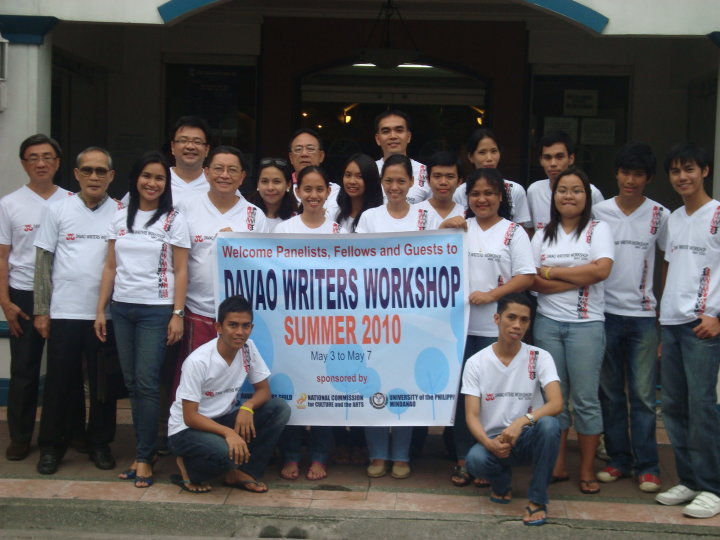
Like King, I knew that if I attend a workshop I would subject myself and wy works to criticisms. I knew that I would receive "no sweet words, unless my works are truly exceptional, and they are not." Nevertheless, on May 3-7, 2010, I attended the Davao Writers Summer Workshop, which was sponsored by the Davao Writers Guild, National Commission for Culture and the Arts, and UP Mindanao.

To be continued...

Thursday, May 13, 2010

Nanos gigantium humeris insidentes

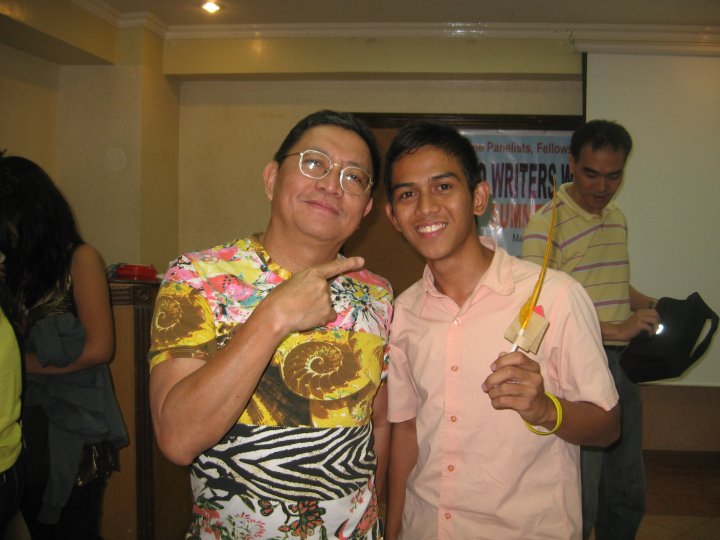
That means "dwarfs standing on the shoulders of giants." According to my ever-reliable source, Wikipedia, it is a Western metaphor that means, "One who develops future intellectual pursuits by understanding the research and works created by notable thinkers of the past." Joining the 2010 Davao Writers Workshop is like standing on the shoulders of giants. Here are some of the photos in which I, well, stood beside the giants (literally and figuratively).

[caption id="attachment_1795" align="alignleft" width="400" caption="Ma'am Aida Rivera-Ford and I."][/caption]

[caption id="attachment_1796" align="alignleft" width="400" caption="Sir Ricky de Ungria and I."][/caption]

[caption id="attachment_1797" align="alignleft" width="400" caption="Sir Mac Tiu and I."][/caption]

[caption id="attachment_1798" align="alignleft" width="400" caption="Sir Tony Tan and I."][/caption]

[caption id="attachment_1799" align="alignleft" width="400" caption="Dominique Cimafranca and I."][/caption]

[caption id="attachment_1800" align="alignleft" width="400" caption="Sir Tim Montes and I."][/caption]

Monday, May 10, 2010

149 Minutes

Nervous, I inserted my ballot into the PCOS (Precinct Count Optical Scanner) machine. I was nervous because what if the PCOS would reject my ballot like it did to the woman before me. The PCOS didn't reject her ballot at all. But she inserted it six times before her ballot was counted. Less than a minute passed, the words, "Congratulations! Your ballot has been counted." appeared. I sighed.

What the COMELEC (Commission on Elections) say is really true. With the automated elections, the counting of the ballots will no longer take a long time, unlike the manual elections. But it's too early to celebrate.

Lest we forget, the searching of polling precinct, the lining up---all that, too, is part of the election. And there are so many things that can be said of them. So many, in fact, that I don't know where to begin.

Perhaps I'll begin with my arrival. If the election were manual, I would have arrived at the polling precinct very early. But no, the election is now automated. Which, as the COMELEC promised, is faster and more efficient. There is therefore no need for me to hurry.

When I woke up in the morning, I turned on the TV, watching what's going on in other parts of the Philippines, instead of preparing to leave for the polls. Over at ABS-CBN, Gloria Macapagal-Arroyo was shown voting. Per ABS-CBN's calculation, GMA took only six minutes to vote. If it's that fast, I figured I would go to the precinct at 8:00 in the morning.

The night before the election day, I had planned what would I wear and what would I bring. To warn the voters that if they thought only for themselves when they vote, if they wouldn't think of future of the country, they would get nowhere, I would wear my T-shirt with a quote by Conrado de Quiros: "You don't have national pride or a sense of country, you'll get nowhere." Sadly, however, I would find out that the voters were too busy to even bother to look at my T-shirt, let alone contemplate the profundity of what's written on it. To monitor the time and see if the election is faster than before, I would wear a wrist watch, although I'm not used to wearing it because it annoys me.

At 8:45, I arrived at the polling precinct. Already, the entrance to the Cabantian Elementary School, where I would be casting my vote, was dominated by "poll assistors" (poll assistants would be much simpler) distributing sample ballots, vendors selling mineral water, Max and Snowbear, teenagers and bystanders doing...nothing.

Then I went to my precinct: 1808C. Like all the other precincts, mine was already crowded. There were those who were looking for their names on the list pasted on wall. Some were asking for priority numbers. There were also the omnipresent "poll assistors," struggling to get inside, or at least get close to, the precinct.

I searched my name on the list to double-check if my precinct was really there. I'm glad I did, because when I found my name, it was listed under a different precinct: 1808E. But that was no matter. I was still on the right precinct. The COMELEC, I discovered, put the five precincts in one cluster. For instance, the precincts from 1808A to 1808E were put in cluster 545. Hence, the overcrowded precincts.

The polling precincts were replete with posters informing the voters of the six things they need to do to cast their votes. The procedure looked good---on paper. It was not followed. I don't know if the same procedure was followed in other places, but the actual voting procedure in Brgy. Cabantian went like this: First, the voter would fall in line to get a priority number. As for me, I started to fall in line at 8:50. I received my priority number at 10:24. After the voter got his priority number, he would again fall in another line that which led to the precinct. Once the voter got inside, he would tell his precinct number to the BEI (Board of Election Inspector). If his name is on the list, the BEI would ask for his signature and thumb mark. All that that took me no less than 50 minutes.

At 11:14, I was done casting my vote. All in all, it took me 149 minutes (2 hours and 29 minutes) to vote. I can say that I'm lucky to have just been inconvenienced for 149 minutes.

Some of you would say that 149 minutes is too much. But come to think of it. This was no ordinary day. We are talking about election here. It is the time when we choose our next leaders. It is the time when we decide not only the fate of our country, but also our fate.

If it takes only 149 minutes to choose leaders who would help our country better again; if it takes only 149 minutes to undo all that GMA did; if it takes only 149 minutes to reclaim what this country has lost; if it takes only 149 minutes to save us from another six years of felony, perfidy, and larceny----if it takes only 149 minutes to achieve all that, then we should be more than willing to spare 149 minutes of our time.

It cannot be denied that we have this tendency to inflate our own misery. But as the man, who tried to organize the disorganized voters at my polling precinct, said, "Kini na ang panahon para mag-sakripisyo lang ta gamay" (This is the time that we have to sacrifice a little).

Friday, May 7, 2010

Aida Rivera-Ford recited Sonnet 29


Aida River-Ford is so known she need not be introduced at length. Suffice it to say that the opening ceremony of the 2010 Davao Writers Workshop was made more special by her presence, and by other venerable artists' presences: Tita Lacambra-Ayala, Margot Marfori, and Maria Virginia Yap Morales.

During lunch time, Ma'am Aida seated near us. She didn't eat right away, as everyone else did. Yes, she did get her food. But after putting down her sparsely filled plate on the table, she asked us if we have a copy of Dr. Anthony Tan's lecture, in which Shakespeare's Sonnet 29 was cited.

"I will recite it with feelings," she said.

Gino, one of the fellows for this year's workshop, handed his copy to Ma'am Aida. Then Ma'am Aida stood in front and held the copy in her left hand.

"You know, aside from being a writer, I'm also a performer," she said. "I used to memorize this, but now I forgot this already. But anyway, I will recite it."Ma'am Aida didn't frustrate her listeners. True to her word, she recited Shakespeare's Sonnet 29 with feelings.

When, in disgrace with fortune and men's eyes,
I all alone beweep my outcast state
And trouble deaf heaven with my bootless cries
And look upon myself and curse my fate,
Wishing me like to one more rich in hope,
Featured like him, like him with friends possess'd,
Desiring this man's art and that man's scope,
With what I most enjoy contented least;
Yet in these thoughts myself almost despising,
Haply I think on thee, and then my state,
Like to the lark at break of day arising
From sullen earth, sings hymns at heaven's gate;
For thy sweet love remember'd such wealth brings
That then I scorn to change my state with kings.


Then everyone applauded her.

So beautiful is her rendition that, how shall I say this, nanindog gayod ang akong balahibo paghuman niya ug basa sa poem. As both fellows from CDO, Gino and Kuya Jay, would say, "Chada kaayo bay."

Thursday, May 6, 2010

Notes on the Davao Writers Workshop 2010

[caption id="attachment_1740" align="aligncenter" width="500" caption="The opening ceremony of the 2010 Davao Writers Workshop was graced by Aida Rivera-Ford and Tita Lacambra-Ayala, the grand dames of Philippine Literature"][/caption]

The Davao Writers Workshop Summer 2010 is about to end. There are only few pieces left to be critiqued. Call me sentimental, but this is one of the events in my life that I will never forget. Ages and ages hence, I shall be able to tell this: For once in my life, I brushed elbows with the big-shots of the Philippine Literary scene: Jhoanna Cruz, Tim Montes, Gen Quintero, Mac Tiu, Anthony Tan, and Ric de Ungria, who serve as our mentors, or "tormentors" as some would say.

Merely looking at the roster of this workshop's panelists can be intimidating, what with their accomplishments and intellectual acumen. In fact, before the workshop, I felt as though I was so puny that if ever I'd be absent or present, my presence or absence would not make anyone budge.

Yet, for one reason or another, I didn't feel that way. Here, no one questions me why I do the things I do, which is to write.

Tuesday, April 20, 2010

No time for Mindanao?

[caption id="attachment_1683" align="aligncenter" width="468" caption="Photo courtesy of davaobloggers.net"][/caption]

Towards the end of the forum "Paminaw Mindanao," Amina Rasul, one of the the forum's convenors, gave a summary of Gibo's, JC's, Perlas's, and Villanueva's plans for Mindanao.

There is, however, a trace of disappointment in Rasul's voice. And she expressed the same sentiment in her column:
Unfortunately, of the nine presidential candidates, only Secretary Gilbert Teodoro, Brother Eddie Villanueva, Coun-cilor JC de los Reyes and independent candidate Nicky Perlas came. The others were no shows, perhaps clearly indicating that Mindanao is not a critical component of their campaigns (although they did come to dialogue with Pastor Quiboloy, the “appointed son of God”). [Emphasis mine]

The Five Men who were no shows at the forum, is Mindanao really not a "critical component of your campaigns," is it?

Friday, April 16, 2010

Wala naminaw sa Paminaw Mindanao

Unlike some of my friends who went to HCDC Gym to attend Paminaw Mindanao, a presidential forum on Mindanao, I was able to secure a white ticket, that which allowed me sit in the chairs below, among the important and not-so important people, not in the bleachers above.

Since I don't have a laptop to document all that happened there, I just used my cp and saved what I wrote in the outbox. Here goes:

  • "Forum, paminaw mindnanao. 4 came. Gbo, jc, perlas, bro. Edie. jc was late.

  • "Startd with a prayr from tri.people."

  • "Gibo, cutlre, devt, and securty."


From there, I stopped typing. By the time Gibo laid out his plan for Mindanao----he said there is a need for a paradigm shift, a one-size-fits-all approach to Mindanao won't work because the causes of conflicts in this island are varied----we were busy searching for Who's Who in Philippine Politics.

Anton Lagdameo was there. My friend said it would have been better had he brought Dawn Zulueta with her.

Bebot Bello, the senatorial candidate who styled himself as Justice Man, was there, wearing a violet vest that reminds me very much of sapin-sapin.

Nanding Pacheco, founder of Ang Kapatiran Party, was there.

I don't know who else were there.

I didn't get much of what the presidentiables said. All I can say is that the forum was enlightening. There, I learned that the color of the dress that Amina Rasul, of the Philippine Council for Islam and Democracy, wore yesterday was not orange. It's saffron.

Wednesday, April 14, 2010

Fellows for the Davao Writers Workshop 2010

The Davao Writers Guild, in cooperation with the National Commission for Culture and the Arts and University of the Philippines-Mindanao, proudly announces the Fellows for the Davao Writers Workshop 2010:

Short Story
April Dawn M. Paramio
Arvin Antonio V. Ortiz
Freeda Ko Quejada
Jayson E Parba

Essay
Ella Jade Ismael
Seneca Pellano

Play
Hiyasmin Gabriela Espejo

Poetry
Erika Navaja
Friedrich Simon C Layno
Gino Boy Dolorzo
Iryne O. Kaamino
James Roy C. Pascual
Reymond L Pepito

The workshop will take place on May 3 to 7 at Lispher Inn, Juna Subdivision, Matina, Davao City.

Tuesday, March 2, 2010

Davao Summer Writers Workshop 2010

The Davao Summer Writers Workshop 2010 is now accepting applications.

Monday, January 4, 2010

After the inquiry, what?

When the CHR started looking into the extrajudcial killings in Davao City, I was one of those who cheered. At long last, I thought then, we started talking about it publicly.

Today, however, I begin to wonder what the CHR is really up to. The CHR inquiry, it seemed to me, produced only more heat and and less light. It said it's going to release its report after it's done with the inquiry. But until now, the report is still to be released.

And yet...where's the CHR now? Off it goes to Maguindanao, investigating another incident. Tsk...tsk...tsk...

Sunday, October 18, 2009

What a semester!

The semester is over, and I can say that this semester is by far the most productive semester that I've ever had. Not that I was slumbering the previous semesters or, as the Bisaya would put it, nagpadako ra ko'g itlog. It's just that this semester alone, I've done things I never did before:

Tuesday, October 13, 2009

Top of the world

DSC01042Philippine Academy of Sakya, Davao: I wonder what it's like to be here.