Showing posts with label Law. Show all posts

Monday, May 6, 2013

Why Dabawenyos are soooooooo conyo?


Girl 1: Mag-go ka sa birthday niya?
Girl 2. Hindi. Gisabihan ko na siya na hindi ako mag-go.
Girl 1: Ano ka man uy? Gina-expect ko na baya siya na yang mag-go ka.

This is how a normal conversation goes between two Dabawenyo teenagers studying in a private school. Because non-Dabawenyos used to hear this kind of conversation, they can’t help saying, “Pamati ang mga taga-Davao. Sigeg Tagalog.”

But why do Dabawenyos speak Bisaya peppered with Tagalog, sprinkled with English, and marinated in FB-Twitter expressions?

There is a theory circulating among law students. The theory is that today's generations of Dabawenyos are descendants of the women in Villavicencio v.Lukban.

Who were those women? Why were they shipped to Davao secretly?

Sunday, April 14, 2013

An Online Coaching Clinic on Answering Bar Exam Essay Questions

Atty. Ralph Sarmiento
In the recent past, the Philippine Bar Exam has been reformed. Where before it comprised merely of Essay Questions, today Multiple Choice Questions (MCQs) are included. Assuming that you know the answer, there's no problem to answering MCQs. Just encircle, shade, or tick as the case may be the letter of your answer.

But what about the Essay Questions? What a Bar Exam taker needs to hurdle it? 

Atty. Ralph Sarmiento, 10th Placer in the 1997 Bar Exam, Dean of University of St. La Salle College of Law, and Counsel for Petitioner in the Team Patay/Team Buhay Tarpaulin Case (Diocese of Bacolod v. COMELEC), Atty. Sarmiento provides an "Online Clinic and Coaching on Bar Answering Techniques for the 2013 Bar Exams," especially on answering the essay questions:

Friday, April 5, 2013

The Secret to Passing the CEM-LSQT: Prepare Like Pacquiao The Boxer

LSQT
It's the time of the year when fresh college graduates are mulling over whether to take that law school entrance exam. Obviously for anyone who wants to be a lawyer, it's the first exam that one needs to hurdle.

I'm not familiar with other law schools' entrance exam, but here in Davao City, the University of Mindanao-College of Law and ADDU-College of Law both require prospective law students to pass the LSQT (Law School Qualifying Test) provided by CEM (Center for Educational Measurement).

Having taken the test myself and passed it, I know how it feels when your family is constantly egging you on to take the test, and the pressure is building up as the entrance exam date is getting nearer.

Relax! Just prepare. Only if you prepare, and prepare like Pacquiao The Boxer, you can pass the test. The old Manny Pacquiao used to prepare way ahead of his fight. He used to spend long hours of grueling drills and exercises. Here are five steps you might want to take:

1. Research on the nature of exam.

What sort of questions are asked in the exam? How long is the exam?  How is the exam scored? What score should I get to pass the exam?

You must be familiar with the nature of the exam before taking it. Think of how Pacquiao studies his opponent before going up on the boxing ring. Prepare like Pacquiao the boxer.

According to CEM,  the "LSQT, a 240-item test administered for 2 hours and 50 minutes...consists of sub-tests in Verbal Reasoning, Critical Thinking, Quantitative Ability, and Figural Reasoning. It also features an Essay Test designed to assess an applicant's ability to present ideas in written form. Intended users are graduates or graduating students of degree programs.

For additional information on CEM-LSQT, read this LSQT Guide.

2. Determine your strong and weak points.

Remember that the LSQT has four sub-tests:

a. Verbal Reasoning (Don't be bogged down by the jargon, language lang ito.)

b. Critical Thinking (Logic)

c. Quantitative Ability (Math)

d. Figural Reasoning (Abstract)

Of the four, ask yourself where are you good at, and where are you weak at.

3. Make your strong points stronger, but focus most on your weak points.

Give more time to that which you're not good at. But never disregard the others, lest what is formerly your strong point becomes your weak point now.

For instance, I'm not good at Math. So what I did was I asked my Math major friends to tutor me. Talk about tapping human resources.

4. Test yourself.

There is this thing people are addicted to. It's called the Internet. And in the Internet, there are lots of practice tests for each sub-tests of the LSQT. Almost all of them can be had for free.

5. Show up!

Of course, all these things don't mean anything if, because you're crippled by your fear of failing the test, you don't show up. In the first place, how would you know you fail or pass if you haven't taken the test. Take the test by all means.

If, after all, you fail, no big deal. It's better to be an LSQT flunker than a Bar flunker.

Wednesday, April 3, 2013

What pre-Law course is best to take?

By now those students who will go to college must have already decided what course to take. I've been asking my students about their plans. As with the many Pinoys who answer a question with another question, a few of them ask me back so that the interviewer became the interviewee now.

"What's a good pre-Law course to take, Sir?"

Well, that question could be answered on two different levels.

First, law schools don't prescribe a particular pre-Law course. Whatever course will do, provided your pre-Law course complied with the required number of units in Math, English, and Social Science. But that depends on the university. For example, in the University of Mindanao College of Law, the requirements are: 6 units in Math, 12 units in English, and 9 units in Social Science (History, Psychology, or Sociology).

Second, if by a good pre-Law course means that what course will better prepare your for law school, the answer is there is none.

True some may say it should be AB English or Communication Arts since in law school what matters is not what answers you give, but how to give what you give. Other may say it should be Philosophy, for it trains you to be a critical thinker.

I think it depends on what kind of lawyer you want to be. I have Law professors whose pre-Law courses were varied. My teacher in Constitutional Law 2 took up an Engineering course. My Statutory Construction teacher used to be a MedTech before he took up law. My Persons and Family Relations teacher is a CPA and an MBA holder, then she proceeded to Law.

The field of law is vast. What matters is you have to think first what kind of lawyer you want to be. Then you can fairly determine what pre-Law course to take.

Thus, if you want to be a Commercial Lawyer, a background in Business Administration, Accounting, or Management might come in handy. If you want to enter the government service, a Political Science or a Public Administration course might be useful. Those who relish a courtroom drama and all that verbal brawl might take up AB English or Philosophy.

Thursday, March 21, 2013

Long Live Justice Cruz

CruzFormer Supreme Court Justice Isagani Cruz is my idol. Cruz is most notable for his well-written ponencia (Supreme Court judicial opinions), which never fail to amuse me, and his defense of individual liberty, which never fail to inspire me. Sadly, Justice Cruz is gone. Long live Justice Cruz.

Wednesday, March 13, 2013

Legal Ethics in 300 Words: Introduction

IMG_20130314_144122

A lawyer never gets rich, my law professor told me, if he practices law strictly according to the ethics of the legal profession as embodied in the Code of Professional Responsibility (CPR).

That statement is not without implications. That implies that a rich lawyer is necessarily unethical. That also implies that the CPR is meant to impoverish a lawyer.

The truth, however, is that the CPR was put in place, according to Dean Ernesto Pineda, "to guard against the abuses and ill of the profession such as dishonesty, deceit, immorality, negligence, slothfulness, lack of diligence and the many forms of malpractice of the members of the Bar."

Without these rules found in the CPR, Dean Pineda said, "The practice of law which covers a wide range of activities...will be transgressive, anarchic, riotous, lawbreaking, defiant and disobedient to courts..."

Positively, the CPR will "raise the standard of the legal profession, encourage and enhance the respect for the law, assure an effective...administration of justice, assist in keeping and maintenance of law and order..."

"It also provides the basis for the weeding out of the unfit and the misfit in the legal profession for the protection of the public."

Promulgated on June 21, 1988, the CPR provides the rules of conduct for lawyers who are not members of the judiciary. It has twenty-two Canons which are grouped under four Chapters. All four Chapters refer to the four-fold duties of the lawyer to the Society, to the Legal Profession, to the Courts, and to the Client.

In the subsequent posts, I will try to discuss each Canon and provide my own observation in 300 words to also help the public understand the legal profession, and the ethical tenets by which lawyers are, theoretically at least, bound to follow.

Monday, March 11, 2013

Less Fanfare, More Substance: UMLAC Celebrates the International Women's Day 2013

[caption id="attachment_2517" align="aligncenter" width="521"]L-R: Atty. Eliza Lapina, Jing Remolar, Dr. Tessa Mae Bongyan L-R: Atty. Eliza Lapiña , Jing Remolar, Dr. Tessa Mae Bongyan[/caption]

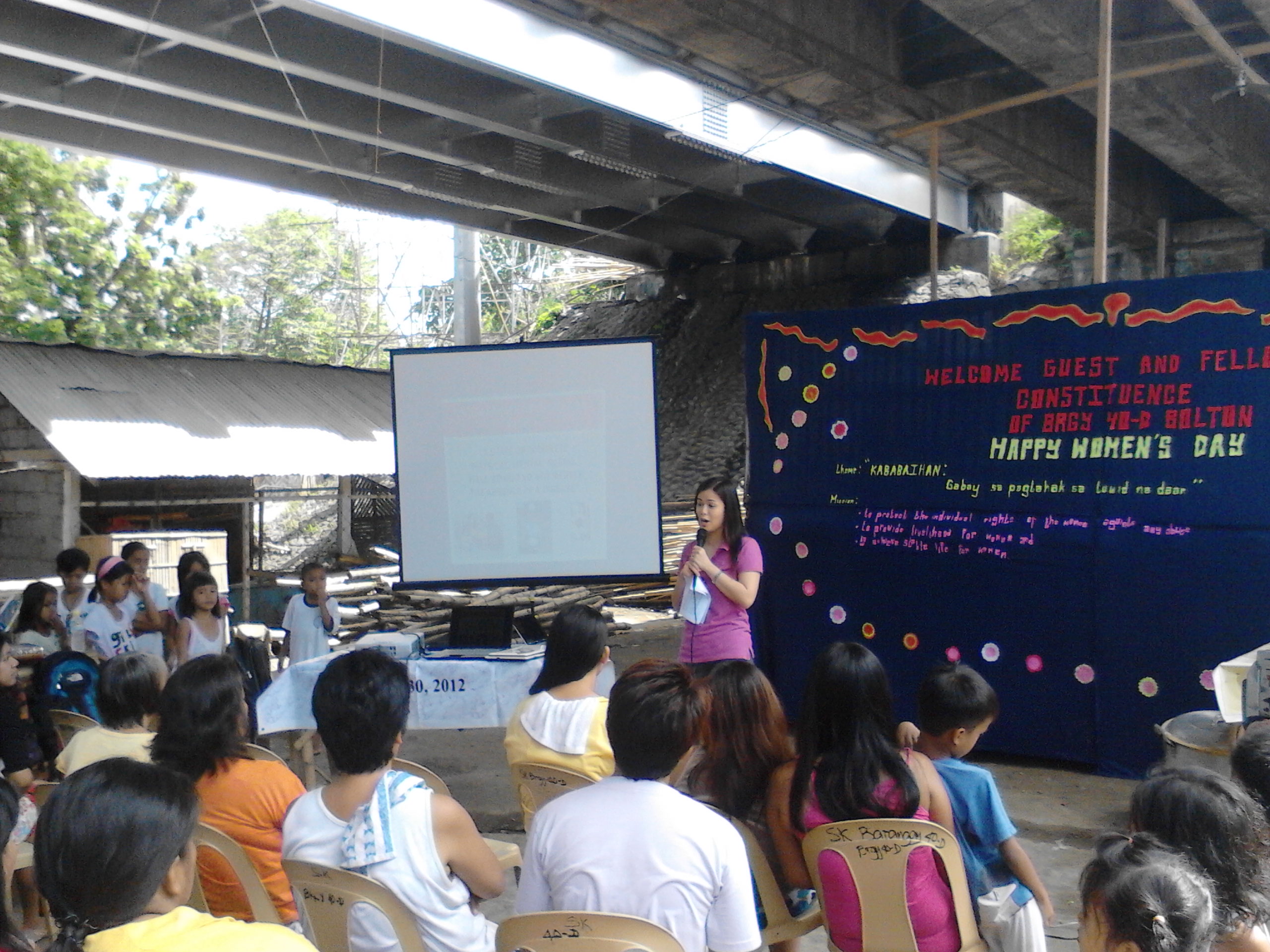
The nascent University of Mindanao Legal Aid Center (UMLAC) was at Barangay 40-D, Bolton Extension on March 9, 2013 to conduct a forum on women's health and related laws on women's welfare in line with the celebration of the International Women's Day.


Held literally under the Bolton Bridge where the noise of passing vehicles is deafening, the forum was nevertheless well-attended. Almost a hundred women from the Barangay came. Most of them are mothers themselves.

IMG_20130309_095654At the forum, Dr. Tessa Mae Bonguyan talked of the basic issues on women's health while Atty. Eliza Lapiña talked especially about R.A. 9262 or the Anti-Violence Against Women and their Children Act (VAWC).

Sunday, March 10, 2013

Due Process in the Garden of Eden

[caption id="attachment_2510" align="aligncenter" width="670"]Expulsion from the Garden of Eden by Giacinto Gimignani Expulsion from the Garden of Eden by Giacinto Gimignani[/caption]

Human rights are recognized here and elsewhere in the world. These human rights include the right to life, liberty, and property. In these modern times, there are various safeguards against the arbitrary and whimsical deprivation of these rights.

In our Constitution, for example, Sec. 1, Art. III provides, "No person shall be deprived of life, liberty or property without due process of law, nor shall any person be denied the equal protection of the laws."

Due process of law, in the classic definition by Daniel Webster, is a "law which hears before it condemns, proceeds upon inquiry and renders judgment only after trial."

The religious among us say that the concept of due process dates as far back as to the time of Adam and Eve. In Genesis, we first heard of the story of Adam and Eve.

Wednesday, February 27, 2013

Broken Promises: Can you sue your fiancé for breach of promise to marry?

[caption id="attachment_2494" align="aligncenter" width="403"]Source: https://www.google.com.ph/search?hl=fil&q=runaway%20groom&psj=1&biw=956&bih=485&bav=on.2,or.r_gc.r_pw.r_qf.&um=1&ie=UTF-8&tbm=isch&source=og&sa=N&tab=wi&ei=_rctUdLEM8KHrAe-64DQCg#imgrc=LgoR4Dtw_0j60M%3A%3BicN6bDC2oE5iVM%3Bhttp%253A%252F%252F3.bp.blogspot.com%252F-omPc_mr9O7w%252FTruhddMowdI%252FAAAAAAAABX8%252FCi6NzfiXMhE%252Fs1600%252FRunaway%252BGroom%252BFinal.jpg%3Bhttp%253A%252F%252Fdiaryofsanjeev.blogspot.com%252F2011%252F11%252Frunaway-groom-part-4-of-4.html%3B720%3B482 Source: www.diaryofsanjeev.blogspot.com[/caption]

Your boyfriend promises to marry you on different conditions: when he finds a stable job, when he saves enough money for the wedding, when he gets 28, or when he's tired of being single. Whatever it is, you patiently wait for that day to come. Then one day he said he changes his mind. He's marrying you no more.

Can you sue your fiancé for his breach of promise to marry?

Of course, yes.

But another question would be, can you compel your fiancé  to pay you for his breach of promise to marry? In legal parlance, is breach of promise to marry an actionable wrong?

Tuesday, February 12, 2013

How I misspelled "case"?

IMG_20130213_071750During our Prelim Exam in Intellectual Property Law, I misspelled a word so simple even a Kindergarten pupil can spell it. A question was asked whether or not Joe Sison, Jr.'s infringement case would prosper.

Then I wrote, "Joe Sison, Jr.'s cas will not prosper."

I admit. I won't even try to rationalize how I did it. It was sheer carelessness that I misspelled the word "case" and instead wrote "cas."

This must be one of the downside of relying too much on Spellchecker in MS Word. I have become so much dependent on it I expect red jagged lines would appear under the word every time I misspell a word.

My consolation was that only one point is deducted from my score.

Sunday, February 3, 2013

Alternative Lawyers – 'Conscience of the Legal Profession'

[caption id="attachment_2476" align="alignright" width="300"]Delegates and organizers of the Basic Orientation Seminar on Legal Aid. Delegates and organizers of the Basic Orientation Seminar on Legal Aid.[/caption]

When you become lawyers, in what field of the law you want to be engaged?

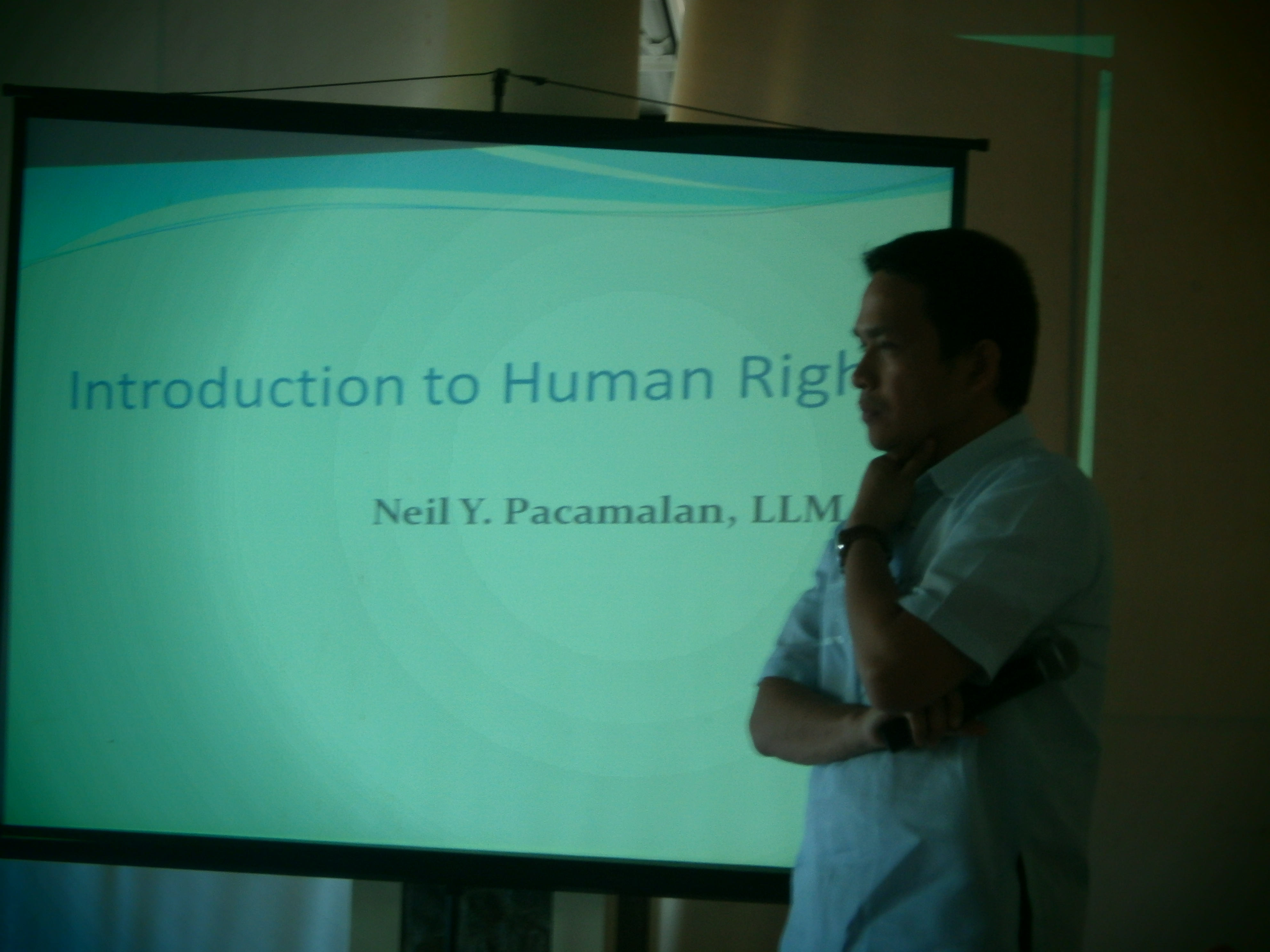
On the second day of the two-day Basic Orientation Seminar on Legal Aid Atty. Neil Pacamalan, Cultural Affairs Specialist for Mindanao of the US Embassy, Manila, asked that question to the delegates from the University of Mindanao and Ateneo de Davao University College of Law.

The question drew a variety of response: commercial law, criminal law, international law, labor law, among others. Few mentioned about public interest lawyering, which others call alternative lawyering or developmental lawyering.

[caption id="attachment_2478" align="alignleft" width="144"]Atty. Neil Pacamalan Atty. Neil Pacamalan[/caption]

This type of lawyering, according to Atty. Pacamalan, is devoted to lending legal assistance and empowering such marginalized groups as urban poor, farmers, or fishers. He said these are the groups that are historically, culturally, and economically marginalized.

Atty. Pacamalan is convinced that involvement in alternative lawyering is not detrimental to the law students’ studies. He surmises that while UP, ADMU, and San Beda excel in the Bar Exams, the three are able to maintain a robust legal aid centers.

He said that alternative lawyering should not be a second choice only, reiterating what former Chief Justice Hilario Davide, Jr. said.

“To me it is troubling that the lawyers who advocate such worthy causes are called the alternative,” said Davide at the First Alternative Law Conference on November 8, 1999. “An alternative is a second choice. You should be considered the mainstream, the first choice, the true and ideal lawyers. Better yet, the conscience of the legal profession.”

Help Mindanao, US Embassy official urged law students

[caption id="attachment_2469" align="alignleft" width="240"]483714_2776201700910_2049610267_n Officials from the US Embassy, US DOJ-OPDAT, UM, and MYVC join the delegates from UM College of Law and ADDU College of Law.[/caption]

"Stop kidding around," intoned Atty. Neil Y. Pacamalan, Cultural Affairs Specialist for Mindanao, Public Affairs Section, of U.S. Embassy. "This is not for the US Embassy, but for Mindanawons."

Atty. Pacamalan was referring to the two-day Basic Orientation Seminar (BOS) on Legal Aid, which was organized by the U.S. Embassy, Manila and the Mindanao Youth Volunteer Corps. The BOS is attended by 31 law students, 21 of which come from University of Mindanao, and 10 are from Ateneo de Davao University.

[caption id="attachment_2472" align="alignright" width="240"]Atty. Neil Pacamalan, Cultural Affairs Specialist for Mindanao, Public Affairs Section, US Embassy, Manila. Atty. Neil Pacamalan, Cultural Affairs Specialist for Mindanao, Public Affairs Section, US Embassy, Manila.[/caption]

According to Atty. Pacamalan, who gave an introduction on what the purpose of the BOS is, Mindanao has a lot of problems, legal problems at that. Law students, he said, should lend their knowledge of the law to address these problems.

Acknowledging the heavy workload of a law student, Atty. Pacamalan nevertheless encouraged the students to get involved, and disabuse themselves from worrying over their petty problems.

"If you continue to stick to your selfishness," he said, "if you always think that you have no time to help others because you have to study first, then nothing will happen to Mindanao."

One way of helping the community in which law students are a part of, he said, is through establishing a Legal Aid Office, which is primarily run by law students, and working on it seriously.

"Tell us if you need our help," he said. "We will help you. But if you don't, we are not forcing you. But we are knocking on your door. Help Mindanao."

Friday, February 1, 2013

Beyond the Bar Exam

Almost everything we do in law school is for the Bar Exam. In a little while, however, a group of law students from the University of Mindanao College of Law will gather for a seminar on the establishment of a Legal Aid Office.

A Legal Aid Office, usually run by graduating law students who are supervised by law professors, primarily provides free legal assistance to those cannot afford to have one. The experience law students get from dealing with real clients and doing real legal stuff is definitely something they can use long after the Bar Exam.

The seminar will be held at Loleng's Mountain Spring Resort. It will last from February 02 to 03, 2013. It will be sponsored by the U.S. Embassy.

Thursday, January 31, 2013

Read, Think, then Answer

During our second exam in Criminal Law 2, a question is asked:
The Municipality allocated 2 million for the concreting of road in Brgy. Tagakpan. X, a municipal treasurer, authorized the release of 1 million for the purchase of fire truck. Besides, the ordinance for the purchase of fire truck was submitted to the Mayor for approval. Did X commit any crime? Explain.

To this question, I answered:
X did not commit any crime. He did not commit malversation of public funds because, although the fund was allocated for the concreting of road but was used instead for the purchase of fire truck, the fund was nonetheless used for another public purpose. Neither did X commit technical malversation because the ordinance allocating the 2 million was not yet approved. In technical malversation, it is essential that there is a law or ordinance allocating the fund for public use.

I almost had it right. X, of course, committed technical malversation because there was already an approved ordinance allocating the 2 million. The ordinance that was not yet approved refers to the ordinance for the purchase of fire truck.

Modesty aside, I find the question easy to answer. But why did I answer it incorrectly? Simple! I was so in a hurry I misappreciated the facts.

Lesson learned: Read, think, then answer. Never answer, then think later.

Far worse than answering incorrectly, however, is not answering at all. Unfortunately, this happened to me, too, during our Midterm exam in Persons and Family Relations. At least, if your answer is wrong, they give you some credit, however little. But if you have no answer at all, you get nothing.

In my Persons exam, I wasn't able to answer the last essay question. Nine of the ten questions are found on the first page, and I thought that there were only nine questions. Unknown to me, and to some of my classmates, is that there's still a tenth question, which is found on the second page, just above the instruction for the Multiple Choice test type. Those of us who did not answer the last essay question were of the impression that the tenth question was part of the instruction for Multiple Choice. It turned out it was not.

Lesson learned: Look before you leap.

Thursday, January 17, 2013

The Criminals' Right

All humans have basic rights. Criminals are humans. Therefore, criminals have basic rights.

This syllogism, although to my mind is valid, is for some hard to accept,  or is simply unacceptable. For how can someone possess a right and yet trample upon another's right? How can someone's constitutional right to due process be protected when other's right to life is violated? Which right should be given more weight? To whom should the balance be tilted?

Take the Vic Siman et al ambush or rub-out or checkpoint-gone-bad (depending on whom you are listening to), which happened in Atimonan, Quezon on January 6, 2013. Vic Siman and 12 others who were with him were believed to be members of a criminal group.

If indeed Vic Siman et al were members of a criminal group, then they shall punished. But how? The answer is, they shall be punished in ways that do not violate the law and the Constitution. The rule of law must be upheld at all times.

That criminals must be pursued is beyond debate. But, to cite Justice Isagani Cruz, “Zeal in the pursuit of criminals cannot ennoble the use of arbitrary methods that the Constitution itself abhors."

Thursday, January 3, 2013

5 Law Student Must-Haves

There are people who use a lot of tools to do their work. And there are those who use nothing at all.

As for law students?

Well, there are lots of things a law student brings every day to class. But there are five things that I consider a law student list of must-haves. To be sure, law students could live without these things. But these things are so common a property among law students that they seemed to have become part of what a law student must have:

Wednesday, January 2, 2013

Blogging in 2012: A Review

Since I started my law studies in June, 2012, I thought 2012 would mean death for my blog. On the contrary, I became more active in blogging. I found a new source of material from studying law. Thus, most of the posts for 2012 have something to do with the law. How did my blogging activity fare in 2012? Here's a review the guys at Wordpress did:

The WordPress.com stats helper monkeys prepared a 2012 annual report for this blog.


Here's an excerpt:
600 people reached the top of Mt. Everest in 2012. This blog got about 7,300 views in 2012. If every person who reached the top of Mt. Everest viewed this blog, it would have taken 12 years to get that many views.

Click here to see the complete report.

Wednesday, December 19, 2012

Nag-iisang Isagani A. Cruz

Reading Supreme Court decisions is dreary. The decisions are so long that after reading them, all you want to do is sleep. But rarely does one experience it if one were to read a decision written by former Associate Justice Isagani A. Cruz. They say Justice Cruz is one of those rare breed of lawyers who could both write and reason well. Here's a random sample and you be judge:

"Zeal in the pursuit of criminals cannot ennoble the use of arbitrary methods that the Constitution itself abhors." (Bagalihog vs. Fernandez, G.R. No. 96356 June 27, 1991)

"Laws must come out in the open in the clear light of the sun instead of skulking in the shadows with their dark, deep secrets...The furtive law is like a scabbarded saber that cannot feint, parry or cut unless the naked blade is drawn." (Tañada vs. Tuvera, G.R. No. L-63915 December 29, 1986).

"The possible exception is the lawyer whose income is derived from teaching ballroom dancing or escorting wrinkled ladies with pubescent pretensions." (Dissenting, Cayetano vs. Monsod, G.R. No. 100113 September 3, 1991)

"[S]ocial justice –– or any justice for that matter –– is for the deserving, whether he be a millionaire in his mansion or a pauper in his hovel. It is true that, in case of reasonable doubt, we are called upon to tilt the balance in favor of the poor, to whom the Constitution fittingly extends its sympathy and compassion. But never is it justified to prefer the poor simply because they are poor, or to reject the rich simply because they are rich, for justice must always be served, for poor and rich alike, according to the mandate of the law." (Gelos vs. CA, G.R. No. 86186 May 8, 1992)

"Unless we are vigilant of our rights, we may find ourselves back to the dark era of the truncheon and the barbed wire, with the Court itself a captive of its own complaisance and sitting at the death-bed of liberty." (Dissenting, Valmonte vs. De Villa,G.R. No. 83988 September 29, 1989)

Update: See Justice Cruz's concurring opinion in Adiong vs. COMELEC, G.R. No. 103956 March 31, 1992 and dissenting in National Press Club vs. COMELEC, G.R. No. 102653 March 5, 1992.

Wednesday, December 5, 2012

Victims of Love

To be a lawyer in this country is never easy. It takes eight years of formal study (4 years of Pre-Law & 4 years of Law proper), a year of preparing for the Bar Exam, and an eternity of reading, reading, and reading. It also takes a lot of sacrifices, many are supreme but some are trivial. Thus, being disbarred is perhaps the most painful thing that can ever happen to a lawyer.

That is why, in Buado vs. Layag, the Supreme Court said, "Disbarment is the most severe form of disciplinary sanction.  The power to disbar must always be exercised with great caution, for only the most imperative reasons, and in clear cases of misconduct affecting the standing and moral character of the lawyer as an officer of the court and a member of the bar."

Yet in the case of former PBA Commissioner Atty. Noli Eala, that's the price he had to pay for having the right love at the wrong time.

Sunday, December 2, 2012

Better Handwriting, Better Chances at the Bar Exam

No one can tell for sure because no one stands behind the examiner, looks over his shoulder, and see how he checks the exams. But rumor has it---and in fact it's an oft-repeated warning by law professors---that if an examiner doesn't find your handwriting palpable to read, they'll toss off your exam booklet and give you a failing grade.

"Remember class," law professors would say, "most of the Bar examiners are already old." By old they probably meant grandfather old. They don't have the luxury of time to decipher what you wrote in the booklet. Neither do these examiners possess the Rosetta Stone which could help them understand Hieroglyphics. This belief is not baseless at all. Every year there are at least 5,000 Bar takers. Imagine if one examiner would spend half an hour reading one exam booklet, he won't meet the deadline.

Thus, law professors constantly remind first year law students to improve their handwriting. If not, forget about being a lawyer. Trivial as it may be, one's handwriting could pose a great obstacle to one's ambition.

The story may be apocryphal, but they say that there are those who took the bar twice or thrice before they passed. The defect has nothing to do with their knowledge of the law, but it has everything to do with their handwriting.

What then should the proper handwriting be? Or is there a prescribed or preferred handwriting? Should we write in cursive or in print?

There's I think no proper or prescribed form of handwriting when taking the Bar Exam. All handwriting, however, should have the same characteristic---legibility.

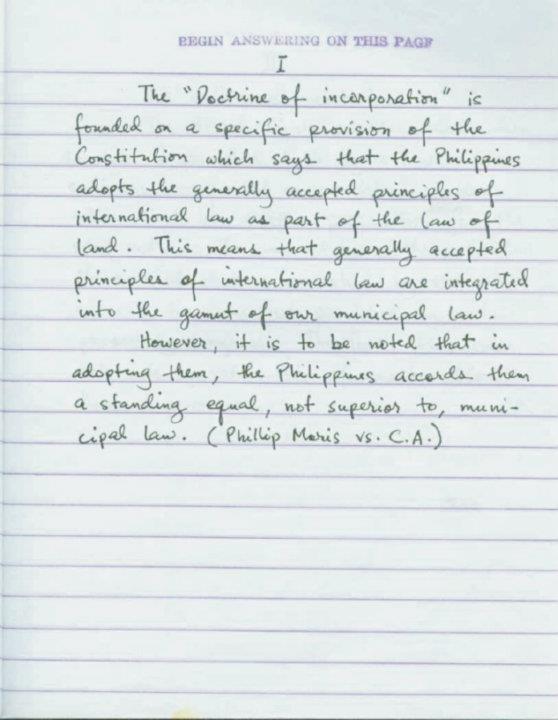
Now this is an example of legibility.

5


This is the actual Bar exam notebook of Atty. Ralph Sarmiento, Dean of University of St. La Salle, College of Law. He was Top 10 in the 1997 Philippine Bar Exam.


It may not be true that Bar examiners checked exam booklets solely on the taker's handwriting, but it doesn't hurt to improve one's handwriting.