No one can tell for sure because no one stands behind the examiner, looks over his shoulder, and see how he checks the exams. But rumor has it---and in fact it's an oft-repeated warning by law professors---that if an examiner doesn't find your handwriting palpable to read, they'll toss off your exam booklet and give you a failing grade.
"Remember class," law professors would say, "most of the Bar examiners are already old." By old they probably meant grandfather old. They don't have the luxury of time to decipher what you wrote in the booklet. Neither do these examiners possess the Rosetta Stone which could help them understand Hieroglyphics. This belief is not baseless at all. Every year there are at least 5,000 Bar takers. Imagine if one examiner would spend half an hour reading one exam booklet, he won't meet the deadline.
Thus, law professors constantly remind first year law students to improve their handwriting. If not, forget about being a lawyer. Trivial as it may be, one's handwriting could pose a great obstacle to one's ambition.
The story may be apocryphal, but they say that there are those who took the bar twice or thrice before they passed. The defect has nothing to do with their knowledge of the law, but it has everything to do with their handwriting.
What then should the proper handwriting be? Or is there a prescribed or preferred handwriting? Should we write in cursive or in print?
There's I think no proper or prescribed form of handwriting when taking the Bar Exam. All handwriting, however, should have the same characteristic---legibility.
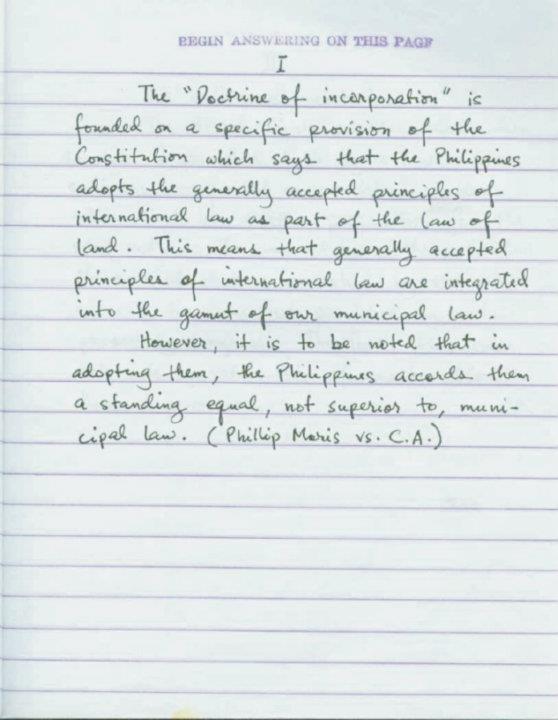
Now this is an example of legibility.

This is the actual Bar exam notebook of Atty. Ralph Sarmiento, Dean of University of St. La Salle, College of Law. He was Top 10 in the 1997 Philippine Bar Exam.
It may not be true that Bar examiners checked exam booklets solely on the taker's handwriting, but it doesn't hurt to improve one's handwriting.