Thursday, June 10, 2010

Remembrance of the workshop past (Part 2)


What I was in for I really didn't know, until I threw myself into the sometimes shattering and sometimes enriching---depending on one's own experience---world of the writing workshop.


In the early morning of May 3, the first day of the workshop, I arrived in the conference room of Lispher Inn where the Davao Writers Workshop would be held. There was only one person present yet. By my estimate, he's somewhere between seventy and eighty. He's wearing floral long sleeves; his attache case was placed on the table.

The old man turned about, and when he saw me, he greeted me and offered me a seat near him. When he began to talk, I thought maybe this old man is a writer because writers are generally talkative.

It's not in my book to ask people's name first lest they'll get offended, but the old man saved me the burden of having to ask his name because he introduced himself.

"I am Satur," he said in Bisaya. "Satur Apoyon."

I just sat there with amazement. I couldn't believe that I was seating beside a real writer. All these years, I have not met a real writer, he who makes writing a living. But now there was something in me that told me not to let this opportunity slip by me, and so I tried as hard as I could to get the conversation between us going.

Satur and I talked about many things, from the difference of Cebuano and Mindanao Bisaya to the seven-year ordeal he had while completing his fantasy novel, "Ang Karibal ni Pilemon," from the difficulty he finds whenever he reads today's writings in Bisaya to the dearth of writers in Bisaya.

Not long afterward, people started to crowd the conference room, and then the workshop started (without a prayer), and Jhoanna Lynn Cruz, the Workshop Director, welcomed everyone. Then Rick de Ungria, being the president of Davao Writers Guild, gave a message. And so did Gilda Rivero, UP Mindanao's Chancellor. Then Dominique Cimafranca introduced the fellows and the panelists.

Four men and a woman served as panelists: Dr. Anthony Tan, who has the loudest voice of them all and was asked by Tita Lacambra-Ayala "Are you going to die?" when he told us, as a preface to his lecture, that he's going to retire from sitting as a workshop panelist; Mac Tiu, who, if not mean, was mild; Ric de Ungria, who was either the fellows' tormentor or defender; Genevieve Quintero, whose curly hair is as memorable as her positive comments; and Tim Montes, who was at one time very serious and at another naughty---he once said that poems must sometimes have the comic punch of this Bisaya verse: "Ay kakapoy/ Naay bata gatutoy/ Naay o**n gataroy/ Ay kakapoy."

There were also those who served as guests panelists: Satur Apoyon, who received the "Ug-Og" Palangga award, a parody of the Palanca award, for his emphasis on the difference between the words "ug" and "og"; Arnel Mardoquio, director of Hunghong sa Yuta, who just went to the workshop to critique the plays of Hiyasmin Espejo, the lone fellow for play; and Jhoanna Lynn Cruz, a Palanca awardee, who once took the place of Tim Montes.

15 slots were allotted for this workshop, but there were only 12 fellows who attended: James Pascual of ADDU, fellow for poetry; Gino Dolorzo of Xavier Univerity, poetry; Reymond Pepito of ADDU, poetry; Hiyasmin Espejo of UP Mindanao, play; Fred Layno of UP Mindanao, poetry; Ella Ismael of UP Mindanao, essay; Erika Navaja of UP Mindanao, poetry; Jayson Parba of Capitol University of CDO, fiction; Freeda Ko, granddaughter of Tita Lacambra-Ayala, fiction; Iryne Kaamino of Mindanao Medical School Foundation, poetry; Seneca Pellano of UP Mindanao, essay; and I, who came from Holy Cross of Davao College and was damn fortunate to have been chosen as a fellow for fiction, though I should have applied for essay because I like to style myself as an essayist.

Before the workshop, while looking at the roster of panelists and imagining the prospect of being inside a room full of writers of no mean achievement, I felt as though I were a speck whose presence would not make anyone budge, or whose absence would not be sorely missed by everyone.

And then Ms. Jhoanna introduced our keynote speaker, Dr. Anthony Tan, who would be giving a lecture on "Tension in Poetry." Oddly, while he's discussing tension in poetry, there was also a tension in me. That tension, I was sure, was due to the fact that my first piece, "The Young Sultan and the Plague," was slated to be critiqued first in the afternoon of that day.

The moment it was critiqued, all I did was prepare myself for the worst of comments. I didn't hold any illusions that it would come out unscathed. And true enough, it did come out strangled, stabbed, sliced, torn, lacerated, and hacked into pieces.

Sir Tim Montes called it "hilaw." The plot, he said, was not clear. Neither were the characters. Rick de Ungria said it's an "ambitious" piece, as though the writer wanted to cram so many things in so limited a form as short story.

It's hard to keep up with the pace of the panelists and take notes, but whatever they say, it only led to one irreversible conclusion: My piece didn't make it.

My second piece, "Badge of Honor," didn't make the grade either. Sir Mac Tiu said it's "novelistic," whose scenes "flits from one to another." He said, too, that the point of view needed to be fixed. There were so much background information that should not be included. Ms. Gen Quintero prepared to like the story because it started with the history of an indigenous people, and the IP is her area of interest. But she was left with no choice but to dislike it, for while reading it she had more "Huh?" moments than "Aha!" moments. Sir Rick de Ungria said my story is a good example of a story...that needed revision. There was, he said, a story, but no plot. The two, he reminded, should go together. He also said that I have this tendency to show instead of tell, and tell instead of show. Ms. Jhoanna was peeved by my use of triple asterisks to signal the reader of the new scene. It shows, she said, that the writer is immature. She suggested that I should read more, and even added that I ask a syllabus from Sir Tim Montes.

Their comments are enough to make you loathe them, and loathe them till you run out of cuss words. They can be so brutal that there was, in fact, one time that one fellow left the next day after his piece had been critiqued. They said the fellow wasn't just feeling well at that time, but it could be that the fellow couldn't stomach anymore the things the panelists were saying of his work.

To me, however, their comments are secondary; the experience itself primary. Not that I'm downplaying or belittling their comments, which were fair and well-thought-out in the first place, but the wonder of this all is that the utterly harsh comments are balanced and obliterated by the refreshingly congenial experience that the entire workshop provides for a novice writer.

Today, our society has little appreciation for writers. It is discouraging to writers, if not outright hostile. In school, students are mocked as "Emo" for turning their passions into prose. They are scoffed at if they keep a diary. At home, a son's or daughter's plan to be a writer is nipped right in the bud.

But at the writing workshop, there was not a slightest rebuke. Talks about writing are not discouraged; they are encouraged. It's as if writing is just like any other things in the world. Like PBB, like Rubi, like FB.

It is at the writing workshop, too, where I felt that I can be Arvin The Writer. It's there that I found it not strange to talk about writing being my passion. It's there where I was not questioned why I write. It's there where I was not considered quirky just because I see myself as a writer.

But the whole thing, after all, may be put very simply. The genius of a writing workshop does not lie in the panelists ability to issue an advice to young writers---sometimes it helps, and sometimes it thwarts, if not destroys, the writer's development. It lies in its ability to gather like-minded individuals, who are as passionate about writing as you are.

It sometimes get so frustrating when you find little support for the things you are most passionate about, but being in the company of such kindred spirits as the fellows and panelists, who think just what exactly you think, who feel just what exactly you feel, and who do just what exactly you do---it somehow buoys me.

Wednesday, June 2, 2010

Remembrance of the workshop past (Part 1)

Almost two decades ago, writer Doreen Fernandez, a noted critic herself, pleaded that this country should have more critics. They do an important work. They tell the readers which stories are good and which are not; which plays are worth watching and which are not; which books are worth buying and which are not.

Yet to us Filipinos whose sensibilities are not like the Americans’, it is but hard to have these critics around. We cannot withstand to have our work, the mere completion of which took us a long time and hard work, being subjected to criticism. We take the criticisms, however constructive, personally. We mistake criticism as an assault on our very being.

It is in writing workshop where much criticism takes place; although criticizing books or stories or plays is somewhat different from the criticism at writing workshops, it is criticism nontheless. I have never attended a writing workshop, until recently. But I’ve had a fair idea what goes on at a writing workshop, thanks to Stephen King,.

In his book "On Writing: Memoir of a Craft," King recounted his own experience at a writing workshop he once attended. Despite his harrowing experience at a writing workshop, King would become an established writer himself.

Although he's "doubtful" if a writer can benefit from writing classes and seminars, he's not "entirely against them."

"I knew that if I attend a workshop," he said, "I'd receive no sweet words, unless my works are truly exceptional, and they are not. I knew that my works would be criticized. What are critics for if they don't criticize?"

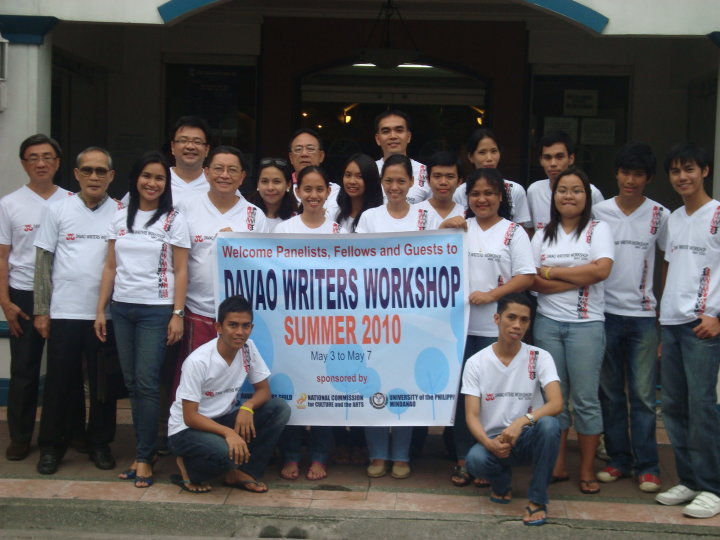
Like King, I knew that if I attend a workshop I would subject myself and wy works to criticisms. I knew that I would receive "no sweet words, unless my works are truly exceptional, and they are not." Nevertheless, on May 3-7, 2010, I attended the Davao Writers Summer Workshop, which was sponsored by the Davao Writers Guild, National Commission for Culture and the Arts, and UP Mindanao.

To be continued...

Thursday, May 27, 2010

The search for relevance is an illusion

The question that often arises at conferences, seminars, meetings, and even at an ordinary gathering of Doctors, not of medicine but of education, is, "Are the subjects, say, history, offered at our schools are still relevant?"

The search for relevance, however, is an illusion, said Jacques Barzun. One who undertakes to find an answer to that question here or in the nether world will be frustrated, for relevance is "not a property of things, but a relationship in the mind."

Relevance exists only in the mind, not in the things outside the mind. There is therefore no such thing as inherently relevant or irrelevant. For instance, history in itself is neither relevant nor irrelevant. It only becomes relevant if the student of history plans to use his knowledge of history in understanding his present situation.

Thursday, May 13, 2010

Nanos gigantium humeris insidentes

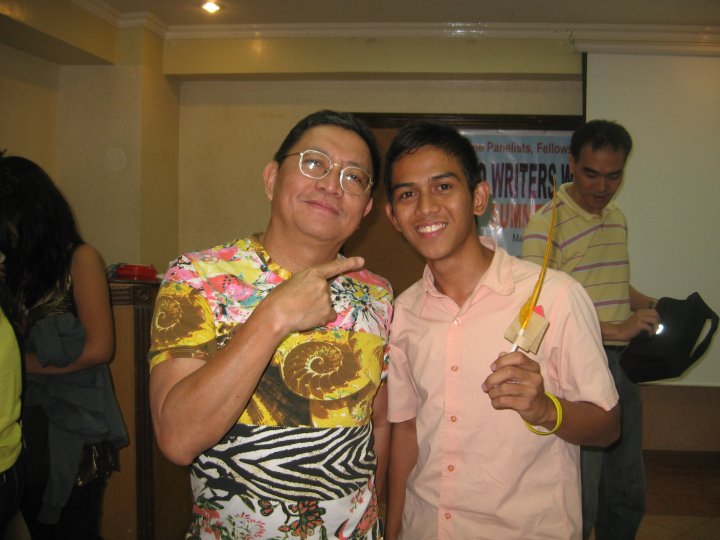
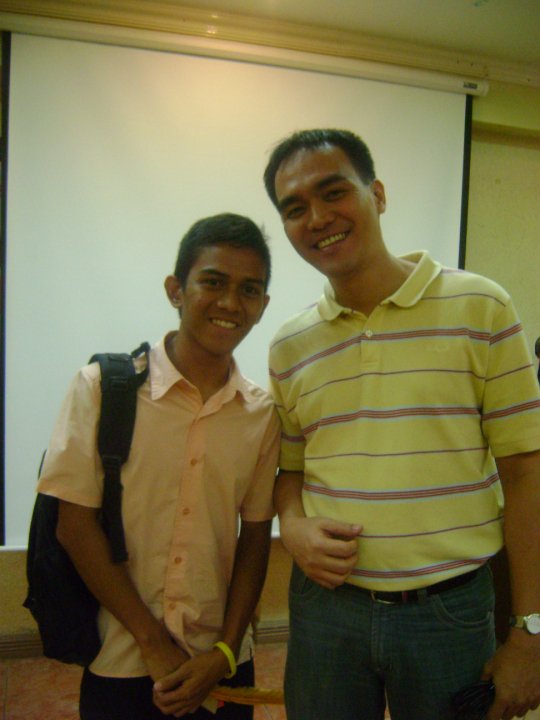
That means "dwarfs standing on the shoulders of giants." According to my ever-reliable source, Wikipedia, it is a Western metaphor that means, "One who develops future intellectual pursuits by understanding the research and works created by notable thinkers of the past." Joining the 2010 Davao Writers Workshop is like standing on the shoulders of giants. Here are some of the photos in which I, well, stood beside the giants (literally and figuratively).

[caption id="attachment_1795" align="alignleft" width="400" caption="Ma'am Aida Rivera-Ford and I."][/caption]

[caption id="attachment_1796" align="alignleft" width="400" caption="Sir Ricky de Ungria and I."][/caption]

[caption id="attachment_1797" align="alignleft" width="400" caption="Sir Mac Tiu and I."][/caption]

[caption id="attachment_1798" align="alignleft" width="400" caption="Sir Tony Tan and I."][/caption]

[caption id="attachment_1799" align="alignleft" width="400" caption="Dominique Cimafranca and I."][/caption]

[caption id="attachment_1800" align="alignleft" width="400" caption="Sir Tim Montes and I."][/caption]

Monday, May 10, 2010

149 Minutes

Nervous, I inserted my ballot into the PCOS (Precinct Count Optical Scanner) machine. I was nervous because what if the PCOS would reject my ballot like it did to the woman before me. The PCOS didn't reject her ballot at all. But she inserted it six times before her ballot was counted. Less than a minute passed, the words, "Congratulations! Your ballot has been counted." appeared. I sighed.

What the COMELEC (Commission on Elections) say is really true. With the automated elections, the counting of the ballots will no longer take a long time, unlike the manual elections. But it's too early to celebrate.

Lest we forget, the searching of polling precinct, the lining up---all that, too, is part of the election. And there are so many things that can be said of them. So many, in fact, that I don't know where to begin.

Perhaps I'll begin with my arrival. If the election were manual, I would have arrived at the polling precinct very early. But no, the election is now automated. Which, as the COMELEC promised, is faster and more efficient. There is therefore no need for me to hurry.

When I woke up in the morning, I turned on the TV, watching what's going on in other parts of the Philippines, instead of preparing to leave for the polls. Over at ABS-CBN, Gloria Macapagal-Arroyo was shown voting. Per ABS-CBN's calculation, GMA took only six minutes to vote. If it's that fast, I figured I would go to the precinct at 8:00 in the morning.

The night before the election day, I had planned what would I wear and what would I bring. To warn the voters that if they thought only for themselves when they vote, if they wouldn't think of future of the country, they would get nowhere, I would wear my T-shirt with a quote by Conrado de Quiros: "You don't have national pride or a sense of country, you'll get nowhere." Sadly, however, I would find out that the voters were too busy to even bother to look at my T-shirt, let alone contemplate the profundity of what's written on it. To monitor the time and see if the election is faster than before, I would wear a wrist watch, although I'm not used to wearing it because it annoys me.

At 8:45, I arrived at the polling precinct. Already, the entrance to the Cabantian Elementary School, where I would be casting my vote, was dominated by "poll assistors" (poll assistants would be much simpler) distributing sample ballots, vendors selling mineral water, Max and Snowbear, teenagers and bystanders doing...nothing.

Then I went to my precinct: 1808C. Like all the other precincts, mine was already crowded. There were those who were looking for their names on the list pasted on wall. Some were asking for priority numbers. There were also the omnipresent "poll assistors," struggling to get inside, or at least get close to, the precinct.

I searched my name on the list to double-check if my precinct was really there. I'm glad I did, because when I found my name, it was listed under a different precinct: 1808E. But that was no matter. I was still on the right precinct. The COMELEC, I discovered, put the five precincts in one cluster. For instance, the precincts from 1808A to 1808E were put in cluster 545. Hence, the overcrowded precincts.

The polling precincts were replete with posters informing the voters of the six things they need to do to cast their votes. The procedure looked good---on paper. It was not followed. I don't know if the same procedure was followed in other places, but the actual voting procedure in Brgy. Cabantian went like this: First, the voter would fall in line to get a priority number. As for me, I started to fall in line at 8:50. I received my priority number at 10:24. After the voter got his priority number, he would again fall in another line that which led to the precinct. Once the voter got inside, he would tell his precinct number to the BEI (Board of Election Inspector). If his name is on the list, the BEI would ask for his signature and thumb mark. All that that took me no less than 50 minutes.

At 11:14, I was done casting my vote. All in all, it took me 149 minutes (2 hours and 29 minutes) to vote. I can say that I'm lucky to have just been inconvenienced for 149 minutes.

Some of you would say that 149 minutes is too much. But come to think of it. This was no ordinary day. We are talking about election here. It is the time when we choose our next leaders. It is the time when we decide not only the fate of our country, but also our fate.

If it takes only 149 minutes to choose leaders who would help our country better again; if it takes only 149 minutes to undo all that GMA did; if it takes only 149 minutes to reclaim what this country has lost; if it takes only 149 minutes to save us from another six years of felony, perfidy, and larceny----if it takes only 149 minutes to achieve all that, then we should be more than willing to spare 149 minutes of our time.

It cannot be denied that we have this tendency to inflate our own misery. But as the man, who tried to organize the disorganized voters at my polling precinct, said, "Kini na ang panahon para mag-sakripisyo lang ta gamay" (This is the time that we have to sacrifice a little).