What keeps me busy these past weeks---aside from trying to figure out how to stop our neighbor from making so much noise when he's inebriated---is the making of professional readings. These are reviews of articles, publications, studies, books, etc. related to the education in general and teaching profession in particular.
Our practicum supervisor asked us to make ten. To us, it's considered many, considering that it's not the only thing that we have to do. Teachers do so many things that they could be the computers turned flesh.
I cannot say I've enjoyed doing them. I have not, although the upside of it is that I was able to learn new things that I've never known before. It sounds trite. Of course, I should learn new things. Otherwise, what does it profit me if I don't learn something out of my professional readings?
But I'm glad I'm already through with my professional readings. Here's a list:
1.Rewards for students under a microscope
2. More schools, not troops
3. The children won't sit still, and that's O.K.
4. Cool school: United nations of education
5. Maintaining order and discipline in the classroom
6. Sorry I'm late
7. Element's of a learner's preferences
8. Web-age librarian's look beyond books
9. Is too much self-esteem not good for kids?
10. Behavior coaching for teens with special needs

Showing posts with label Science and Technology. Show all posts
Showing posts with label Science and Technology. Show all posts
Tuesday, November 24, 2009

Thursday, November 27, 2008
Environmental education, Happy LA style
If my memory serves me best, it was in 2006 when 1st District Councilor Leo Avila III--Happy LA to his radio listeners--visited HCDC where he gave a talk on coastal environmental education. I remember Sir Giovs, a former high school Science teacher, asked a soft copy of the councilor's presentation. The good councilor obliged. I searched for it in one of the library's computer units where Sir Giovs saved it. Luckily, I found the file. The presentation is instructive. So I thought it would be better to post it online although I don't have the councilor's permission. But I presume he would have also wanted others to have a copy of it.
His presentation is entitled "Coastal Environment: Protecting and Conserving Our Resources." For those who want to have a copy of it, e-mail me at arvin_1123@yahoo.com.ph and I'll send it. It would be a lot easier, though, if I'll simply post it here, but the computer won't cooperate. Maybe next time.
His presentation is entitled "Coastal Environment: Protecting and Conserving Our Resources." For those who want to have a copy of it, e-mail me at arvin_1123@yahoo.com.ph and I'll send it. It would be a lot easier, though, if I'll simply post it here, but the computer won't cooperate. Maybe next time.
Saturday, November 22, 2008
The heretics' views on global warming
Much of the hot (pun fully intended) rhetoric on global warming comes from Al Gore, a former Vice President of USA and now Nobel Laureate on Peace. Citing evidences spurred over the years by various scientists, Al Gore contends that the warming of the earth is caused by the unprecedented rise of CO2 in the atmosphere.
But from the least publicized views of certain "heretics", the notion that CO2 caused global warming has been thought of as fundamentally flawed. Where Al Gore contends CO2 as the driver of global warming, these "heretics" contend otherwise.
In a video posted at YouTube, Al Gore was pitted against some of the climatologists who hold views opposite to Al Gore's. Here's what they say:
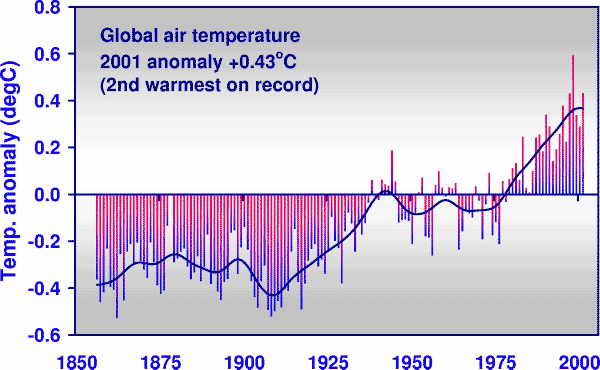
[caption id="" align="aligncenter" width="286" caption="The time series shows the combined global land and marine surface temperature record from 1856 to 2001. Data from Jones et al., 1998; and from the Climate Research Unit at the University of East Anglia (www.cru.uea.ac.uk; compilation by Phil Jones). Source: Earthguide"] [/caption]
As it said towards the end of the video, THEY DEBATE, YOU DECIDE.
But from the least publicized views of certain "heretics", the notion that CO2 caused global warming has been thought of as fundamentally flawed. Where Al Gore contends CO2 as the driver of global warming, these "heretics" contend otherwise.
In a video posted at YouTube, Al Gore was pitted against some of the climatologists who hold views opposite to Al Gore's. Here's what they say:
Prof. Ian Clark (Dept. of Earth Sciences, University of Ottawa): If we look at climate from the geological timeframe, we would never suspect CO2 is a major climate driver.
We can't say that CO2 would drive climate. It certainly never did in the past.
Piers Corbyn (Climate Forecaster, Weather Action): None of the major climate changes in the last thousand years can be explained by CO2.
Prof. Patrick Michaels (IPCC & Dept. of Environmental Science, University of Virginia): Anyone who goes around and says that CO2 is responsible for most of the warming of 2oth century hasn't looked at the basic numbers.
[caption id="" align="aligncenter" width="286" caption="The time series shows the combined global land and marine surface temperature record from 1856 to 2001. Data from Jones et al., 1998; and from the Climate Research Unit at the University of East Anglia (www.cru.uea.ac.uk; compilation by Phil Jones). Source: Earthguide"]
 [/caption]
In the past hundred fifty years, the temperature has risen just over half of degrees celsius. But the strange thing is most of that lies in the early decades of the 20th century--between 1905 and 1940 when industrial production was still...on its mold. At 1940, as industry expanded, for some reason, the world cooled.
Prof. Syun-Ichi Akasofu (Director, International Arctic Research Center): CO2 began to increase exponentially in about 1940. But temperature actually began to decrease in 1940 and continue to about 1975...When the CO2 is increasing rapidly and yet the temperature is decreasing, then we can not say that CO2 and temperature go together.
Dr. Tim Ball (Former Professor of Climatology, University of Winnipeg): Temperature went up significantly up to 1940 when human production of CO2 was relatively low. And then in the post-war years when industry and the whole economies of the world really got going and human production of CO2 just soared, the global temperature was going down. In other words, the facts didn't fit the theory (CO2 caused global warming).
There have now been several major ice core surveys. Every one of them shows the same thing: the temperature rises or falls, then after a few hundred years CO2 follows.
Dr. Tim Ball (Former Professor of Climatology, University of Winnipeg): The ice-cold record goes to the very heart of the problem we have here. It said, if the CO2 increases in the atmosphere, as a greenhouse gas, then the temperature will go up. But the ice core record shows exactly the opposite. So the fundamental assumption--the most fundamental assumption of the whole theory of climate change to the humans--is shown to be wrong.
As it said towards the end of the video, THEY DEBATE, YOU DECIDE.
Sunday, November 16, 2008
Risks present in going organic
Published in the Philippine Daily Inquirer's opinion section, this is a reply to Ma. Ceres P. Doyo's column.
Organic foods have been thought of as beneficial to people and to the planet. Which makes it good news for Ma. Ceres Doyo that the Department of Agriculture has launched a campaign that encourages farmers to use organic fertilizers and produce organic foods. (“Going organic, better late than never,” Inquirer, 11/13/08)
However well-meaning the campaign may be, going organic will prove to be detrimental in the long run. Looking at the marginal cost and benefit of going organic, Bjorn Lomborg, head of the Copenhagen Consensus, a think tank under the auspices of the Copenhagen Business School, has this to say:
“You know how you are told to give your kids organic food because pesticides will give them cancer? Well, it’s technically true that there is a link between the chemicals and illness, but the risk is miniscule in any well-regulated country.
“There is another threat that you haven’t been told much about. One of the best ways to avoid cancer is to eat lots of fruits and vegetables. Organic items are 10 or 20 percent more expensive than regular produce, so most of us naturally buy less when we ‘go organic.’
“If you reduce your child’s intake of fruits and vegetables by just 0.03 grams a day (that’s the equivalent of half a grain of rice) when you opt for more expensive organic produce, the total risk of cancer goes up, not down. Omit buying just one apple every 20 years because you have gone organic, and your child is worse off.”
The intention here, in Lomborg’s term, “isn’t to scare people away from organic food,” and if I may add, the government from making policies encouraging farmers to go organic. “But we should hear both sides of any story.”
Organic foods have been thought of as beneficial to people and to the planet. Which makes it good news for Ma. Ceres Doyo that the Department of Agriculture has launched a campaign that encourages farmers to use organic fertilizers and produce organic foods. (“Going organic, better late than never,” Inquirer, 11/13/08)
However well-meaning the campaign may be, going organic will prove to be detrimental in the long run. Looking at the marginal cost and benefit of going organic, Bjorn Lomborg, head of the Copenhagen Consensus, a think tank under the auspices of the Copenhagen Business School, has this to say:
“You know how you are told to give your kids organic food because pesticides will give them cancer? Well, it’s technically true that there is a link between the chemicals and illness, but the risk is miniscule in any well-regulated country.
“There is another threat that you haven’t been told much about. One of the best ways to avoid cancer is to eat lots of fruits and vegetables. Organic items are 10 or 20 percent more expensive than regular produce, so most of us naturally buy less when we ‘go organic.’
“If you reduce your child’s intake of fruits and vegetables by just 0.03 grams a day (that’s the equivalent of half a grain of rice) when you opt for more expensive organic produce, the total risk of cancer goes up, not down. Omit buying just one apple every 20 years because you have gone organic, and your child is worse off.”
The intention here, in Lomborg’s term, “isn’t to scare people away from organic food,” and if I may add, the government from making policies encouraging farmers to go organic. “But we should hear both sides of any story.”
Subscribe to:
Posts (Atom)