Showing posts with label Environment. Show all posts

Wednesday, March 20, 2013

Baguio is so Common We are Going There

lion-head-on-the-way-to-baguio-cityWe'll be leaving for Baguio on April for a week-long vacation. Next to Boracay, Baguio is perhaps the most cliché vacation place. But we don't mind. We'll go there anyway.


For what?

The cold weather? But BuDa (Bukidnon-Davao) also has cold weather.

Strawberries? But we can buy them from the groceries.

Picture taking with an Igorot clad in a traditional attire? But we have more Indigenous People living here than there. Don't we see them during Kadayawan Festival?

Even if Baguio is so common a vacation spot, it doesn't dissuade us from going there. We want to see and feel Baguio ourselves simply because we haven't gone there yet. It's our first time.

There really is always a thrill about a first-time experience, diba?

Sunday, March 18, 2012

An armchair environmentalist

[caption id="attachment_2133" align="aligncenter" width="720" caption="Tree planting is one of the requirements of the fourth year students of Stella Maris Academy of Davao. (Photo courtesy of Herica Tiu.)"][/caption]

Even if I flunked one grading period of my high school Chemistry and even if Science is a subject I don't particularly have a strong affection with, I know what global warming is. It is partly caused by human activities. We released too much greenhouse gases---carbon dioxide and methane are some examples---into the atmosphere, so that they form a kind of blanket that traps the heat that entered the planet instead of being bounced back out of the planet.

There is no panacea to global warming, but the most common, one that has in fact done by many people in many places, is to plant trees. For, trees sequester carbon.

I've done tree planting before, and I could tell it's exhausting.

But to those who want to help Mother Earth but have no time to go out and plant trees, one can blog. Yes, in lieu of planting is blogging.

Friday, August 20, 2010

Fog and sunflowers

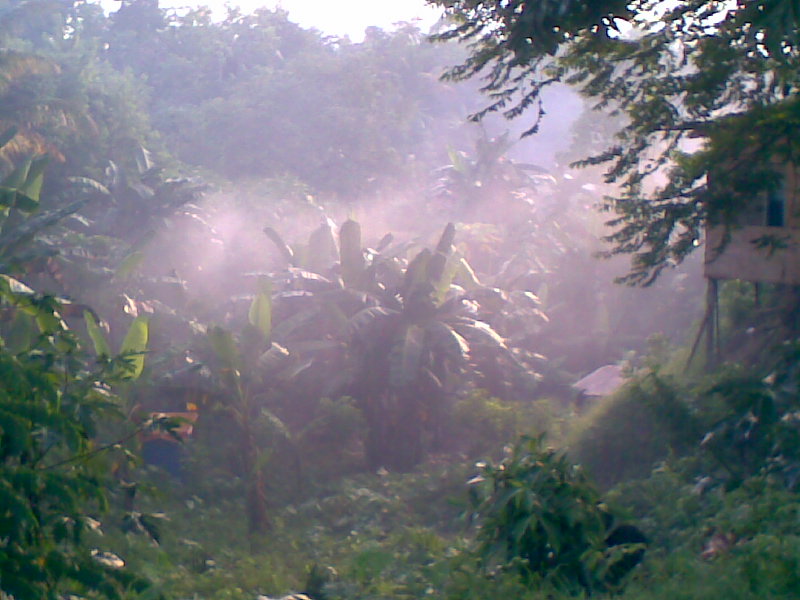
[caption id="attachment_1859" align="alignleft" width="614" caption="A shot at our neighborhood. Rarely does this happen. A fog hanging so low. As if someone is burning dry leaves. [Image003"] [/caption]

[caption id="attachment_1861" align="alignleft" width="240" caption="This one, too. The sunflowers of our neighbor are in bloom."][/caption]

Sunday, December 6, 2009

The curious case of the Filipinos

We Filipinos are a bunch of...never mind. We know that a catastrophe is about to break. We see the signs of its coming all over us. Yet we don't do anything about it. It is as though everything's going to be all right. We sink into deep slumber. And worse, we come back to life only when there's death.

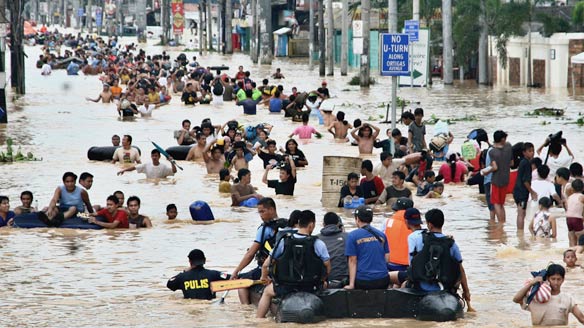
Look at the aftermath of typhoons Ondoy and Peping.


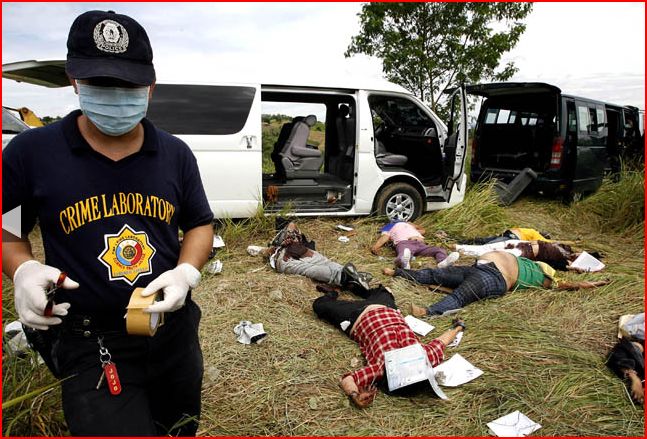
Or better yet, look at The Maguindanao Massacre.

Are our five senses malfunctioning, so that it takes us so long a time to stop what needs to be stopped?

Wednesday, September 30, 2009

A call to arms

Jade ValleyMy first memories of a flood are probably of when we were still living in Jade Valley, a low-lying subdivision located along the Davao River. If I remember it right, the place was visited by floods for four times over. They said the worse flood was during the fourth time when the water reached as high as the rooftop.

To me, however, it was the third time because I had experienced it myself---by the fourth flooding, we had already moved out of Jade Valley. On March 15, 2000 (Araw ng Davao!), around 2 o'clock in the morning, somebody was knocking hard on the door, telling us to evacuate as the water was rising fast. When we went out of the house, bringing nothing but the clothes we're wearing, the water was already knee high.

We safely evacuated in Juliville, another subdivision adjacent to Jade Valley. For several days, my siblings and I stayed in my grandmother's house, in Lanang, but my parents stayed in Juliville, and waited for the water to subside.

[caption id="attachment_1090" align="aligncenter" width="458" caption="An aerial view aboard a Philippine Air Force chopper shows devastation brought by Tropical Storm Ketsana in Cainta, province of Rizal , eastern Manila. (Photo courtesy of PSDMN---Private Sector Disaster Management Network)"]An aerial view aboard a Philippine Air Force chopper shows devastation brought by Tropical Storm Ketsana in Cainta, province of Rizal , eastern Manila. (Photo courtesy of PSDMN---Private Sector Disaster Management Network)[/caption]

So we were spared from the ravages of the flood. But when we came back, I heard many stories from my friends. Some recounted how hard it was to wait for rescue that they weren't sure whether it would come. Some recounted how they staved off their hunger and thirst. Others told me how they tried, if vainly, to save their furniture and belongings. Last week, those memories came flooding as I watched on TV, and saw the flooding in many parts of Luzon.

Sunday, April 19, 2009

Copying Costa Rica

Thomas Friedman's column, (No) Drill, Baby, Drill, about Costa Rica's innovative move to "put energy, environment, mines and water all under one minister," which by the way no other country has ever done, got me to thinking if we could do the same here in the Philippines.

To put those departments under one roof might seem unusual. But Costa Rica did just that.

The results? According to Thomas Friedman, Costa Rica "now gets more than 95 percent of its energy from these renewables" [hydro-electric power, wind and geo-thermal] when in 1985, "it was 50 percent hydro, 50 percent oil."

What is more interesting, Friedman adds, is that "Costa Rica discovered its own oil five years ago but decided to ban drilling — so as not to pollute its politics or environment!"

This only goes to show that "economic growth and environmentalism work together." Now can we do the same?

Sunday, January 25, 2009

Think again


[caption id="attachment_278" align="alignright" width="133" caption="Timothy Ball, PhD"]Timothy "Tim" Ball, PhD[/caption]

According to Professor Timothy "Tim" Ball, one of Canada's first PhD holders in Climatology and pioneer of reconstructing the past climates, global warming doesn't exist. But few people believed it. Professor Tim Ball knows why.

"I think it may be because most people don't understand the scientific method which Thomas Kuhn so skilfully and briefly set out in his book "The Structure of Scientific Revolutions," Prof. Tim Ball said. "A scientist makes certain assumptions and then produces a theory which is only as valid as the assumptions. The theory of Global Warming assumes that CO2 is an atmospheric greenhouse gas and as it increases temperatures rise. It was then theorized that since humans were producing more CO2 than before, the temperature would inevitably rise. The theory was accepted before testing had started, and effectively became a law."


Professor Tim Ball belongs to the camp of "heretics" in the climate change debate. Although some would call him and his ilk as "skeptics", "heretics" is more fitting a term. Like the heretics in the past centuries, he is met with disdain and damnation for challenging scientific dogma. The scientific dogma being that global warming exists; that CO2 causes it; and that we should act swiftly before it's too late.


For espousing views that contradict the popular notion
, he is scoffed at.  "I once received a three page letter that my lawyer defined as libellous, from an academic colleague,saying I had no right to say what I was saying, especially in public lectures," Prof. Tim Ball said.

Yet he stood by what he believed is based on facts. Whether you "Believe it or not," Dr. Tim Ball said, "Global Warming is not due to human contribution of Carbon Dioxide (CO2)."

Thursday, November 27, 2008

Environmental education, Happy LA style

If my memory serves me best, it was in 2006 when 1st District Councilor Leo Avila III--Happy LA to his radio listeners--visited HCDC where he gave a talk on coastal environmental education. I remember Sir Giovs, a former high school Science teacher, asked a soft copy of the councilor's presentation. The good councilor obliged. I searched for it in one of the library's computer units where Sir Giovs saved it. Luckily, I found the file. The presentation is instructive. So I thought it would be better to post it online although I don't have the councilor's permission. But I presume he would have also wanted others to have a copy of it.

His presentation is entitled "Coastal Environment: Protecting and Conserving Our Resources." For those who want to have a copy of it, e-mail me at arvin_1123@yahoo.com.ph and I'll send it. It would be a lot easier, though, if I'll simply post it here, but the computer won't cooperate. Maybe next time.

Saturday, November 22, 2008

The heretics' views on global warming

Much of the hot (pun fully intended) rhetoric on global warming comes from Al Gore, a former Vice President of USA and now Nobel Laureate on Peace. Citing evidences spurred over the years by various scientists, Al Gore contends that the warming of the earth  is caused by the unprecedented rise of CO2 in the atmosphere.

But from the least publicized views of certain "heretics", the notion that CO2 caused global warming has been thought of as fundamentally flawed. Where Al Gore contends CO2 as the driver of global warming, these "heretics" contend otherwise.

In a video posted at YouTube, Al Gore was pitted against some of the climatologists who hold views opposite to Al Gore's. Here's what they say:
Prof. Ian Clark (Dept. of Earth Sciences, University of Ottawa): If we look at climate from the geological timeframe, we would never suspect CO2 is a major climate driver.

We can't say that CO2 would drive climate. It certainly never did in the past.

Piers Corbyn (Climate Forecaster, Weather Action): None of the major climate changes in the last thousand years can be explained by CO2.

Prof. Patrick Michaels (IPCC & Dept. of Environmental Science, University of Virginia): Anyone who goes around and says that CO2 is responsible for most of the warming of 2oth century hasn't looked at the basic numbers.

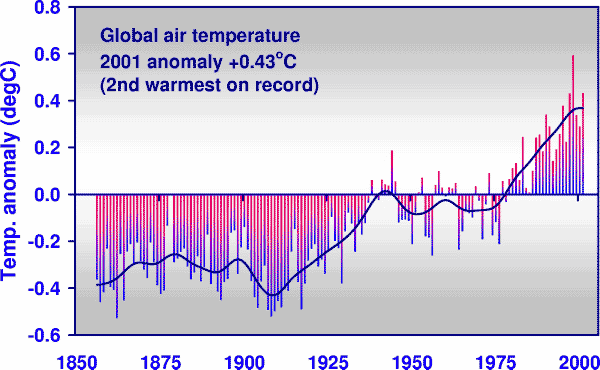
[caption id="" align="aligncenter" width="286" caption="The time series shows the combined global land and marine surface temperature record from 1856 to 2001. Data from Jones et al., 1998; and from the Climate Research Unit at the University of East Anglia (www.cru.uea.ac.uk; compilation by Phil Jones). Source: Earthguide"]The time series shows the combined global land and marine surface temperature record from 1856 to 2001. Data from Jones et al., 1998; and from the Climate Research Unit at the University of East Anglia (www.cru.uea.ac.uk; compilation by Phil Jones).[/caption]
In the past hundred fifty years, the temperature has risen just over half of degrees celsius. But the strange thing is most of that lies in the early decades of the 20th century--between 1905 and 1940 when industrial production was still...on its mold. At 1940, as industry expanded, for some reason, the world cooled.

Prof. Syun-Ichi Akasofu (Director, International Arctic Research Center): CO2 began to increase exponentially in about 1940. But temperature actually began to decrease in 1940 and continue to about 1975...When the CO2 is increasing rapidly and yet the temperature is decreasing, then we can not say that CO2 and temperature go together.

Dr. Tim Ball (Former Professor of Climatology, University of Winnipeg): Temperature went up significantly up to 1940 when human production of CO2 was relatively low. And then in the post-war years when industry and the whole economies of the world really got going and human production of CO2 just soared, the global temperature was going down. In other words, the facts didn't fit the theory (CO2 caused global warming).

There have now been several major ice core surveys. Every one of them shows the same thing: the temperature rises or falls, then after a few hundred years CO2 follows.

Dr. Tim Ball (Former Professor of Climatology, University of Winnipeg): The ice-cold record goes to the very heart of the problem we have here. It said, if the CO2 increases in the atmosphere, as a greenhouse gas, then the temperature will go up. But the ice core record shows exactly the opposite. So the fundamental assumption--the most fundamental assumption of the whole theory of climate change to the humans--is shown to be wrong.

As it said towards the end of the video, THEY DEBATE, YOU DECIDE.